
Monserrate, Bogota’s white sanctuary above the Andes
Published on 09/21/2026 at 07:33 | Editorial responsibility: Rafael Müller, Editor-in-Chief AD HOC NEWS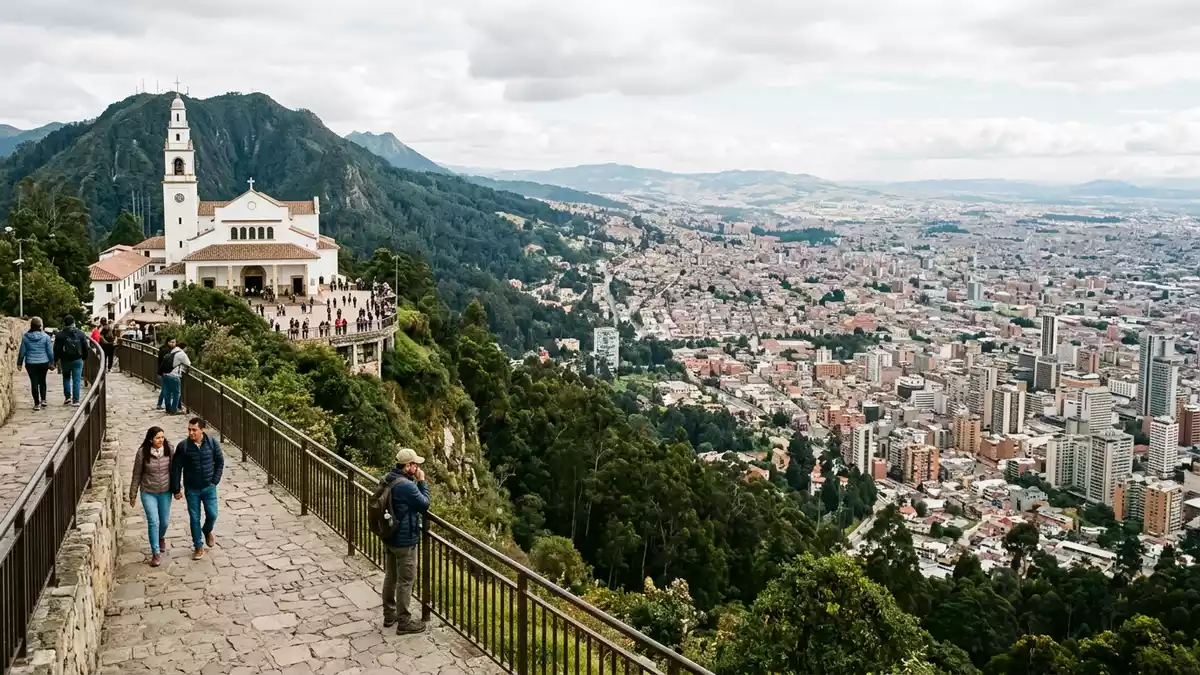
Monserrate is a steep Andean ridge on the eastern edge of Bogota crowned by a white Catholic sanctuary, a place where mountain, cityscape and devotion meet above Colombia’s capital. From central Bogota the elongated church building and terraces are visible against the dark slope, giving Monserrate a fixed presence in the city’s daily horizon.
An Andean mountain watching over Bogota
Monserrate forms part of the Cerros Orientales, the chain of hills that frame Bogota’s eastern side and mark the point where the urban plateau meets the rising Andes. The mountain reaches an elevation of about 3,152 m (10,341 ft) above sea level, lifting its summit terraces several hundred metres above the streets in the historic centre below.an elevation of about 3,152 m The ridge is composed largely of sedimentary rock and is cut by steep slopes and gullies, so the sanctuary and walkways occupy a relatively narrow crest.sedimentary rock mountain rising east of central Bogotá
Well before the colonial city was founded, the indigenous Muisca regarded this high ground as part of a sacred landscape along the edge of the savanna. In 1538 the Spanish conquistador Gonzalo Jiménez de Quesada established the town that became Bogota at the foot of the hills of Monserrate and neighbouring Guadalupe, binding the settlement’s orientation to these summits from its earliest layout.Gonzalo Jiménez de Quesada founded the city in 1538 For visitors looking up from the streets around Plaza de Bolívar, Monserrate still acts as a visual reference point, with the white church and antenna masts standing out clearly against the sky.
A sanctuary of El Señor Caído on the summit
The identity of Monserrate is defined by its hilltop church and shrine dedicated to El Señor Caído, “The Fallen Lord”, a representation of the crucified Christ that has drawn pilgrims for centuries.a shrine devoted to El Señor Caído Devotional activity on the summit began in the seventeenth century, when an early hermitage was established and a carved image of a fallen Christ became the focus of prayers and votive offerings.a first chapel marks the start of Monserrate as a pilgrimage site
The current sanctuary building dates from the twentieth century and combines elements of neo-Gothic design with later neo-colonial alterations, creating a long, white-rendered structure with a tower and simple detailing that can be recognised from far across the city.a new neo-Gothic sanctuary later transformed into a neo-colonial church Inside, the main nave leads towards the altar where the image of El Señor Caído is displayed, surrounded by candles and ex-voto plaques left by worshippers. Side chapels and devotional spaces line the interior, and outside the church a series of terraces offers viewpoints towards the city grid below and across the wider Sabana de Bogota plateau.
Terraces, pilgrimage routes and views over the city
The summit of Monserrate is laid out as a sequence of plazas, balustraded terraces and garden sections, with paved paths linking the sanctuary to restaurants, souvenir stalls and viewing platforms. One of the defining experiences of the mountain is the broad view over Bogota’s central districts and the distant plateau, with the high-rise clusters of downtown sitting directly below and lower neighbourhoods spreading out towards the horizon.Monserrate located near downtown Bogotá On clear days, the outline of the Andes beyond the city forms a second layer of relief behind the urban expanse.
Pilgrims and other visitors reach the summit by different routes. A paved footpath climbs the slope in a series of steps and ramps, accompanied in sections by Stations of the Cross that mark episodes from the Passion narrative.a steep path with Stations of the Cross A funicular railway and a cable car line rise from the city edge to stations near the sanctuary, following separate corridors through the forested slope and offering changing views over Bogota as they ascend.funicular and cable car reach the summit Around the upper platforms, stone paving, planted beds and railings create a structured environment that still leaves the steep drop to the city visibly present beyond the parapets.
Visiting Monserrate: what travellers from Western Europe should know
- Monserrate rises immediately east of central Bogota, above districts around Plaza de Bolívar; the mountain is reached from the city by a funicular, a cable car or a climbing path.
- The ascent on foot follows a long, stepped slope on the mountain flank, with sustained gradients and numerous stone steps that can feel demanding at Bogota’s altitude.
- At the summit, visitors move between terraces, plazas and interior spaces at over 3,000 m (9,843 ft), where thinner air and cooler temperatures than the city streets are part of the setting.
- Spanish is the official language and the currency is the Colombian peso.
Searching for Monserrate on social platforms
These links open searches for Monserrate on each platform.
Frequently asked questions about Monserrate
Where is Monserrate in relation to Bogota?
Monserrate is a mountain immediately east of central Bogota, rising above the city’s historic core and forming part of the eastern Andean foothills.
What should visitors expect on a visit to Monserrate?
Visitors encounter a hilltop sanctuary dedicated to El Señor Caído, a series of terraces and plazas, steep approaches on foot and wide views over Bogota and the surrounding plateau.
What makes Monserrate distinctive among Bogota’s landmarks?
The combination of a seventeenth-century pilgrimage site, a twentieth-century white sanctuary and a commanding Andean viewpoint gives Monserrate a character that links religious devotion to the city’s skyline.


