
Monestir de Poblet and its stone Cistercian walls
Published on 09/16/2026 at 08:49 | Editorial responsibility: Rafael Müller, Editor-in-Chief AD HOC NEWS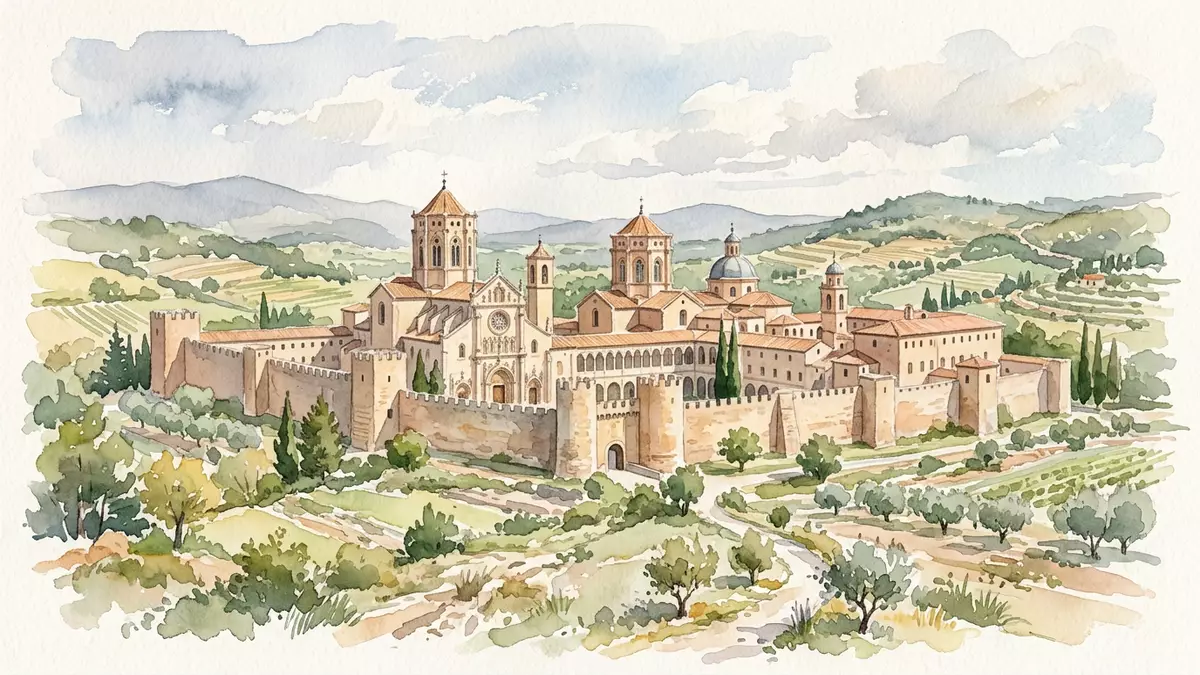
Monestir de Poblet in Vimbodi is a Cistercian abbey with a fortified enclosure, a 12th-century church and royal tombs at its centre. Built across the twelfth to fifteenth centuries, it is one of the largest and most complete Cistercian abbeys in Spain.12th-century churchroyal tombs
The abbey as a walled stone complex
The first impression comes from the walls. Poblet is arranged in enclosed precincts, with defensive towers and gateways shaping the approach before the church and cloister appear.defensive wall
That layout gives the monastery a strong outer edge and a more enclosed inner life. The result is less like a single church with additions than a small monastic settlement in stone.
Romanesque, Gothic and later layers
The monastery began in the twelfth century and developed in Romanesque, Gothic, Renaissance and Baroque forms. Its church, cloister and monastic rooms belong to different phases, yet they remain part of one coherent ensemble.twelfth century
The church is the core of the complex, while the great cloister and the chapter house belong to the monastic daily round. The Royal Gate and the chapel of Sant Jordi add further historic layers to the same place.
Royal memory inside a monastery
Monestir de Poblet is closely linked to the Crown of Aragon. Pere III the Ceremonious established the royal pantheon there, and the church contains the burial place of kings and queens of Catalonia and Aragon.Pere III the CeremoniousCrown of Aragon
That royal presence sits beside the Cistercian plan rather than replacing it. Stone, ritual and dynastic memory share the same buildings, from the cloister to the high altar.
Visiting Monestir de Poblet: what travellers from Western Europe should know
- The monastery lies in the municipality of Vimbodí, in southern Catalonia, at the foot of the Prades Mountains. It is reached by road through the Conca de Barberà countryside.
- The complex is enclosed by walls and gateways, and the interior is arranged in several precincts. The route between church, cloister and royal spaces follows a stone monastic layout.
- The church contains royal tombs, and the high altar has a Renaissance alabaster retable by Damià Forment. The chapter house, refectory, library and dormitory belong to the monastic core.
- The official language is Catalan and the currency is the euro.
- Entry requirements depend on your nationality; UK travellers can check the FCDO travel advice at gov.uk/foreign-travel-advice, Irish travellers the Department of Foreign Affairs at ireland.ie.
Searching for Monestir de Poblet on social platforms
These links open searches for Monestir de Poblet on each platform.
Frequently asked questions about Monestir de Poblet
Where is Monestir de Poblet?
It stands in Vimbodi, in southern Catalonia, near the Prades Mountains. The setting belongs to the Conca de Barberà landscape.
What does a visit involve?
The main buildings are grouped inside a walled monastic complex. Expect church, cloister, gateways and royal burial spaces in one continuous ensemble.
What makes Monestir de Poblet distinctive?
Its Cistercian plan sits beside strong royal associations. The church, cloister and royal pantheon make the monastery both religious and dynastic in character.


