
Monestir de Montserrat on Catalonia’s saw?toothed mountain
Published on 09/07/2026 at 19:52 | Editorial responsibility: Rafael Müller, Editor-in-Chief AD HOC NEWS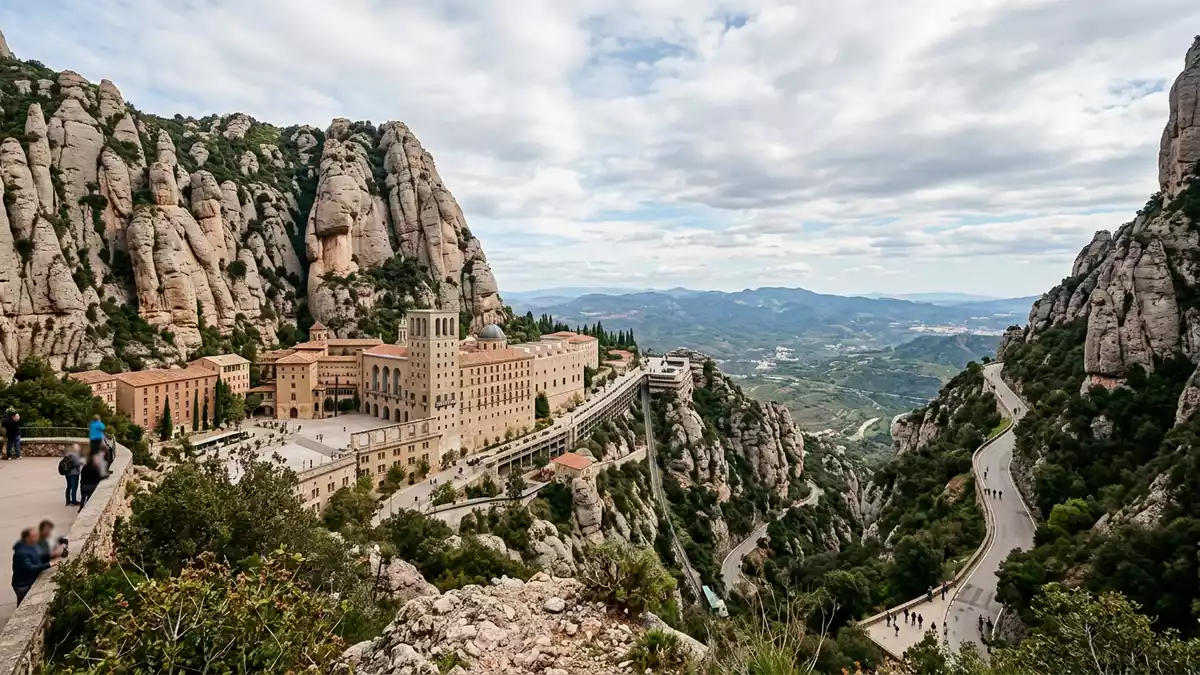
Monestir de Montserrat, officially Santa Maria de Montserrat, is a Benedictine abbey built into the pale limestone of the Montserrat mountain in Catalonia, Spain. Founded in 1025 by Abbot Oliba on a high ledge above the Llobregat valley, it combines monastic life, pilgrimage and dramatic geology in a single compact precinct.
The Benedictine abbey above the Llobregat valley
Monestir de Montserrat stands on the Montserrat range near Monistrol de Montserrat in Catalonia, a massif whose serrated outline gave the mountain its Latin name of Mons Serratus, “saw-toothed mountain”. The abbey occupies a broad terrace cut into the limestone cliffs, with the basilica and monastery buildings pressed against the rock and a separate wing housing accommodation and services for visitors and pilgrims.Montserrat range in Catalonia
The monastery is part of the Benedictine Order and has been an active community for centuries, with dozens of monks living, working and praying within the complex.Benedictine monastery on Montserrat The abbey complex includes the basilica, cloisters, refectory, library and residential areas, alongside a museum and facilities that support the steady flow of pilgrims and visitors.
Faith, the Virgin of Montserrat and Catalan identity
At the heart of Monestir de Montserrat is a long?venerated statue of the Virgin and Child, known as the Virgin of Montserrat or the “Mare de Déu de Montserrat”, which has drawn pilgrims to the mountain for many generations.wooden statue of the Virgin and Child The sanctuary around this image grew from an earlier hermitage and chapel, with written records noting a dedication to the Virgin Mary on the site in 888, before the abbey was formally founded in 1025.hermitage of Santa Maria given in 888
The monastery’s role as a spiritual and cultural centre developed over the late medieval and early modern periods, when Montserrat became an important religious site within Catalonia. In 1409, the community gained the status of an independent abbey, and from 1493 into the nineteenth century it was part of the Valladolid Congregation, a period marked by major architectural works and artistic patronage.independent abbey in 1409 The Montserrat Music School produced composers whose work spread far beyond the mountain, reinforcing the monastery’s place in Catalan cultural life.
Architecture against the cliffs and a long history of rebuilding
The basilica and monastery seen on Montserrat today rest on medieval foundations but bear marks of later reconstruction. The present basilica was begun in the sixteenth century, while monastic buildings were significantly developed in the eighteenth century.basilica begun in 1560 French troops destroyed much of the complex during the Peninsular War in the early nineteenth century, leading to an extensive rebuilding programme in the decades that followed.destruction in the French War and restoration
The twentieth century brought further architectural interventions. Abbot Antoni M. Marcet commissioned the Catalan architect Josep Puig i Cadafalch, a leading figure of Catalan Modernisme, to reshape key parts of the complex. Puig i Cadafalch designed a neo?Romanesque cloister, a new refectory and a renovated library, along with a series of stepped squares that connect the different levels of the monastery and adapt the paved spaces to the steep mountain terrain.neo-Romanesque cloister and refectory These interventions, carried out between 1917 and the end of the 1920s, give the present ensemble its distinctive mixture of historic and early twentieth?century architectural character.
Visiting Monestir de Montserrat: what travellers from Western Europe should know
- Monestir de Montserrat stands on the Montserrat mountain in Catalonia, north?west of Barcelona, near the town of Monistrol de Montserrat. It is reached by road and by rail connections from Barcelona, with onward travel on a rack railway or a cable car that climbs to the monastery terrace.
- The monastery precinct sits on a high ledge of limestone rock, and movement within the complex involves stepped squares, ramps and staircases. Surfaces are paved and there are changes of level between the basilica, the squares and the viewpoints.
- The surrounding terrain is mountainous, with paths leading from the monastery into the Montserrat range. These routes include sections on rock and uneven ground and can rise significantly above the level of the monastery terrace.
- The official language is Catalan and the currency is the euro.
Searching for Monestir de Montserrat on social platforms
These links open searches for Monestir de Montserrat on each platform.
Frequently asked questions about Monestir de Montserrat
Where is Monestir de Montserrat?
Monestir de Montserrat is on the Montserrat mountain near Monistrol de Montserrat in Catalonia, Spain, north?west of Barcelona.
What can visitors expect on a visit?
A visit centres on the basilica, the monastery squares and terraces cut into the limestone cliffs, with religious spaces, viewpoints and access to paths into the surrounding range.
What makes Monestir de Montserrat distinctive?
The abbey combines a long Benedictine tradition, the revered Virgin of Montserrat and architecture built directly against a serrated limestone mountain, giving it a setting that is inseparable from the rock itself.


