
Monestir de Montserrat among Catalonia’s serrated peaks
Published on 09/23/2026 at 23:45 | Editorial responsibility: Rafael Müller, Editor-in-Chief AD HOC NEWS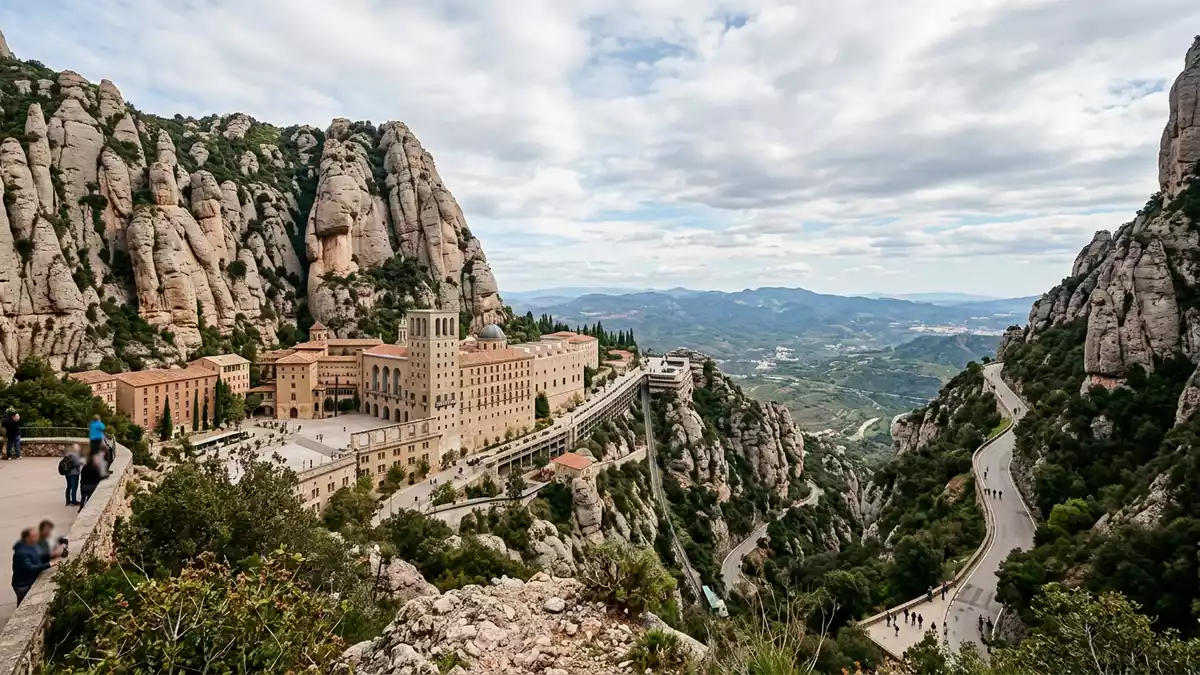
Monestir de Montserrat occupies a high shelf within the serrated limestone peaks of Montserrat, west of the Llobregat River in Catalonia. The Benedictine abbey combines a basilica, monastic buildings and the venerated wooden image of the Virgin of Montserrat.
Monestir de Montserrat and the mountain around it
Montserrat is a mountain massif of pale rock towers, narrow ridges and rounded formations divided by steep ravines. The monastery sits within this broken landscape, with the sanctuary’s walls gathered against the slopes and the peaks rising around it.
The name Montserrat refers to the mountain’s saw-like profile. The setting is inseparable from the monastery’s appearance: masonry, terraces and paths occupy a confined mountain site, while exposed rock forms the wider backdrop. The complex belongs to the municipality of Monistrol de Montserrat, in Barcelona province.
From Santa Maria to a Benedictine abbey
Religious life at Montserrat is connected with the hermitage of Santa Maria, which Count Guifré el Pelós gave to the Monastery of Ripoll in 888. Abbot Oliba founded an organised monastery at Montserrat in 1025, establishing the institution associated with the sanctuary.
The community became an independent abbey in 1410. Its buildings record successive periods of work, with Romanesque, Gothic, Renaissance and later Catalan elements appearing across the complex. A Romanesque church was built in the twelfth century, while the present basilica began in 1560.
French troops damaged and destroyed much of the monastery during the Peninsular War, including the destruction recorded in 1812. Rebuilding during the nineteenth century gave the sanctuary many of its visible façades, while later work added further architectural and artistic layers.
La Moreneta inside the basilica
The basilica houses the wooden image known as La Moreneta, the Virgin of Montserrat. The Romanesque carving is a twelfth-century image, seated with the Christ child and associated with Catalonia’s religious identity.
On 11 September 1881, Pope Leo XIII declared the Virgin of Montserrat patron saint of Catalonia. The statue’s dark colour gives La Moreneta her familiar name, while her place within the basilica connects a small carved figure with the much larger mountain sanctuary.
The basilica’s present form belongs to several periods. Its interior contains Romanesque, Gothic and Renaissance references alongside nineteenth- and twentieth-century restoration. The monastery also includes cloisters, a library, a refectory and spaces connected with Benedictine life.
Montserrat’s cultural role extends beyond the sanctuary walls. The Escolania, the boys’ choir associated with the monastery, belongs to the musical life of Catalonia, while the abbey has supported religious study, art and the use of the Catalan language.
Visiting Monestir de Montserrat: what travellers from Western Europe should know
- Monestir de Montserrat lies in Catalonia, west of the Llobregat River and northwest of Barcelona. Rail services reach Monistrol de Montserrat, with the Cremallera de Montserrat railway continuing towards the sanctuary.
- The mountain site contains steep slopes, exposed rock and stairways. The sanctuary is reached by mountain railway, cable car or roads from the surrounding valleys.
- The Holy Grotto, Santa Cova, lies away from the main basilica on the mountain. Its route follows the rocky terrain of Montserrat.
- The official language is Catalan and Spanish, and the national currency is the euro.
Searching for Monestir de Montserrat on social platforms
These links open searches for Monestir de Montserrat on each platform.
Frequently asked questions about Monestir de Montserrat
Where is Monestir de Montserrat?
Monestir de Montserrat is in Catalonia, in Barcelona province, within the serrated Montserrat massif. The sanctuary stands west of the Llobregat River and northwest of Barcelona.
What can visitors see at the monastery?
The complex includes the basilica, Benedictine buildings, cloisters, the Holy Grotto and the wooden image of the Virgin of Montserrat, known as La Moreneta.
What makes Monestir de Montserrat distinctive?
The monastery combines a Benedictine sanctuary with a dramatic mountain setting. Its architecture spans centuries, while La Moreneta links the basilica with Catalonia’s religious and cultural history.


