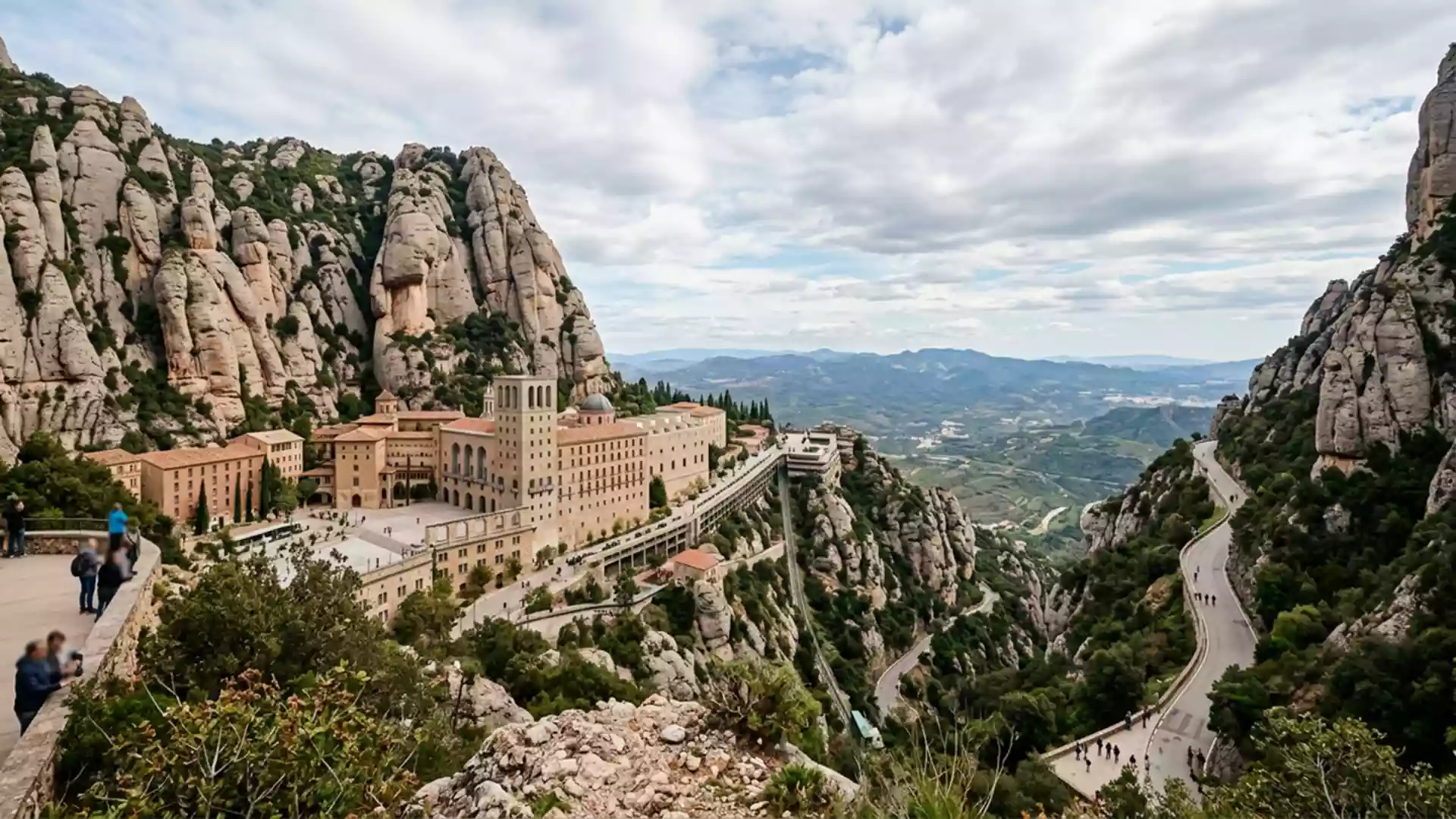
Monestir de Montserrat, a cliffside monastery above Catalonia
Published on 09/08/2026 at 18:54 | Editorial responsibility: Rafael Müller, Editor-in-Chief AD HOC NEWS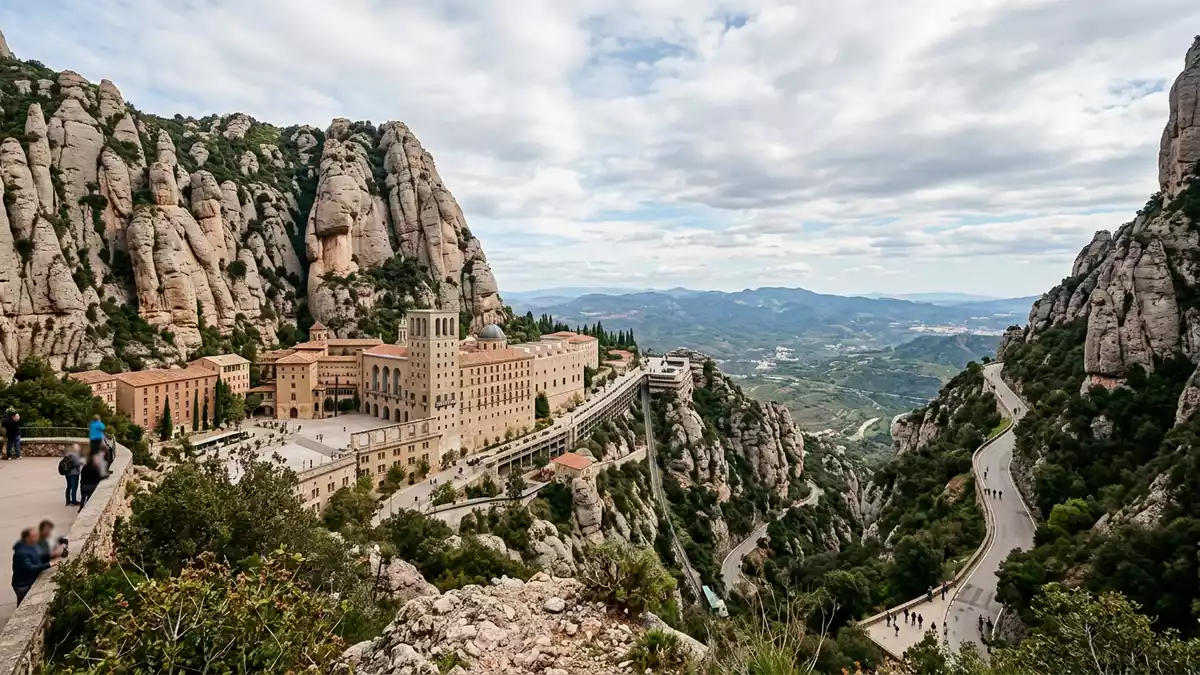
Monestir de Montserrat, formally Santa Maria de Montserrat Abbey, clings to the cliffs of the Montserrat massif in Catalonia and has grown over a millennium into a layered monastic town of stone, courtyards and chapels.
A Benedictine abbey on a serrated mountain
The monastery stands on the mountains of Montserrat in Catalonia, north-west of Barcelona, where weathered sandstone forms jagged pinnacles above the Llobregat valley. Santa Maria de Montserrat Abbey belongs to the Benedictine Order and is part of the Subiaco Mont-Cassin congregation, connecting it with other Benedictine houses across Europe.Benedictine abbey Monastic life here traces back to the eleventh century, when Abbot Oliba of Ripoll and Bishop of Vic founded a new community at an earlier hermitage of Santa Maria in 1025.founded a new monastery
The site’s religious roots reach further into the early Middle Ages. Documents from the ninth century mention Montserrat and record chapels on the mountain, including an early church of Santa Maria linked to the monastery of Ripoll.early chapels on Montserrat Over time, the monastic precinct at Santa Maria grew into an autonomous abbey; by 1409 it held its own abbot and administration, distinct from Ripoll, anchoring Benedictine presence on the jagged ridge as a permanent institution.
Architecture shaped by successive centuries
Architecturally, Monestir de Montserrat is a palimpsest of styles, with Romanesque foundations, Gothic additions, Renaissance façades and later eclectic elements alongside more recent buildings that serve pilgrims and visitors.Romanesque, Gothic and Renaissance styles The first Romanesque church of Montserrat, a single-nave structure documented in the twelfth century, marked the start of a long architectural story that continued as the community expanded and rebuilt.
A basilica dedicated to the Virgin of Montserrat took form in the sixteenth century, replacing earlier structures and giving the sanctuary a sizeable stone church that faces onto a paved square framed by monastic buildings.basilica construction in the sixteenth century That basilica and the surrounding cloisters, refectories and residential ranges were heavily damaged during the Peninsular War in the early nineteenth century and later during the Spanish Civil War, leading to extensive reconstruction between the nineteenth and twentieth centuries that left the complex with its present mix of historic fabric and newer masonry.destruction and rebuilding
The Black Madonna and a living place of pilgrimage
At the heart of Monestir de Montserrat stands the image of the Virgin of Montserrat, affectionately known as La Moreneta, a wooden Madonna and Child venerated in the basilica. The statue’s carving dates to the twelfth or thirteenth centuries and it has long been associated with accounts of a discovery in a cave on the mountain in 880, an episode that gave Montserrat its Marian character.La Moreneta wooden image In 1881 Pope Leo XIII proclaimed Our Lady of Montserrat Patron Saint of Catalonia, underlining the sanctuary’s importance within Spanish Catholicism.Patron Saint of Catalonia
The abbey remains an active Benedictine community. Sources describe between 70 and 80 monks living and praying here, maintaining the liturgical rhythm that has marked the mountain for centuries.monastic community of 70–80 monks The monastery buildings group around courtyards, cloisters and terraces overlooking forested slopes and rock pinnacles, while modern structures accommodate pilgrims, a museum and cultural spaces that sit alongside the historic basilica and monastic ranges.
Visiting Monestir de Montserrat: what travellers from Western Europe should know
- Monestir de Montserrat stands on the Montserrat massif in Catalonia, north-west of Barcelona, reached by road and by the Cremallera de Montserrat rack railway from Monistrol de Montserrat.
- The monastery complex occupies steep mountainside terrain; approaches between levels run along stairways, terraces and ramps above cliffs and wooded slopes.
- The surrounding mountain landscape is part of a protected natural area, with footpaths leading from the monastery to viewpoints and small hermitages on the sandstone peaks.
- The official language is Catalan and the currency is the euro.
Searching for Monestir de Montserrat on social platforms
These links open searches for Monestir de Montserrat on each platform.
Frequently asked questions about Monestir de Montserrat
Where is Monestir de Montserrat located?
Monestir de Montserrat stands on the Montserrat mountain range in Catalonia, Spain, above the town of Monistrol de Montserrat north-west of Barcelona.
What can visitors expect on a visit?
Visitors encounter a large cliffside monastery complex with a basilica, monastic buildings, terraces, viewpoints and paths into the surrounding protected mountain landscape.
What makes Monestir de Montserrat distinctive?
The combination of Benedictine monastery, Marian sanctuary centred on La Moreneta and dramatic sandstone peaks gives Monestir de Montserrat a character that is closely tied to its setting.