
Monasterio de Santa Catalina, a stone labyrinth in Arequipa
Published on 09/10/2026 at 16:55 | Editorial responsibility: Rafael Müller, Editor-in-Chief AD HOC NEWS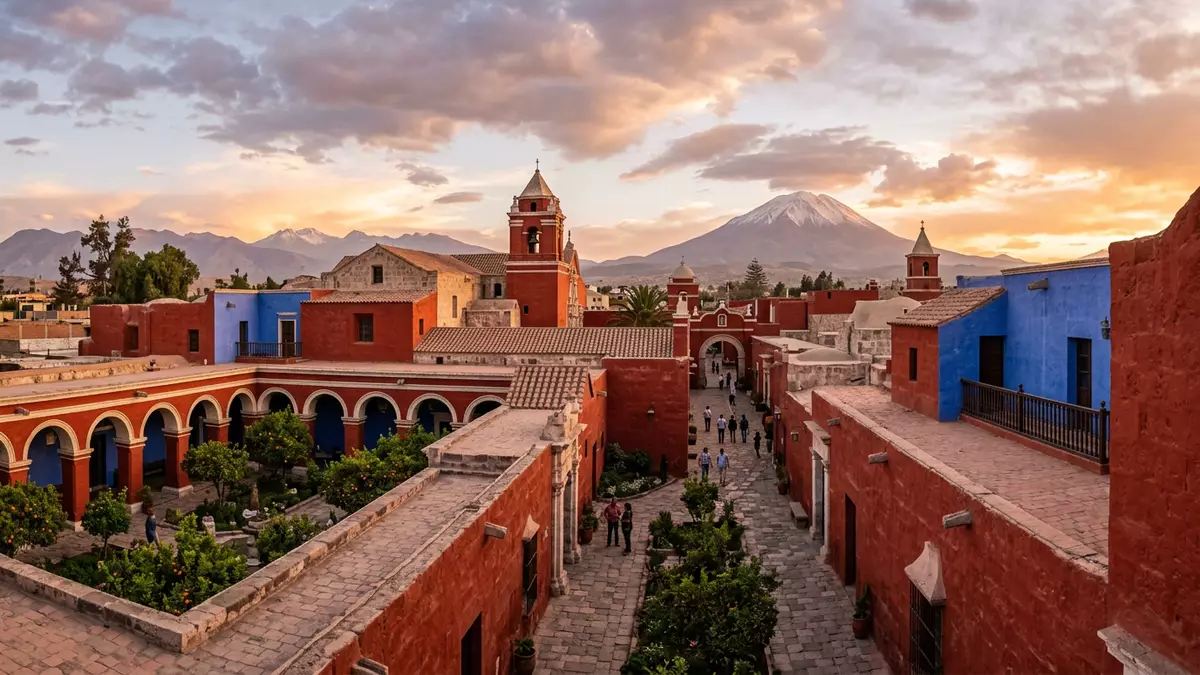
Monasterio de Santa Catalina in Arequipa is a Dominican convent whose enclosed streets, cloisters and courtyards form a miniature city carved from volcanic stone inside the wider colonial centre. Founded in the late sixteenth century under the Dominican order and closely associated with the widow Doña María de Guzmán, it grew into a cloistered world of nuns and servants separated from the bustle of Arequipa by high walls of sillar, the pale lava stone that defines much of the city’s historic architecture.
A convent that became a city within the city
Santa Catalina was established as a Dominican convent in 1579, during the period when Arequipa formed part of the Spanish Viceroyalty of Peru, and formal founding dates in many accounts fall around 1580.Dominican convent in 1579 The convent takes its full name from Saint Catherine of Siena, a fourteenth-century Italian mystic whose intense spirituality and connection to the Dominican order helped shape Catholic devotion in the later medieval period.name from Saint Catherine of Siena
From its earliest years the convent housed nuns of the Dominican Second Order whose families were part of the colonial elite, with daughters entering the cloister for life and bringing dowries and household goods that increased the wealth of the community.Dominican Second Order nuns Over the centuries the monastery expanded, adding new cloisters, chapels and service ranges so that its grounds grew into a self-contained religious citadel with its own internal streets, squares and water features distinct from the surrounding city grid.religious citadel integrating styles
Volcanic stone and mestizo Baroque architecture
Like many of Arequipa’s colonial structures, Monasterio de Santa Catalina is built predominantly from sillar, a porous stone formed from volcanic lava that can appear white, cream or slightly pink depending on light and weathering.sillar, a porous stone formed by volcanic lava Thick walls of this material enclose the convent and divide its interior into cloisters and lanes, and in many places the stone is covered with lime-based plaster finished in strong pigments so that deep reds and blues stand out against the pale masonry.buildings are made from white and reddish volcanic stone
Architecturally the complex brings together Spanish colonial forms, Mudéjar influences from Iberian Islamic design and local vernacular elements in what has been described as mestizo Baroque.Colonial, Mestizo Baroque, Neoclassical Cloisters are framed by rhythmic sequences of arches resting on stone piers, chapels are roofed with barrel vaults or domes, and interior spaces carry carved wooden altarpieces and devotional objects that reflect centuries of Andean Catholic practice. Within this framework later additions in neoclassical taste sit alongside seventeenth-century masonry, so a walk through the monastery traces architectural styles from the sixteenth to the nineteenth centuries within a single enclosure.styles from the sixteenth to nineteenth centuries
Cloisters, domestic quarters and painted streets
Inside the high outer walls, the Novice Cloister forms one of the first major spaces, laid out around a courtyard where a rubber tree rises above paving and planting.Novice Cloister with a rubber tree Arched walkways surround the courtyard, opening into small cells and workrooms where women beginning religious life lived and carried out domestic tasks, and nearby an opening marked with the word “silencio” signals the threshold into parts of the convent where quiet was strictly observed.silence arch leading to cloister
Further inside, other cloisters and streets bear names drawn from their planting or historical uses, such as the Orange Cloister where orange trees mark the centre and the Profundis Room beyond served as a mortuary for deceased nuns.Orange Cloister and Profundis Room Domestic ranges include kitchens with large stone vats and clay ovens, laundries with stone basins set along water channels, and collections of simple cells where nuns slept and prayed, all arranged along alleys whose painted walls and cobbled surfaces give them the character of a small internal town distinct from the streets of Arequipa outside.built predominantly from sillar with colourful walls
Visiting Monasterio de Santa Catalina: what travellers from Western Europe should know
- Monasterio de Santa Catalina stands in Arequipa’s historic centre in southern Peru, within walking distance of Plaza de Armas and other colonial buildings, and is reached along city streets used by local traffic.
- Inside the enclosure, movement between cloisters and courtyards involves stone steps, uneven cobbled surfaces and narrow passageways, and some viewpoints and chapels are accessed by staircases rather than ramps.
- The surrounding region is part of the Andean highlands, so visitors move at altitude and the sun can be strong when crossing open courtyards and streets inside the complex.
- The official language is Spanish and the currency is the Peruvian sol, with signage in the convent primarily in Spanish and some information also available in other languages.
- Entry requirements depend on your nationality; UK travellers can check the FCDO travel advice at gov.uk/foreign-travel-advice, Irish travellers the Department of Foreign Affairs at ireland.ie.
Searching for Monasterio de Santa Catalina on social platforms
These links open searches for Monasterio de Santa Catalina on each platform.
Frequently asked questions about Monasterio de Santa Catalina
Where is Monasterio de Santa Catalina located?
Monasterio de Santa Catalina stands in the historic centre of Arequipa in southern Peru, within the urban grid laid out after the city’s founding in 1540.
What can visitors expect inside the monastery complex?
Visitors encounter cloisters, chapels, domestic quarters and internal streets built from volcanic sillar stone, with painted walls, courtyards, fountains and small gardens arranged in a self-contained enclosure.
What makes Monasterio de Santa Catalina distinctive among Andean convents?
The monastery combines sixteenth-century Dominican origins, mestizo Baroque and neoclassical architecture, and a layout that functions as a religious citadel with named streets and squares inside its walls.


