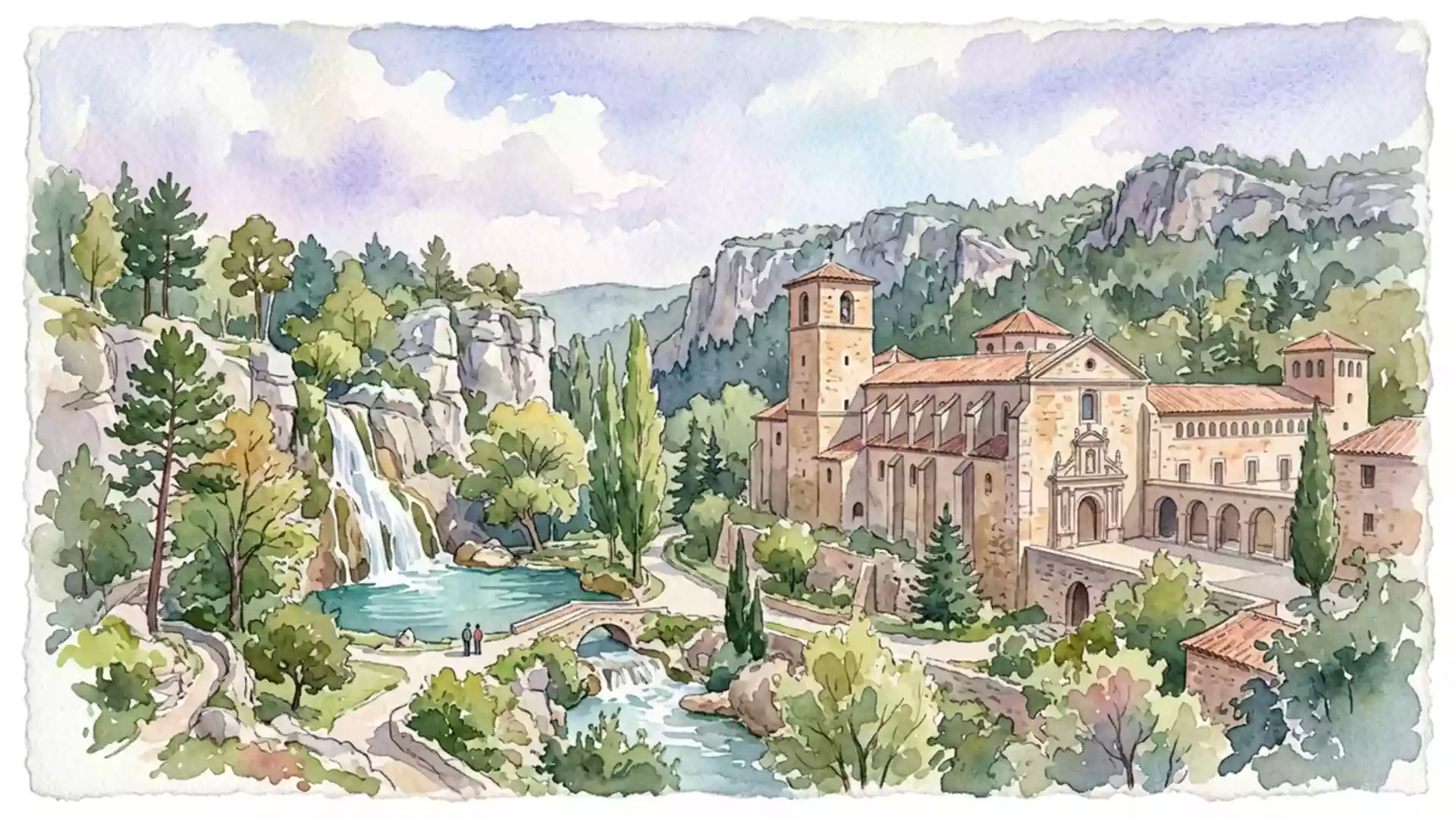
Monasterio de Piedra and its river-cut monastery park
Published on 08/31/2026 at 13:03 | Editorial responsibility: Rafael Müller, Editor-in-Chief AD HOC NEWS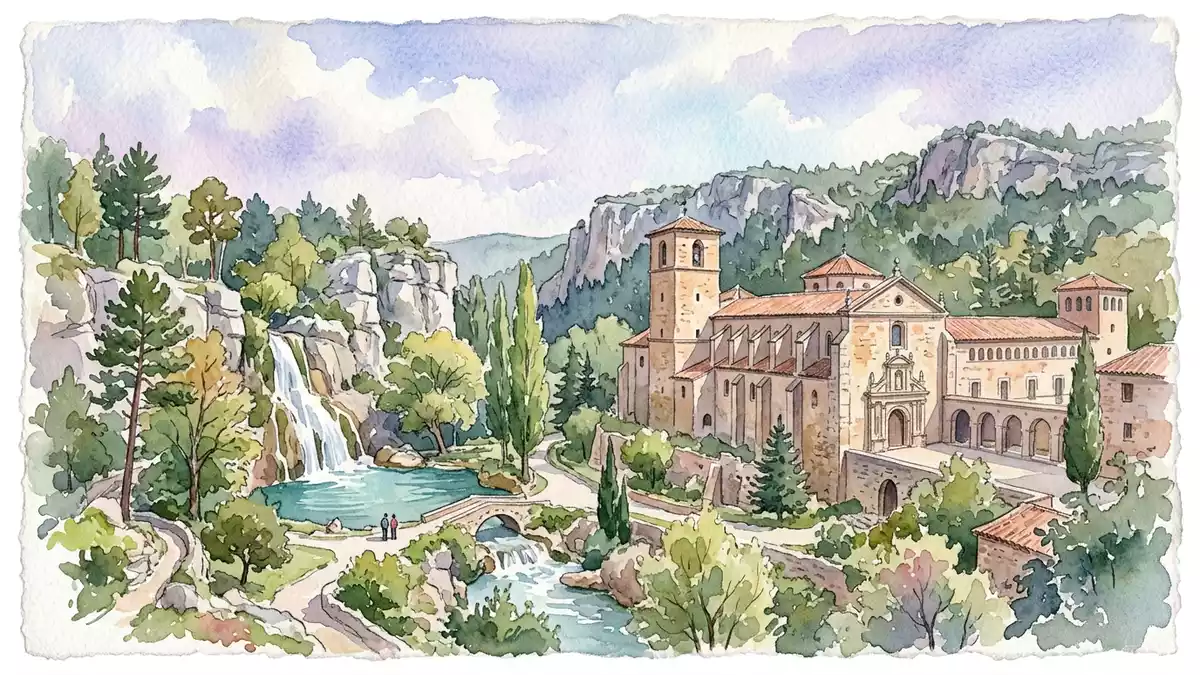
Monasterio de Piedra in Nuevalos combines a Cistercian monastery with a river landscape that has been shaped into paths, caves and waterfalls. Founded in 1194 under Alfonso II of Aragon, it brings medieval stonework and later parkland into a single sitefounded in 1194.
Alfonso II, Poblet and the monastery’s beginnings
The monastery belongs to the Cistercian world of the Crown of Aragon. Its foundation involved Alfonso II, monks from Poblet, and the Piedra valley, with consecration in 1218Alfonso II of Aragon.
The surviving complex shows the long life of the site in stone. The monastery was occupied by the Cistercians between 1218 and 1835, and its fabric belongs to the late Romanesque, Gothic and later Baroque traditionoccupied between 1218 and 1835.
Stone cloisters and later chambers
The church, cloister and monastic rooms still give the place its medieval core. The church had three naves, and the former abbot’s residence preserves Romanesque columns beneath a later neoclassical levelthree naves.
That mix of periods is visible without any need for reconstruction. The complex includes Gothic and Baroque elements, and the architecture remains closely tied to the Cistercian preference for restraintGothic and Baroque elements.
The park beside the Piedra River
Beyond the monastery walls, the site changes character. The park uses the river, rock, caves and planted paths to create a landscape of water and limestone, with the Iris cave and the waterfall known as Cola del Caballo among its most recognisable featuresIris cave.
That landscape was developed under Pablo Muntadas Campeny and Juan Federico Muntadas after the property passed into private hands in the nineteenth century. The result was declared a Natural Scenic Area in 1940, which places the gardens within a formally recorded protected landscapeNatural Scenic Area.
Visiting Monasterio de Piedra: what travellers from Western Europe should know
- The site lies near Nuevalos in Zaragoza, in Aragon. It is reached by road from the village and sits by the Piedra River.
- The park includes paths, steps, caves and wet ground near the water. The monastery stands in a mountainous part of the Iberian System.
- English is not an official language here; the official language is Spanish and the currency is the euro.
- The monastery and the park belong to the same complex, but they present two different faces of the place. One is medieval and architectural, the other is planted and river-based.
- The stonework ranges from Romanesque columns to later additions. That makes the site useful for reading several centuries of religious architecture in one setting.
Searching for Monasterio de Piedra on social platforms
These links open searches for Monasterio de Piedra on each platform.
Frequently asked questions about Monasterio de Piedra
Where is Monasterio de Piedra?
It is in Nuevalos, in the province of Zaragoza, Aragon, beside the Piedra River. The site lies within the Iberian System mountain ranges.
What does a visit involve?
The complex combines monastery buildings with a landscaped river park. Expect stone cloisters, chapels, paths, caves and waterfalls rather than a single enclosed monument.
What makes Monasterio de Piedra distinctive?
The contrast between a medieval Cistercian monastery and a river garden gives the place its character. Its long history, from Alfonso II to the Muntadas family, is still legible in the buildings and grounds.