
Monasterio de El Escorial and the geometry of Spain’s power
Published on 09/14/2026 at 19:02 | Editorial responsibility: Rafael Müller, Editor-in-Chief AD HOC NEWS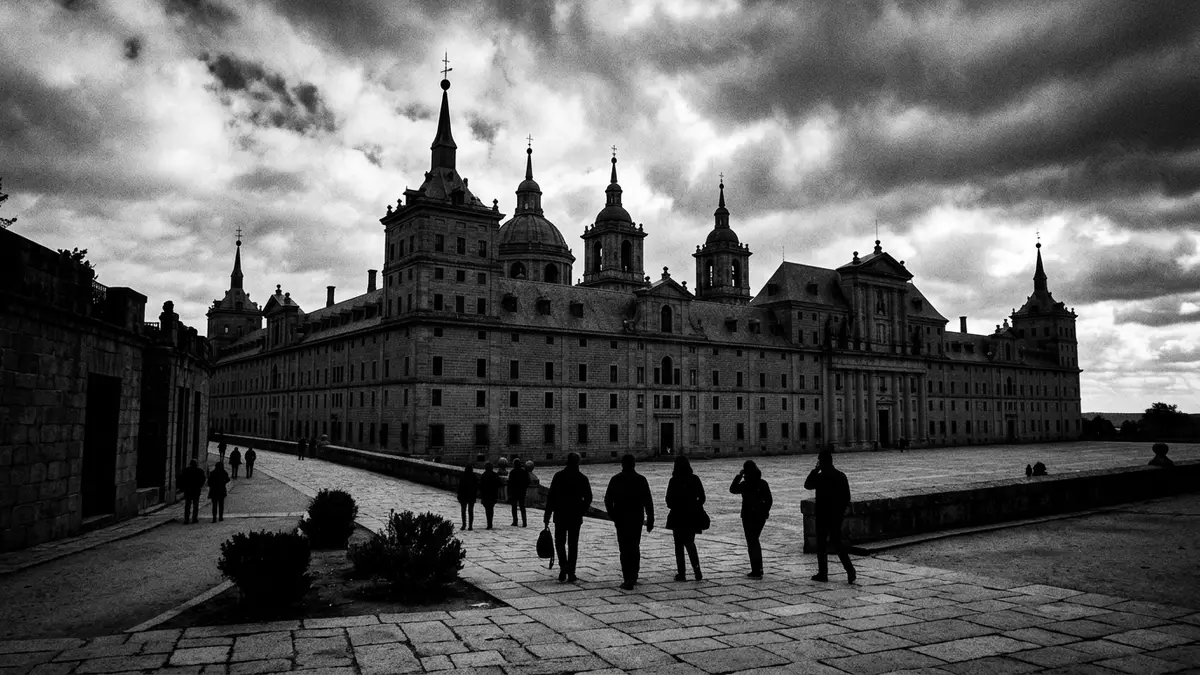
Monasterio de El Escorial, above the town of San Lorenzo de El Escorial in Spain, is a vast granite complex where monastery, royal palace, basilica and pantheon are built into a single ordered structure dating from the second half of the sixteenth century.
A royal monument carved in granite
Monasterio de El Escorial stands on the lower slopes of the Sierra de Guadarrama north of Madrid, with its long façades and towers set against the surrounding hills and sky.foothills of the Sierra de Guadarrama The building was commissioned by King Philip II of Spain in the sixteenth century, in the years when the Habsburg dynasty ruled an empire stretching across Europe and into the Americas.Philip II of Spain Construction began in 1563 and the main fabric was completed in 1584, placing the complex firmly in the Spanish Renaissance.construction started in 1563
The project brought together several leading architects of the time. Juan Bautista de Toledo developed the initial design, and after his death Juan de Herrera continued and refined it, giving the complex its distinctive austere character that became known as the Herrerian style.Juan Bautista de Toledo and Juan de Herrera The result is a monumental ensemble built largely of local granite, with straight lines, restrained façades and firm symmetry that contrast with the more ornate palaces and monasteries of other European courts.
Monastery, palace and basilica in one ordered plan
From above, the plan of Monasterio de El Escorial reads almost like a fortified town, with courtyards, long corridors and blocks arranged around a central basilica. The complex integrates a functioning monastery, a royal palace, a major church, a royal pantheon, a historic library and educational spaces under one roof.monastery, basilica, royal palace, pantheon, library The basilica rises from the heart of the plan, flanked by towers and a dome, while the palace apartments occupy one sector and the monastic buildings frame cloistered courts.
The Herrerian style expresses itself in regular façades pierced by rows of windows, strong horizontal cornices and towers at the corners, avoiding heavy ornament in favour of proportion and clarity.Herrerian-style architectural look Within this ordered shell, individual spaces such as the basilica, the royal pantheon and the grand halls of the palace carry rich decoration, sculpture and painting, many of them influenced by Italian and Flemish artists brought to Spain during the Habsburg period.Italian and Flemish artistic styles
The Royal Library and the power of knowledge
One of the most remarkable spaces within Monasterio de El Escorial is the Royal Library, a long hall lined with shelves that hold manuscripts and printed books from many fields.Royal Library of San Lorenzo de El Escorial The library reflects the intellectual ambitions of the Spanish monarchy in the Renaissance, bringing together works of theology, philosophy, science and geography at a time when Europe’s understanding of the world was expanding rapidly.
The hall itself was designed by Juan de Herrera and became influential in the history of European libraries, with books displayed along the walls and decorative globes and scientific instruments marking the importance of learning.designed by Juan de Herrera In combination with the basilica, palace and pantheon, the library helps make El Escorial one of the key architectural symbols of Spain’s so-called Golden Age, when art, religion, scholarship and imperial power were tightly intertwined.Spanish Golden Age
Visiting Monasterio de El Escorial: what travellers from Western Europe should know
- Monasterio de El Escorial stands in San Lorenzo de El Escorial, north-west of Madrid, and is reached overland from the capital by road and regional rail services that climb towards the Sierra de Guadarrama.
- The complex is built on sloping ground above the town, and visiting the interior involves long corridors, broad stairways and substantial enclosed spaces, so a visit entails extended walking over stone floors.
- The surrounding area includes the wooded foothills of the Sierra de Guadarrama and the peak of Monte Abantos, giving views from the approaches and terraces towards mountains and the Madrid plain.
- Spain’s official language is Spanish and the currency is the euro.
Searching for Monasterio de El Escorial on social platforms
These links open searches for Monasterio de El Escorial on each platform.
Frequently asked questions about Monasterio de El Escorial
Where is Monasterio de El Escorial?
Monasterio de El Escorial is in the town of San Lorenzo de El Escorial in central Spain, on the slopes of the Sierra de Guadarrama north-west of Madrid.
What can visitors expect inside the complex?
Visitors encounter monastic cloisters, royal palace rooms, the basilica, the royal pantheon and the historic library, all arranged within a single large granite building.
What makes Monasterio de El Escorial distinctive?
Its combination of monastery, palace, basilica, pantheon and library, built under Philip II between 1563 and 1584 in the austere Herrerian style, makes it a defining monument of the Spanish Renaissance.


