
Monasterio de El Escorial and its granite world of Renaissance Spain
Published on 09/23/2026 at 01:24 | Editorial responsibility: Rafael Müller, Editor-in-Chief AD HOC NEWS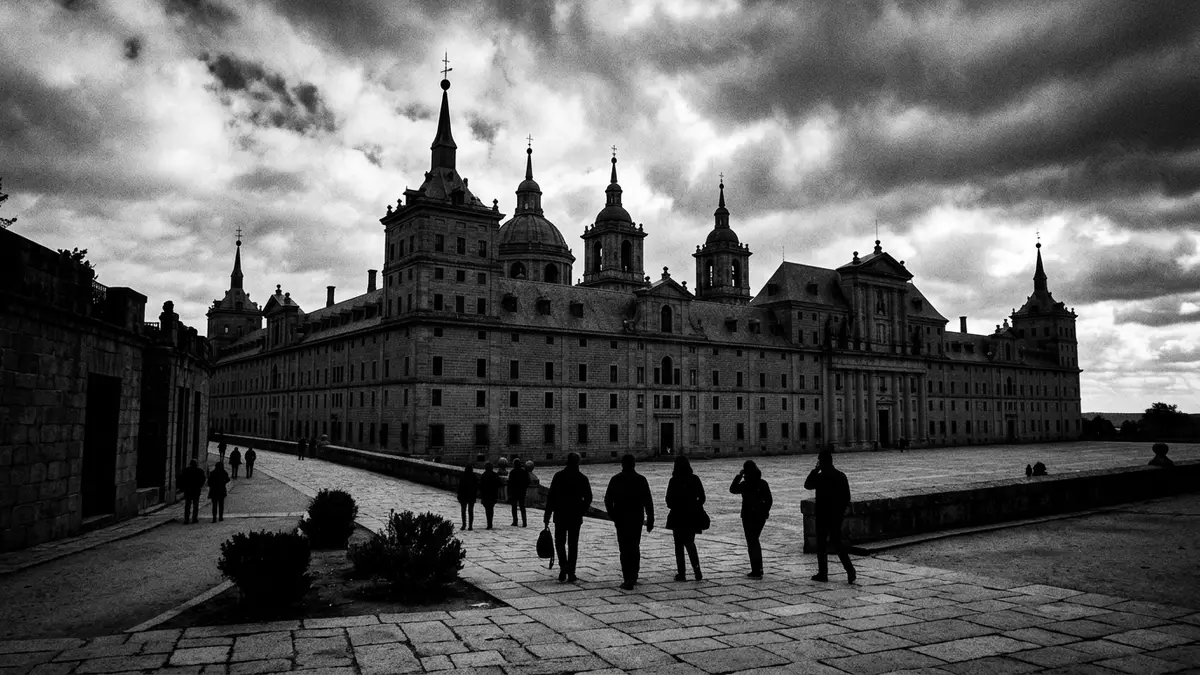
Monasterio de El Escorial is a vast granite complex in San Lorenzo de El Escorial, north-west of Madrid. Palace, monastery, basilica, library and royal pantheon meet within one Renaissance site, whose severe exterior gives way to courtyards, paintings, tombs and scholarly rooms.
Monasterio de El Escorial: a granite complex in the Sierra de Guadarrama
Philip II founded the monastery in 1563, and the completed complex belongs to the Spanish Renaissance of the sixteenth century. Juan Bautista de Toledo began the design, while Juan de Herrera continued the work after Toledo’s death in 1567 and brought the building to completion in 1584. The two names are inseparable from the site’s architectural identity, with Herrera’s influence linked to the style known as Herrerian architecture.
Granite gives the façades their restrained appearance. Long walls, regular windows, corner towers and slate roofs form a monumental composition around interior courtyards. The Royal Site includes the monastery and its historic surroundings, including gardens, friars’ orchards and service buildings. Its UNESCO World Heritage status dates from 1984.
Philip II, Juan de Herrera and the sixteenth-century royal foundation
Monasterio de El Escorial was commissioned by Philip II after the Battle of Saint-Quentin in 1557. The battle took place on the feast of Saint Lawrence, whose name became part of the foundation’s dedication. The complex also became a dynastic burial place for Spanish monarchs from Charles V onwards.
The project joined religious, royal and educational functions within one institution. The Hieronymite community lived at the monastery, while the wider complex contained a royal palace, a college, a seminary, a library and a basilica. The Spanish Ministry of Culture describes this combination as closely associated with the Hispanic monarchy, the Spanish Golden Age and the Catholic Counter-Reformation. The royal foundation’s functions remain visible in the arrangement of its rooms and buildings.
Inside the basilica, library and royal pantheon
The Basilica of San Lorenzo forms the religious centre of the complex. Its high altar, chapels and painted interiors belong to the artistic world of late Renaissance Spain and Italy. The Chapter Rooms contain works by major painters, while the Gallery of Battles presents large historical scenes across its walls.
The Royal Library, founded by Philip II, reflects the intellectual ambitions of the foundation. Its collections include books, manuscripts, maps, scientific instruments and other objects associated with study. The library’s principal hall has a decorated vaulted ceiling and a long interior arrangement that makes the room distinct from the austere outer façades. Beneath the basilica, the Pantheon of Kings contains the remains of Spanish monarchs and members of the royal dynasties. The complex therefore reads as both a monastery and a palace, with scholarship, worship, royal residence and dynastic memory placed within the same architectural world. The Royal Library collection forms one of its most distinctive interiors.
Visiting Monasterio de El Escorial: what travellers from Western Europe should know
- Monasterio de El Escorial stands in San Lorenzo de El Escorial, in the Madrid region. Buses from Madrid reach the town, and rail services connect the area with the Spanish capital.
- The complex contains long interior routes, courtyards, staircases and enclosed historic rooms. A visit involves walking across substantial architectural spaces rather than viewing a single monument.
- San Lorenzo de El Escorial lies on the southern slopes of the Sierra de Guadarrama. The town, palace-monastery and surrounding hills form a connected cultural landscape.
- The official language is Spanish and the currency is the euro.
Searching for Monasterio de El Escorial on social platforms
These links open searches for Monasterio de El Escorial on each platform.
Frequently asked questions about Monasterio de El Escorial
Where is Monasterio de El Escorial?
It is in San Lorenzo de El Escorial, in the Madrid region of Spain, on the southern slopes of the Sierra de Guadarrama.
What can visitors see there?
The complex contains a basilica, royal palace rooms, monastery spaces, the Royal Library, courtyards, art collections and the royal pantheon.
What makes the complex distinctive?
Its distinctive character comes from the combination of palace, monastery, church, library and dynastic burial place within one granite Renaissance complex.


