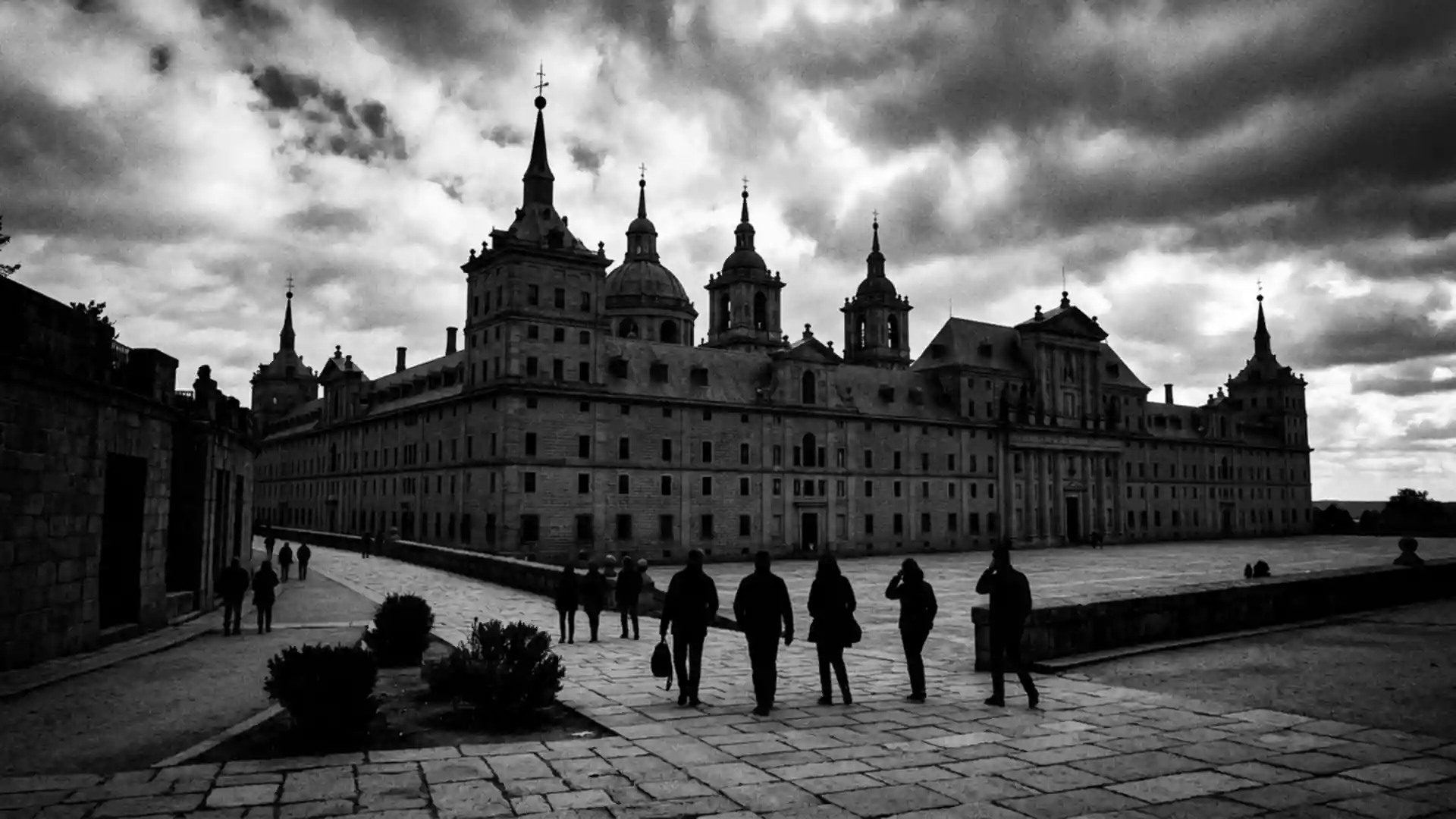
Monasterio de El Escorial and its granite order in the Sierra de Guadarrama
Published on 09/11/2026 at 12:13 | Editorial responsibility: Rafael Müller, Editor-in-Chief AD HOC NEWS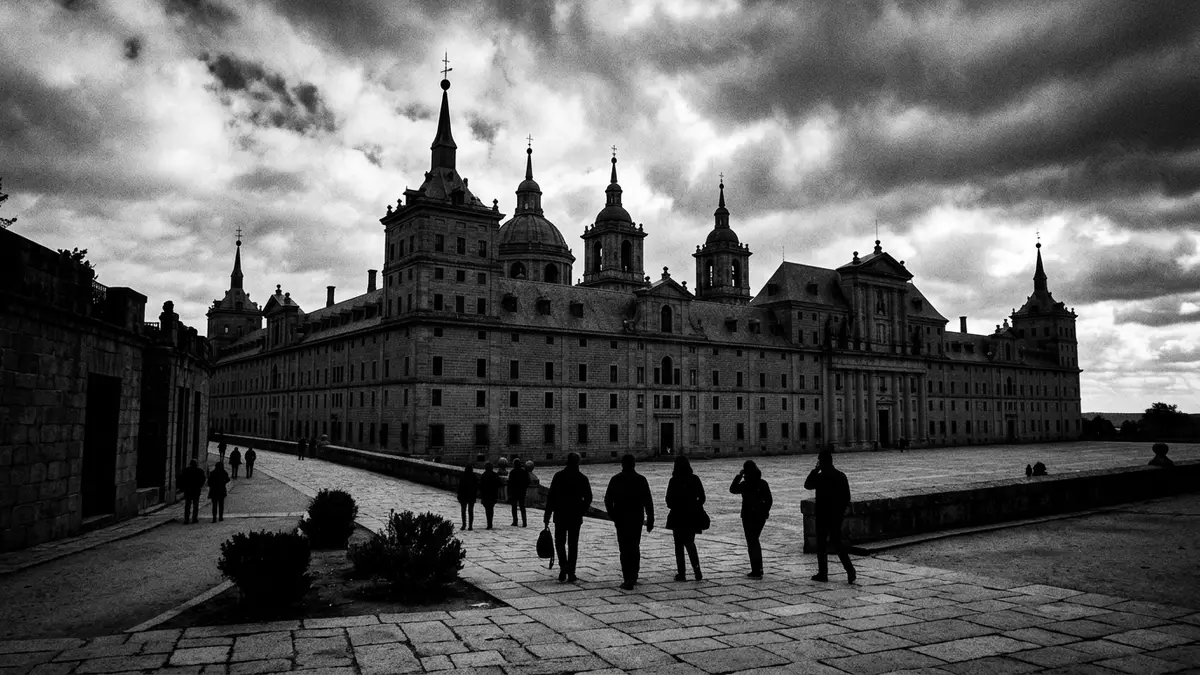
Monasterio de El Escorial in San Lorenzo de El Escorial is a vast Renaissance complex of granite rising on the southern slopes of the Sierra de Guadarrama, combining monastery, royal palace and basilica in one ordered mass.Real Monasterio de San Lorenzo de El Escorial From the sixteenth century onwards it has anchored the royal landscape north-west of Madrid as a site of power, faith and scholarship.
Granite geometry and Renaissance scale
The defining experience of Monasterio de El Escorial is its sheer scale in stone: an immense rectangle of pale granite walls and towers enclosing courtyards, cloisters and halls in a strict orthogonal plan.Granitblöcke aus der Sierra de Guadarrama The building, extending over tens of thousands of square metres, reads as a single disciplined composition rather than a collection of separate structures.ocupa una superficie de 33 327 m²
Its overall form is a vast horizontal block set against the slopes of Mount Abantos, with long, plain façades pierced by regular rows of windows and topped by slate roofs and corner towers.Royal Monastery of San Lorenzo de El Escorial Inside that outer shell the geometry continues in the arrangement of cloisters, chapels and galleries around courtyards, giving the complex a legible, almost diagrammatic clarity that is characteristic of Spanish Renaissance architecture.
Philip II, Herrera style and the Counter?Reformation
Monasterio de El Escorial was commissioned by King Philip II of Spain and built between 1563 and 1584, at the height of the Spanish monarchy’s power in the sixteenth century.Built between 1563 and 1584 by order of King Philip II The initial layout is attributed to Juan Bautista de Toledo, a Spanish architect who had worked on major projects in Rome, and construction continued under Juan de Herrera, whose austere interpretation of Renaissance classicism gave the complex its distinctive “Herrerian” character.nach Plänen von Juan Bautista de Toledo und ... Juan de Herrera
The site embodies the Catholic Counter?Reformation and the Spanish Golden Age in built form: a place that unites religious community, dynastic burial and royal residence into a single ordered complex.expression of the Catholic Counter-Reformation and the Spanish Golden Age In later centuries it continued to serve as a royal seat and pantheon for Spanish monarchs, tying the architecture to the continuity of the dynasty as much as to any single reign.royal monastery-palace complex in Spain
Monastery, palace, basilica and library in one
Within its granite perimeter Monasterio de El Escorial combines several distinct functions that elsewhere would be separate buildings: a royal palace, a Hieronymite monastery now cared for by Augustinians, a basilica, dynastic pantheon, library, school, museum and hospital.functions as a monastery, basilica, royal palace, pantheon, library, museum, university, school, and hospital The result is a self?contained world where cloistered courts and monastic spaces sit beside royal apartments and ceremonial halls.
One of the most striking interiors is the basilica, rising at the heart of the complex with its chapels and high altar, while nearby lie the Pantheon of the Kings and the historic library, lined with volumes that recall the site’s role as a centre of learning.Royal Monastery of San Lorenzo de El Escorial Together these spaces show how Monasterio de El Escorial has long served both religious life and royal ceremony, as well as scholarship and education.
Visiting Monasterio de El Escorial: what travellers from Western Europe should know
- Monasterio de El Escorial stands in San Lorenzo de El Escorial in the Madrid region of Spain, north?west of Madrid, and is reached by road and rail services from the capital.
- The complex occupies a hillside position on the southern flank of Mount Abantos, so walks through its courtyards and around its outer terraces involve gradients and extended distances on foot within the site.
- The grounds and stone façades face the Sierra de Guadarrama, and the elevation on the mountain foothills means weather in the open areas can be cooler and more exposed than in central Madrid.
- Spain’s official language is Spanish and the currency is the euro.
Searching for Monasterio de El Escorial on social platforms
These links open searches for Monasterio de El Escorial on each platform.Frequently asked questions about Monasterio de El Escorial
Where is Monasterio de El Escorial located?
Monasterio de El Escorial stands in the municipality of San Lorenzo de El Escorial in the Madrid region of Spain, on the foothills of the Sierra de Guadarrama.
What should visitors expect on a visit to Monasterio de El Escorial?
Visitors encounter a vast granite Renaissance complex with monastery spaces, royal apartments, a basilica, pantheon and historic library arranged around courtyards and cloisters.
What makes Monasterio de El Escorial distinctive among Spanish sites?
Its combination of royal palace, monastery, basilica and dynastic burial place in one ordered granite complex, built under Philip II, gives it a singular role in Spanish history.