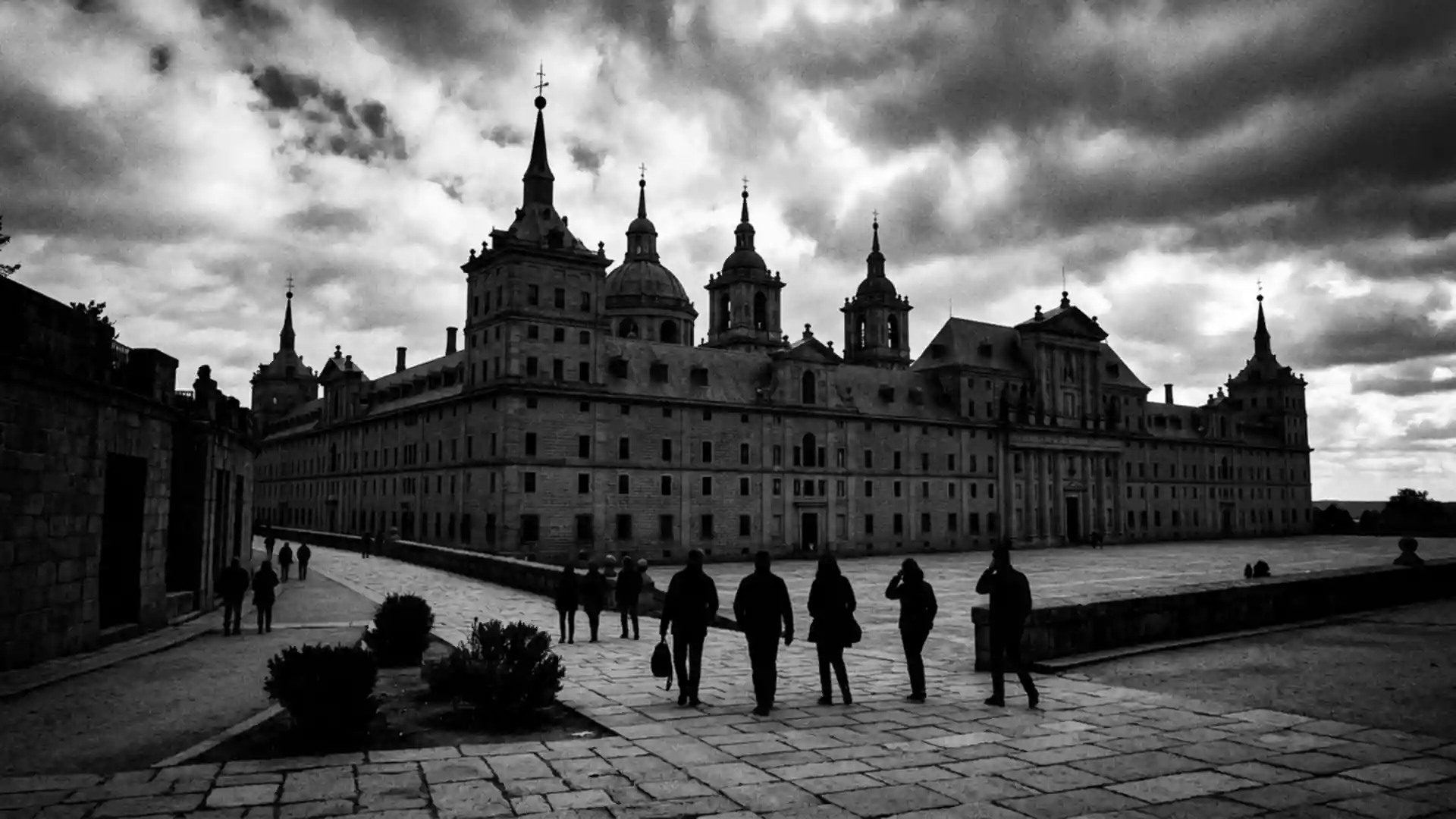
Monasterio de El Escorial, a granite grid of power and faith
Published on 09/09/2026 at 19:04 | Editorial responsibility: Rafael Müller, Editor-in-Chief AD HOC NEWS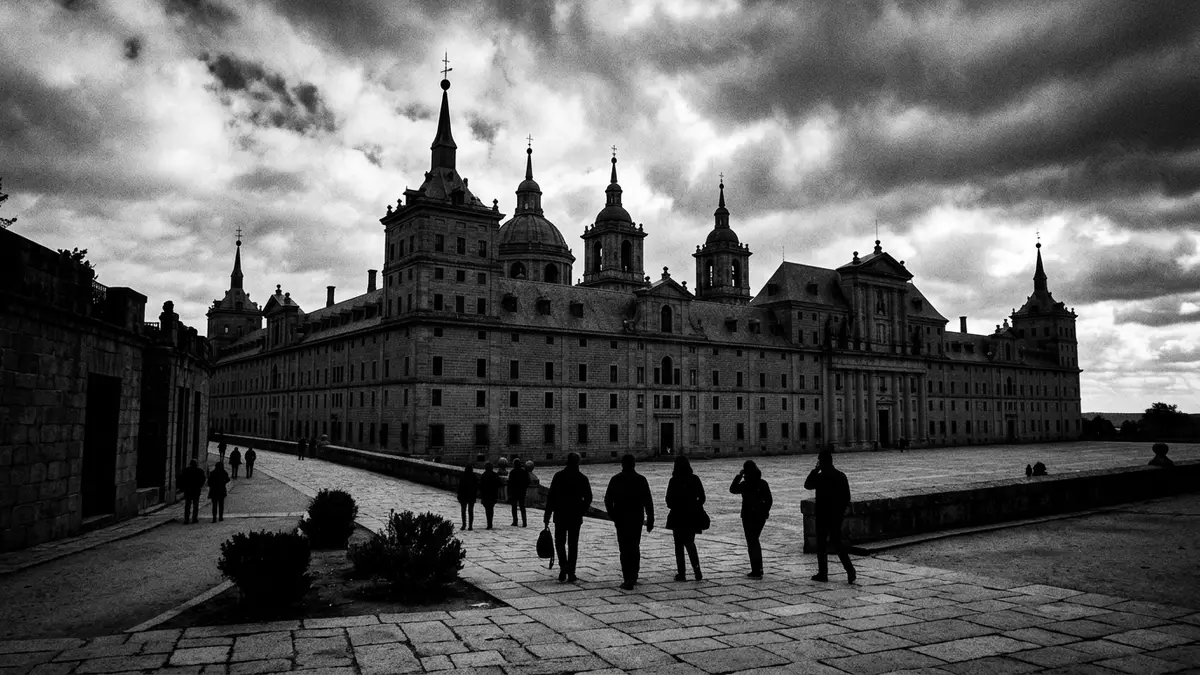
Monasterio de El Escorial rises above San Lorenzo de El Escorial as a vast rectangle of granite, its strict grid of courtyards and towers binding monastery, palace and basilica into a single Renaissance complex. Conceived under King Philip II in the sixteenth century, it became the central monument of Habsburg Spain and the dynastic pantheon of its rulers.
A royal monastery laid out as a stone grid
From a distance, Monasterio de El Escorial reads as an immense horizontal mass, anchored by corner towers and a central dome, set on the foothills of the Sierra de Guadarrama north-west of Madrid. The complex occupies an extensive rectangle whose plan is famously organised as a regular grid of patios and corridors, evoking the form of a grille associated with Saint Lawrence, the martyr to whom the monastery is dedicated.grid of patios and corridors Within this rectangle lie several distinct but connected realms: the monastic cloisters, the royal palace, the basilica, the college and the library.
The foundation of El Escorial dates to 1563, under the patronage of King Philip II of Spain, whose reign from 1556 to 1598 framed the height of Habsburg power.Built between 1563 and 1584 Construction extended through the later sixteenth century, with completion recorded in 1584 in many accounts, giving the complex a clear position within European Renaissance architecture.ambitious monument constructed during the Renaissance The official designation as the Royal Site of San Lorenzo de El Escorial reflects both its monastic and royal functions.
Herrerian architecture: austere granite and measured order
El Escorial is one of the principal works associated with the architect Juan Bautista de Toledo, who prepared the initial designs after experience with Italian Renaissance projects, and Juan de Herrera, who took over after Toledo’s death in 1567 and brought the complex to completion.Designed by architects Juan Bautista de Toledo and later Juan de Herrera The resulting style, often termed Herrerian after Herrera, is characterised by large unornamented wall surfaces, straight lines and restrained profiles. At El Escorial that language appears in long granite façades broken by evenly spaced windows and simple cornices, and in towers capped with spires whose outlines remain spare.
The material palette centres on pale granite, giving the monastery its cool, persistent appearance against the slopes of the Sierra de Guadarrama.Schloss- und Klosteranlage The façades frame a sequence of interior courts, from the Patio de los Reyes beside the basilica to quieter cloister gardens used by the religious community. The basilica itself rises from near the centre of the plan, crowned by a dominant dome that signals the complex’s religious heart, while arcaded cloisters and vaulted passageways link the sacred and secular parts of the site.
Monastery, palace, basilica, pantheon and library in one
Monasterio de El Escorial was conceived as more than a single function building: it combines a working monastery, a royal palace, a church, burial vaults and a scholarly library within one integrated ensemble.monastery, a royal palace, a basilica, a royal pantheon, and a historic library The monastery wing, originally occupied by members of the Order of Saint Jerome and later by other communities, includes refectories, cells and cloister walks arranged around internal courts.palacio, basílica, monasterio Adjoining these spaces lie the royal apartments, where Philip II and his successors could reside within immediate reach of the basilica.
Beneath and beside the basilica, El Escorial houses the Pantheon of Kings and other burial chambers used for generations as the resting place of Spanish monarchs and royal family members.Pantheon of Kings The Royal Library stands as another focal element of the complex, with richly decorated ceilings above shelves holding thousands of manuscripts and printed volumes that trace the intellectual life of the Spanish Golden Age.rare collection of over 4,700 manuscripts and 40,000 printed books Together these parts demonstrate how Monasterio de El Escorial integrates religious devotion, royal memory and scholarship in a single architectural organism.
Visiting Monasterio de El Escorial: what travellers from Western Europe should know
- Monasterio de El Escorial stands in San Lorenzo de El Escorial in central Spain, north-west of Madrid, and is reached by road and regional rail services from the capital.
- The complex occupies a broad site on the lower slopes of the Sierra de Guadarrama, and visits involve walking through long corridors, staircases and expansive courtyards.
- The surrounding town of San Lorenzo de El Escorial provides additional viewpoints towards the monastery’s granite mass and the nearby mountain landscape.
- The official language is Spanish and the currency is the euro.
Searching for Monasterio de El Escorial on social platforms
These links open searches for Monasterio de El Escorial on each platform.
Frequently asked questions about Monasterio de El Escorial
Where is Monasterio de El Escorial located?
Monasterio de El Escorial is in the town of San Lorenzo de El Escorial in central Spain, on the foothills of the Sierra de Guadarrama north-west of Madrid.
What can visitors expect to see at Monasterio de El Escorial?
Visitors encounter a vast granite complex combining monastery, royal apartments, basilica, burial vaults, cloistered courts and the historic Royal Library, all arranged in a rigorous rectangular plan.
What makes Monasterio de El Escorial distinctive among European sites?
Its scale as a Renaissance monastery-palace, the austere Herrerian architecture in granite and the integration of royal pantheon and library give Monasterio de El Escorial a distinctive place in European architectural history.