
Mogao Ku: painted cave temples on the Silk Road
Published on 08/20/2026 at 19:06 | Editorial responsibility: Rafael Müller, Editor-in-Chief AD HOC NEWS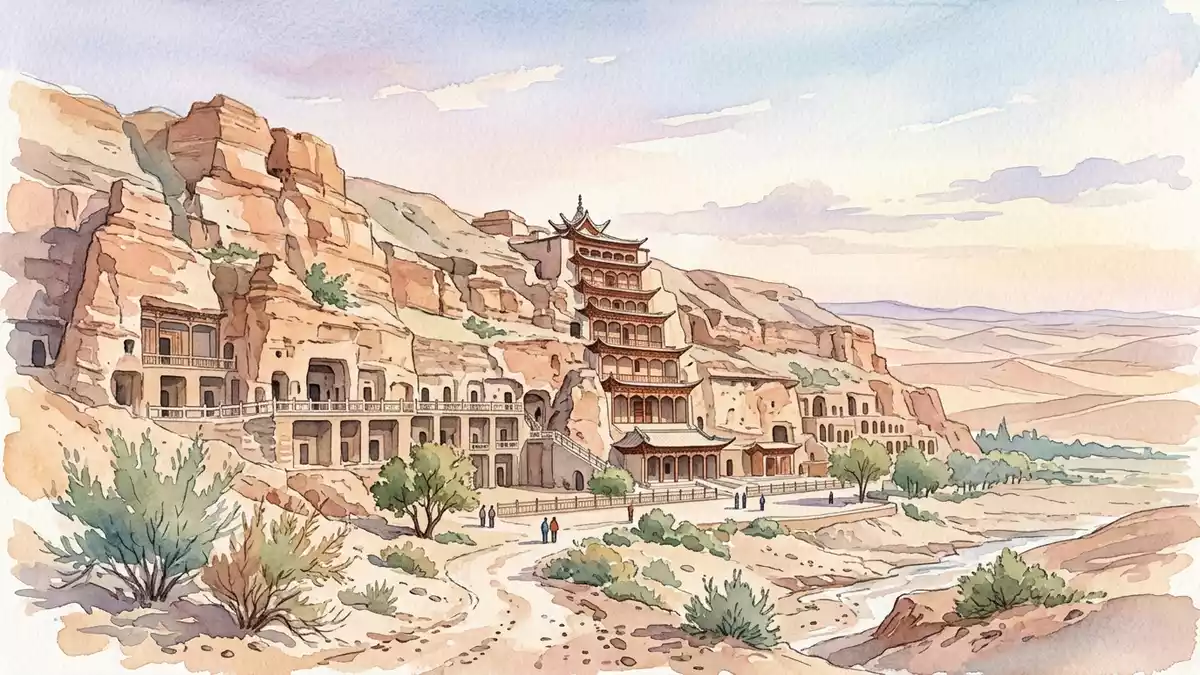
Mogao Ku near Dunhuang in north?western China is the Chinese name for the Mogao Caves, a long cliff of Buddhist cave temples carved into desert rock along the Silk Road trade route in Gansu province. The site developed from the fourth century AD as a religious complex and is now recognised as a major repository of Buddhist murals and sculptures spanning about a thousand years.
A cliff of caves above an oasis corridor
Mogao Ku occupies a band of sandstone cliff above the Dachuan River, some 25 km (15.5 miles) south?east of Dunhuang, at the edge of the Gobi Desert. The caves run along the eastern slope of Mingsha Shan, also known as Echoing?Sand Mountain, overlooking an oasis corridor that once formed part of the Silk Road between China and Central Asia.Dachuan River cliff face The wider setting is open desert, with low scrub and sand beyond the river valley.
The cave complex is traditionally dated to 366 AD, when the first cells were cut into the cliff during the period known as the Five Hus and Sixteen States.Mogao Caves built in 366 Over the centuries, further caves were added in successive dynasties, creating a dense cluster of temple spaces linked by paths and stairways along the rock face.
Buddhist murals and sculptures across a millennium
The core of Mogao Ku consists of hundreds of decorated caves containing wall paintings and painted clay sculptures that illustrate Buddhist narratives, devotional figures and scenes of everyday life. Around 492 caves are formally recorded as part of the principal complex, with murals covering tens of thousands of square metres and more than 2,000 sculpted figures ranging from small icons to large seated Buddhas.UNESCO description of 492 caves The paintings and sculptures reflect artistic styles from different periods between the fourth and fourteenth centuries.
Many caves have painted ceilings and side walls organised into registers of narrative scenes, with donors, monks and lay followers depicted beneath. Others contain large central images flanked by attendant bodhisattvas and guardians. Surfaces are typically coated with plaster and pigments applied over it, creating layers of colour that have survived in varying condition. In addition to the visual art, the site is known for manuscripts discovered in a sealed cave containing a large cache of religious and secular texts dating from the same broad period.cache of Buddhist manuscripts
Mogao Ku as a World Heritage site on the Silk Road
Mogao Ku is inscribed on the UNESCO World Heritage List under the name Mogao Caves, recognised as an important Silk Road site for the exchange of religious and artistic traditions.Mogao Caves World Heritage listing The location at a crossroads of caravan routes brought merchants, pilgrims and monks from different regions, and this movement is reflected in the combination of Chinese, Central Asian and Indian influences in the imagery.
The caves form part of a wider group of Buddhist grotto sites around Dunhuang, which also includes the Western Thousand Buddha Caves and other smaller complexes.Mogao Caves overview Within the main Mogao cliff, the caves are numbered and many have been studied and documented in detail, providing material for research into painting techniques, iconography and the history of Buddhism in north?west China.
Visiting Mogao Ku: what travellers from Western Europe should know
- Mogao Ku lies south?east of Dunhuang in Gansu province, China, reached by road from the city towards the Dachuan River and the eastern slope of Mingsha Shan.
- Access to the numbered caves is along paths and stairways on the cliff face, with some sections involving steps and uneven surfaces inside the cave temples.
- The wider area is desert terrain on the edge of the Gobi, so exposed outdoor sections can involve sun and sand conditions.
- The official language is Chinese and the currency is the Chinese yuan.
- Entry requirements depend on your nationality; UK travellers can check the FCDO travel advice at gov.uk/foreign-travel-advice, Irish travellers the Department of Foreign Affairs at ireland.ie.
Searching for Mogao Ku on social platforms
These links open searches for Mogao Ku on each platform.
Frequently asked questions about Mogao Ku
Where is Mogao Ku located?
Mogao Ku is on a sandstone cliff above the Dachuan River, about 25 km south?east of Dunhuang in Gansu province in north?western China.
What can visitors expect inside the caves?
Visitors encounter caves with plastered and painted walls, sculpted Buddha figures and other devotional images, arranged in different layouts that reflect Buddhist art from various dynasties.
What makes Mogao Ku distinctive among Silk Road sites?
Mogao Ku combines hundreds of decorated caves, long use from the fourth to fourteenth centuries and a large body of murals, sculptures and manuscripts linked to Buddhist practice along the Silk Road.


