
Mogao Ku, painted cave temples on a desert cliff
Published on 09/12/2026 at 17:03 | Editorial responsibility: Rafael Müller, Editor-in-Chief AD HOC NEWS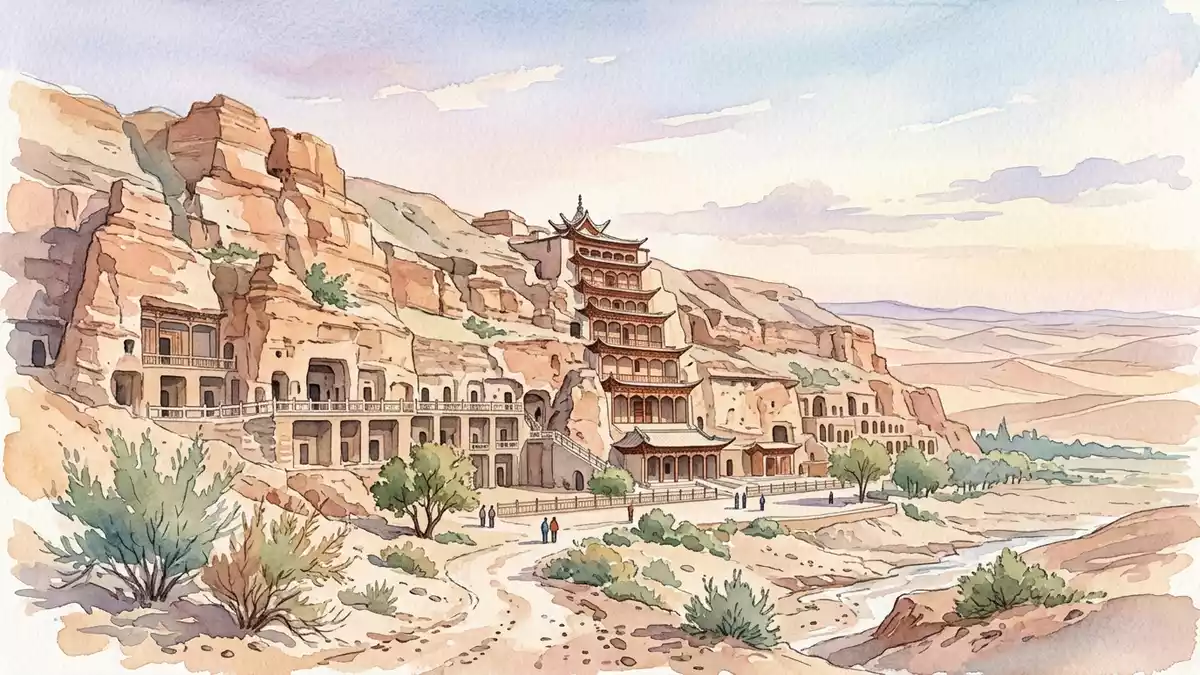
Mogao Ku near Dunhuang in north-western China is a long row of Buddhist cave temples carved into a sandstone cliff, facing the desert and the Dachuan River. The site developed from the year 366 AD onwards, and the caves preserve paintings and sculptures created between the fourth and fourteenth centuries.
A cliff of caves along the Silk Road
Mogao Ku occupies a cliff above the Dachuan River on the south-eastern side of the Dunhuang oasis in Gansu Province, where desert, river and former trade routes meet.Carved into the cliffs above the Dachuan River the caves form tiers of openings linked by external walkways and staircases along the rock face.The location about 25 km south-east of downtown Dunhuang places Mogao Ku at the edge of the Gobi Desert.
The earliest caves are associated with the Former Qin period in the fourth century, and construction continued through successions of Chinese dynasties into the Yuan period of the thirteenth and fourteenth centuries.Work beginning in 366 AD and spanning dynasties from Former Qin to Yuan gives Mogao Ku a thousand-year architectural and artistic timeline that remains legible in the cliff.
Buddhist art painted onto sandstone
Mogao Ku is known internationally as the Mogao Caves or Thousand Buddha Grottoes, and recognised by UNESCO as a World Heritage Site.The inscription in 1987 reflects the concentration of Buddhist art preserved in the cave interiors. Hundreds of caves are numbered, and many contain painted clay sculptures of Buddhas and bodhisattvas surrounded by wall paintings.
The murals cover tens of thousands of square metres of rock surface and depict scenes ranging from serene seated Buddhas to narrative panels of donors, caravans and cosmological diagrams.Figures such as the 45,000 square metres of murals and more than 2,000 painted sculptures convey the scale of this painted environment. Cave layouts vary from simple chambers with a main image niche to multi-room complexes with side chapels and upper storeys reached by internal staircases.
Mogao Ku in the wider Dunhuang landscape
Mogao Ku stands on the eastern slope of Echoing-Sand Mountain, part of the dune landscape south of Dunhuang.The cliff lies on the eastern side of the dune ridge known as Mingsha Shan, with the Dachuan River flowing at its foot. From the approach road the sandstone wall appears as a horizontal band punctuated by timber facades and stair towers built in front of cave entrances.
Dunhuang itself is an oasis town in Gansu Province, historically acting as a gateway between the Hexi Corridor and routes leading west across Central Asia.Descriptions of Dunhuang as a Silk Road crossroads help explain why a concentration of Buddhist cave temples was established at Mogao Ku and maintained over centuries. The desert, river and dunes form a setting in which the cliff of caves reads as a constructed counterpart to the surrounding rock.
Visiting Mogao Ku: what travellers from Western Europe should know
- Mogao Ku lies south-east of Dunhuang in Gansu Province and is reached by road from the town and its railway station.
- The caves are cut into a sandstone cliff, and movement within the site involves external staircases, walkways along the rock face and internal steps between cave levels.
- The area forms part of the Gobi Desert on the eastern side of Echoing-Sand Mountain, so the terrain combines bare rock, riverbank and dune landscapes around the cliff.
- The official language is Chinese and the currency is the renminbi (yuan).
- Entry requirements depend on your nationality; UK travellers can check the FCDO travel advice at gov.uk/foreign-travel-advice, Irish travellers the Department of Foreign Affairs at ireland.ie.
Searching for Mogao Ku on social platforms
These links open searches for Mogao Ku on each platform.
Frequently asked questions about Mogao Ku
Where is Mogao Ku located?
Mogao Ku is on a sandstone cliff about 25 km south-east of Dunhuang in Gansu Province, at the edge of the Gobi Desert in north-western China.
What should visitors expect at Mogao Ku?
Visitors encounter a cliff lined with cave temples, timber facades, stair towers and cave interiors decorated with Buddhist wall paintings and painted clay sculptures.
What makes Mogao Ku distinctive among cave sites?
Mogao Ku combines hundreds of rock-cut sanctuaries, large mural surfaces and sculpted figures created over a thousand-year span, forming a continuous band of Buddhist art along the desert cliff.


