
Mogao Ku, Dunhuang’s painted cave temples on the Silk Road
Published on 09/16/2026 at 15:48 | Editorial responsibility: Rafael Müller, Editor-in-Chief AD HOC NEWS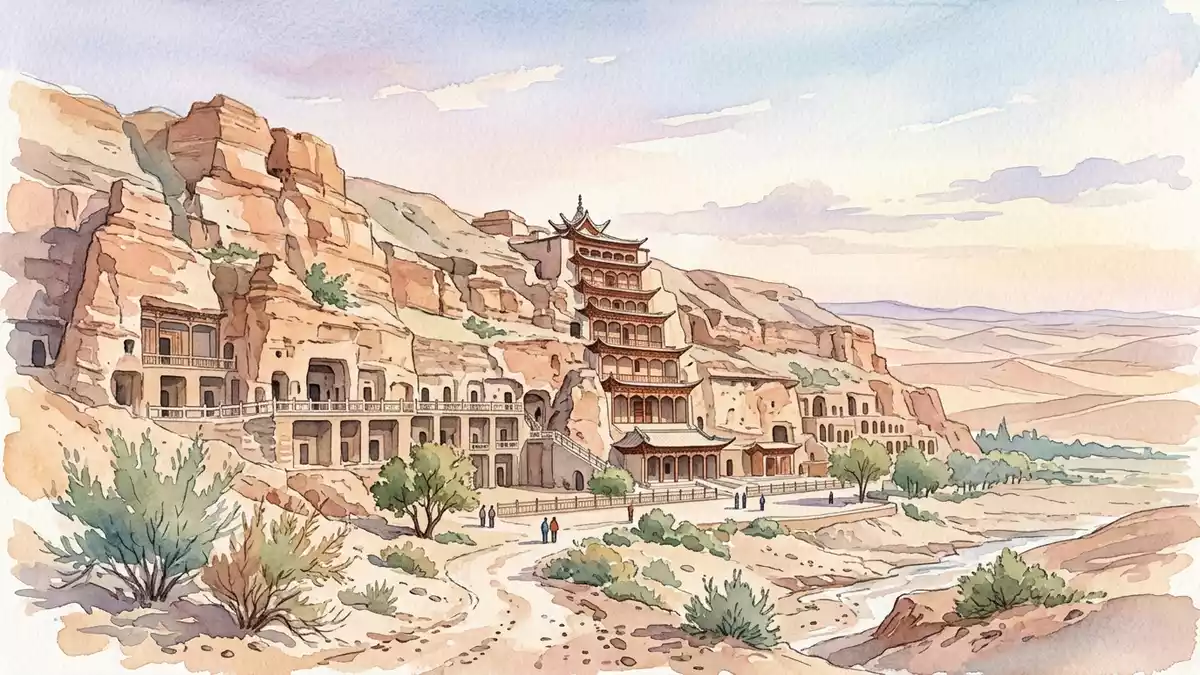
Mogao Ku, internationally known as the Mogao Caves or Thousand Buddha Grottoes, is a long band of Buddhist cave temples carved into a desert cliff south?east of Dunhuang in north?western China. Cut into the sandstone above the Dachuan River, this complex preserves murals and sculptures created across more than a thousand years of Silk Road history from the fourth to the fourteenth century.
A cliff of painted caves above the Dunhuang oasis
The Mogao Caves occupy a cliff face on the eastern foot of Mingsha Mountain, a sandy ridge that rises beside the Dunhuang oasis in Gansu Province. From a distance the cliff reads as a horizontal strip punctuated by cave openings and timber facades, with stairways and walkways clinging to the rock to reach different levels.Carved into the cliffs above the Dachuan River the caves form a continuous frontage rather than a single isolated temple building.
The site lies about 25 km (15.5 miles) south?east of Dunhuang, at the western end of the Gansu Corridor on the edge of the Gobi Desert.Mogao Ku is about 25 km south east from the town of Dunhuang The desert setting is part of its character: a line of man?made caves in an otherwise bare cliff, with the oasis and distant dunes visible from the walkways.
From fourth?century beginnings to a millennium of Buddhist art
Mogao Ku was first established as a Buddhist cave?temple site in 366 AD, and cave construction at the cliff continued through successive Chinese dynasties until the fourteenth century.It was first constructed in 366 AD and represents Buddhist art from the 4th to the 14th century Over these centuries, patrons and artisans created decorated cells and sanctuaries that reflected changing styles of Buddhist imagery, architecture and costume.
Out of the wider complex, 492 caves are formally recognised as part of the core heritage area and retain their interior decoration.492 cells and cave sanctuaries in Mogao are famous for their statues and wall paintings Together they contain around 45,000 square metres (484,000 sq ft) of murals and more than 2,000 painted sculptures in clay, ranging from small devotional figures to larger Buddha images that occupy tall niches in the cliff.the remaining caves contain altogether about 45,000m2 of murals and more than 2,000 painted statues
UNESCO World Heritage and the Silk Road crossroads
Mogao Ku stands at a historic crossroads of trade and culture where routes across the Gobi Desert met corridors leading towards central China and Central Asia. Dunhuang’s position on the Silk Road brought merchants, monks and travellers through the oasis, and the caves record this movement in painted caravans, donors in foreign dress and inscriptions in several languages.
The Mogao Caves, together with related grotto complexes in the Dunhuang region, were inscribed on the UNESCO World Heritage List in 1987 in recognition of their outstanding collection of Buddhist art and manuscripts.UNESCO inscribed Mogao Caves on the World Heritage List in 1987 Mogao Ku is one of five major Buddhist cave?temple sites around Dunhuang, standing alongside the Western Thousand?Buddha Caves, the Eastern Thousand?Buddha Caves, the Yulin Caves and the Wugemiao Caves.Mogao Ku is one of five Buddhist cave-temple sites in the Dunhuang region Together these grottoes form a wider landscape of religious sites in the desert.
Visiting Mogao Ku: what travellers from Western Europe should know
- Mogao Ku lies south?east of Dunhuang in Gansu Province in north?western China and is reached by road from the city’s urban area, with the caves cut into a cliff above the Dachuan River.
- The cave complex rises on a rock face with multiple tiers; access to individual caves involves stairways, raised walkways and interior steps within the cliff.
- The surrounding landscape combines desert dunes and the Dunhuang oasis, so exposed sections of the approach and viewing platforms lie in open, sandy terrain.
- The official language is Chinese and the currency is the renminbi (RMB).
- Entry requirements depend on your nationality; UK travellers can check the FCDO travel advice at gov.uk/foreign-travel-advice, Irish travellers the Department of Foreign Affairs at ireland.ie.
Searching for Mogao Ku on social platforms
These links open searches for Mogao Ku on each platform.
Frequently asked questions about Mogao Ku
Where is Mogao Ku located?
Mogao Ku is on a sandstone cliff about 25 km south?east of Dunhuang in Gansu Province in north?western China, above the Dachuan River and near the edge of the Gobi Desert.
What can visitors expect inside the caves?
Visitors encounter cave interiors lined with Buddhist murals and clay sculptures, with different caves reflecting styles from the fourth to the fourteenth century and varying in scale from small cells to taller sanctuaries.
What makes Mogao Ku distinctive among Silk Road sites?
Mogao Ku is distinctive for its dense concentration of decorated caves in a single cliff, its thousand years of Buddhist art and its recognition as a UNESCO World Heritage Site linked to the Silk Road.


