
Mogao Ku: Buddhist cave art carved into the desert cliffs
Published on 09/05/2026 at 09:01 | Editorial responsibility: Rafael Müller, Editor-in-Chief AD HOC NEWS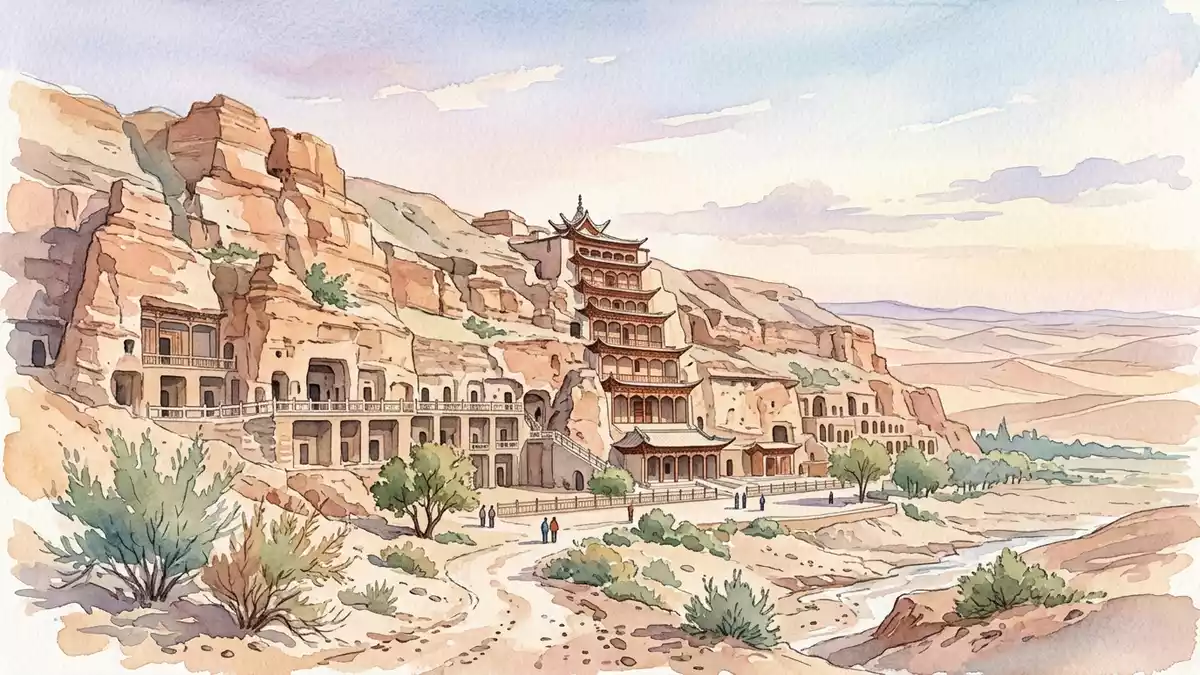
Mogao Ku, known in English as the Mogao Caves or the Thousand Buddha Grottoes, is a vast complex of Buddhist cave temples carved into desert cliffs south-east of Dunhuang in Gansu province. Stretching for hundreds of metres along a river valley at the edge of the Gobi Desert, the caves preserve murals and sculpture created between the fourth and fourteenth centuries, turning a sandstone escarpment into a layered record of Buddhist art along the Silk Road.
A cliff turned into a vertical temple city
The defining impression of Mogao Ku is the way a natural cliff has been transformed into a vertical city of shrines. Buddhist monks began cutting cells and sanctuaries into the sandstone in 366, working on the eastern slope of the desert hills near Dunhuang.first construction in 366 Over centuries the escarpment above the Dachuan River and at the foot of Echoing-Sand Mountain filled with cave-temples, their facades structured by timber porches, stairways and reinforced front walls built against the rock.
The result is not a single monumental hall but hundreds of individual spaces cut into the cliff face. At Mogao Ku more than 700 caves are known, with 492 described as extant in modern surveys.492 preserved caves From the valley floor the rock band reads as a long, pierced elevation, with doorways, wooden gallery structures and access stairs creating a stacked pattern of levels.
A millennium of Buddhist murals and sculpture
Inside the caves, Mogao Ku is defined by its extraordinary concentration of Buddhist imagery. Walls and ceilings are covered with murals showing Buddhas, bodhisattvas, donors, narrative scenes and decorative patterning, dating broadly from the fifth to the thirteenth centuries.fifth to thirteenth centuries The paintings span major Chinese dynasties, including the Tang dynasty, whose influence is visible in the colour palettes and figure styles.
Sculpture accompanies the paintings, ranging from small clay figures to monumental seated Buddhas. Surveys describe more than 2,000 painted sculptures at Mogao Ku and about 45,000 square metres of murals, a scale that makes the cliff one of the richest concentrations of Buddhist art in China.extent of murals and sculpture Each cave presents a different arrangement of altar, images and painted surfaces, reflecting the period in which it was cut and decorated.
Silk Road crossroads and World Heritage status
Geographically, Mogao Ku stands at a Silk Road crossroads where routes across the Gobi Desert met the Dunhuang oasis. The caves lie about 25 km (15.5 miles) south-east of central Dunhuang, carved into cliffs beside the Dachuan River and near Echoing-Sand Mountain in Gansu.location near Dunhuang Their position reflects Dunhuang’s historical role as a stopping point on trade and pilgrimage routes linking China with Central Asia.
The cultural value of Mogao Ku has been formally recognised through national and international protection. The cave complex was inscribed as a UNESCO World Heritage Site in 1987, highlighting its significance as a long-used treasure house of Buddhist art and its role in documenting exchanges along the Silk Routes.UNESCO inscription in 1987 Conservation work has included reinforcing facades and adding doors to many cave entrances to limit exposure of the mural surfaces to wind and sand.
Visiting Mogao Ku: what travellers from Western Europe should know
- Mogao Ku lies south-east of Dunhuang in Gansu province, with the cave complex carved into cliffs near the Dachuan River and Echoing-Sand Mountain.
- The site is approached across desert terrain, and visiting the caves involves walking on paths along the cliff base and climbing stairways to elevated entrances.
- Dunhuang is reached by transport links within north-western China, including services to Dunhuang Railway Station, from where local connections lead towards the cave area.
- The official language is Chinese and the currency is the renminbi (yuan).
- Entry requirements depend on your nationality; UK travellers can check the FCDO travel advice at gov.uk/foreign-travel-advice, Irish travellers the Department of Foreign Affairs at ireland.ie.
Searching for Mogao Ku on social platforms
These links open searches for Mogao Ku on each platform.
Frequently asked questions about Mogao Ku
Where is Mogao Ku located?
Mogao Ku is located about 25 km south-east of Dunhuang in Gansu province, with its cave-temples carved into sandstone cliffs beside the Dachuan River and Echoing-Sand Mountain.
What can visitors expect at Mogao Ku?
Visitors encounter a long cliff band pierced by cave entrances, with selected caves accessible to view their Buddhist murals, clay sculpture and the timber structures built against the rock face.
What makes Mogao Ku distinctive among Buddhist sites?
Mogao Ku is distinctive for its large number of cave-temples, the extensive area of preserved murals and sculpture, and its setting on a historic Silk Road route recognised as a UNESCO World Heritage Site.


