
Mogao Ku and the painted caves of the Silk Road
Published on 08/27/2026 at 11:06 | Editorial responsibility: Rafael Müller, Editor-in-Chief AD HOC NEWS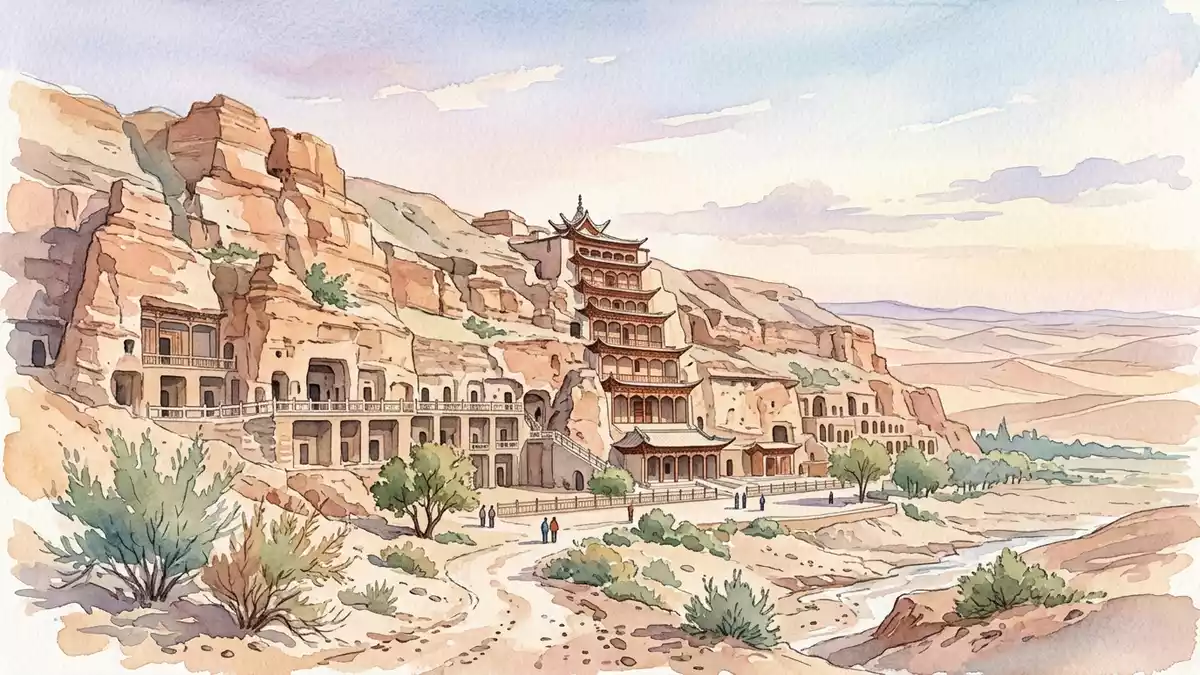
Mogao Ku, better known in English as the Mogao Caves or Thousand Buddha Grottoes, lines a cliff face in the desert southeast of Dunhuang in north-western China. The site brings together Buddhist cave temples carved into rock, covered with murals and filled with sculptures created between the fourth and fourteenth centuries.
Carved sanctuaries on a Silk Road cliff
Mogao Ku stands on the eastern side of a rocky escarpment near the Dunhuang oasis in Gansu province, above the Dachuan River and close to the edge of the Gobi Desert.Carved into the cliffs above the Dachuan River The location places the caves on one of the main historical routes linking China with Central Asia along the Silk Road.an oasis located at a crossroads on the Silk Road
Work on the first caves is recorded for the year 366, anchoring Mogao Ku in the era when Buddhism was spreading along these caravan routes.It was first constructed in 366 AD The sanctuary complex continued to grow under successive dynasties, with cave interiors reflecting styles from the Northern Wei and Sui through to the Tang and Yuan periods, so that visitors encounter a visual survey of about a thousand years of religious art in one place.their realisation from the fourth to the fourteenth century
A hillside of caves, halls and painted walls
The cliff at Mogao Ku is punctuated by hundreds of cave openings, many of them fronted by timber facades or walkways that turn the rock face into a multi-level streetscape of temples. In total, 492 decorated caves are preserved, arranged in tiers reached by ladders, stairways and galleries cut along the cliff.492 caves are presently preserved Some caves are small meditation cells, while others form broad halls with central Buddha statues and painted walls.
Inside, the caves carry murals over an area of about 45,000 square metres (approximately 484,000 square feet), depicting Buddhas, bodhisattvas, donors, processions, and narrative scenes from Buddhist sutras.about 45,000 square metres of murals Many caves house painted clay sculptures, with more than 2,000 statues recorded, ranging from small attendant figures to towering multi-storey images of the Buddha that fill the height of the chamber.more than 2,000 painted sculptures The combination of carved rock, timber structures, plaster, pigment and sculpture turns each cave into a complete painted space rather than a gallery of separate panels.
Buddhist art, manuscripts and world heritage
Mogao Ku developed as a Buddhist centre under Chinese rule, patronised by officials, merchants and pilgrims who left inscriptions and donor portraits on the cave walls. The sequence of murals and sculptures preserves changing approaches to Buddhist imagery from the Northern Liang period through the Tang and Song dynasties, with stylistic echoes from Central Asia alongside courtly painting traditions from the Chinese heartland.a major centre of Buddhist art on the Silk Road In addition to painted and sculpted images, some caves contained manuscript caches, including the celebrated library cave with its sealed deposit of scrolls in multiple languages.
The Mogao Caves were inscribed as a UNESCO World Heritage Site in 1987, recognising both the scale of the complex and the breadth of its surviving artworks.inscribed on the World Heritage List in 1987 The designation highlights the site as a major repository of Buddhist art and a record of cultural exchange along the Silk Roads between about the fourth and fourteenth centuries.listed as a UNESCO World Heritage Site Conservation programmes focus on stabilising the cliff, controlling access to decorated caves and documenting murals and sculptures in digital form.
Visiting Mogao Ku: what travellers from Western Europe should know
- Mogao Ku lies about 25 km (15.5 miles) south-east of central Dunhuang in Gansu province, on the eastern slope of Mingsha Mountain and above the Dachuan River. Dunhuang is reached by domestic flights and rail services within China.
- The caves are cut into a rock face, with access involving stairways, walkways and some narrow passages inside the cliff, so visits involve walking and climbing steps at varying gradients.
- The area stands on the edge of the desert near Mingsha Mountain, and wind-blown sand is a permanent feature of the landscape surrounding the cliff and its approach paths.
- The official language is Chinese and the currency is the renminbi (yuan).
- Entry requirements depend on your nationality; UK travellers can check the FCDO travel advice at gov.uk/foreign-travel-advice, Irish travellers the Department of Foreign Affairs at ireland.ie.
Searching for Mogao Ku on social platforms
These links open searches for Mogao Ku on each platform.
Frequently asked questions about Mogao Ku
Where is Mogao Ku located?
Mogao Ku stands on a cliff southeast of Dunhuang in Gansu province, in north-western China, near the edge of the Gobi Desert.
What can visitors expect to see inside the caves?
Visitors are guided into selected caves where walls and ceilings are covered with Buddhist murals and where painted clay sculptures of Buddhas and bodhisattvas stand in the dimly lit halls.
What makes Mogao Ku distinctive compared with other Buddhist sites?
Mogao Ku is distinctive for the sheer number of decorated caves, the extent of its murals and sculptures, and the long span of Buddhist art it preserves in a single cliffside complex.


