
Mogao Ku and the long cliff face of Buddhist art
Published on 09/17/2026 at 12:00 | Editorial responsibility: Rafael Müller, Editor-in-Chief AD HOC NEWS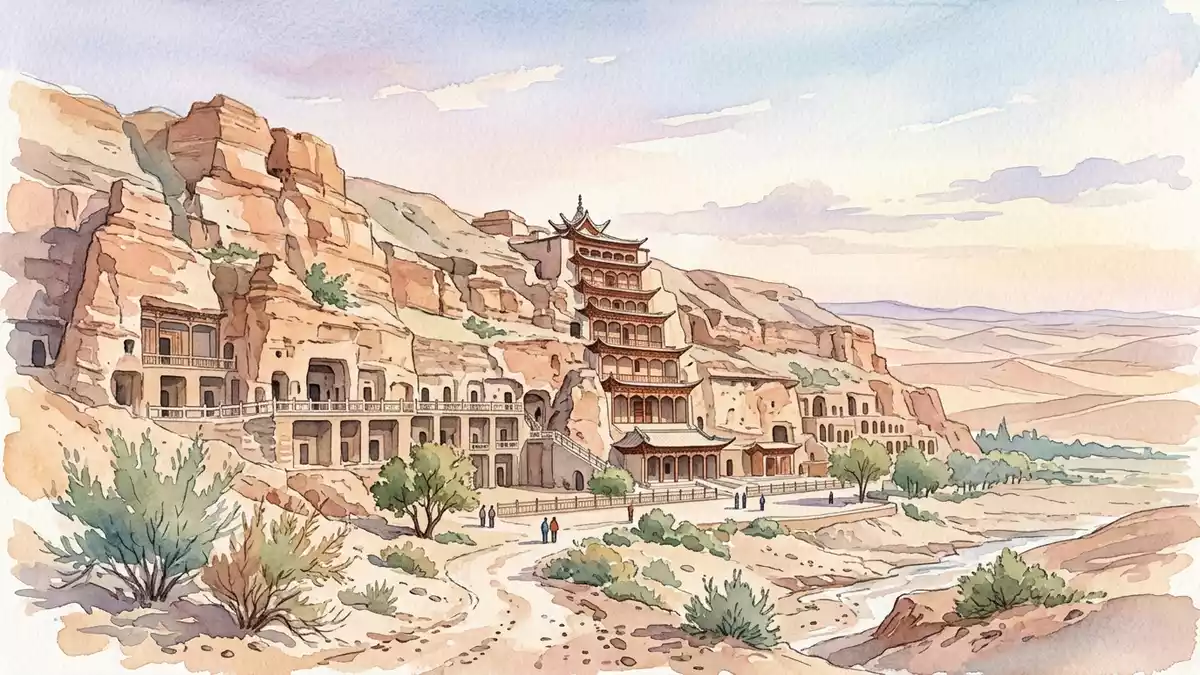
Mogao Ku in Dunhuang is a cliff-carved Buddhist complex on the Silk Road, inscribed on the UNESCO World Heritage List in 1987. It is known for its sandstone face, painted caves and long historical span.
The cliff, the caves and the Buddhist record
The site lies above the Dachuan River, south-east of the Dunhuang oasis in Gansu Province, China. UNESCO describes Mogao Ku as first constructed in 366 AD, and the complex belongs to the broad cultural world of the Silk Road.
The caves preserve murals and painted sculptures across a long sequence of Buddhist art, from the fourth to the fourteenth century. The complex includes 492 preserved caves, with about 45,000 square metres of murals and more than 2,000 painted sculptures, a scale that gives the site its distinctive density.492 preserved caves
Dunhuang, the Silk Road and the cave interiors
Mogao Ku stands within a wider Dunhuang landscape shaped by oasis settlement and desert routes. The caves were cut into cliff rock, and their surfaces were later covered with painted figures, narrative scenes and devotional imagery.
The strongest impression comes from the combination of rock-cut architecture and painted interior surfaces. The walls and ceilings carry dense colour, while the site as a whole keeps the structure of a religious cave sanctuary rather than a freestanding temple.World Heritage List
A Buddhist monument with a long period of use
The site represents a long phase of Buddhist patronage in north-west China. Its surviving caves show how artistic styles changed across dynasties, from early medieval phases through later imperial periods.
That historical breadth matters because Mogao Ku is not a single building with one date attached to it. It is a sequence of carved spaces and painted surfaces that records centuries of work in one cliffside setting.centuries of work
Visiting Mogao Ku: what travellers from Western Europe should know
- The site is in Dunhuang, in Gansu Province, in western China. Access is by road from the town and by the wider transport network that serves the oasis region.
- The terrain is a cliff face above the river corridor. The caves are reached through a carved landscape rather than a level urban forecourt.
- The complex is a Buddhist heritage site with painted caves and sculpture. Its focus is on the decorated interiors rather than on a single monumental façade.
- Mogao Ku belongs to the broader Silk Road world of desert trade, monastery culture and patronage across dynasties. The site is a good reference point for understanding Buddhist art in north-west China.
Searching for Mogao Ku on social platforms
These links open searches for Mogao Ku on each platform.
Frequently asked questions about Mogao Ku
Where is Mogao Ku?
Mogao Ku is in Dunhuang, in Gansu Province, China. It sits south-east of the Dunhuang oasis on a cliff above the Dachuan River.
What does a visit focus on?
A visit centres on carved cave sanctuaries, murals and painted sculpture. The place is organised around interiors rather than open courtyards.
What makes Mogao Ku distinctive?
The key feature is the long sequence of Buddhist art preserved in one cliffside complex. The 366 AD foundation and the 1987 World Heritage inscription are part of its core identity.


