
Mogao Ku and a thousand years of painted grottoes
Published on 08/21/2026 at 13:36 | Editorial responsibility: Rafael Müller, Editor-in-Chief AD HOC NEWS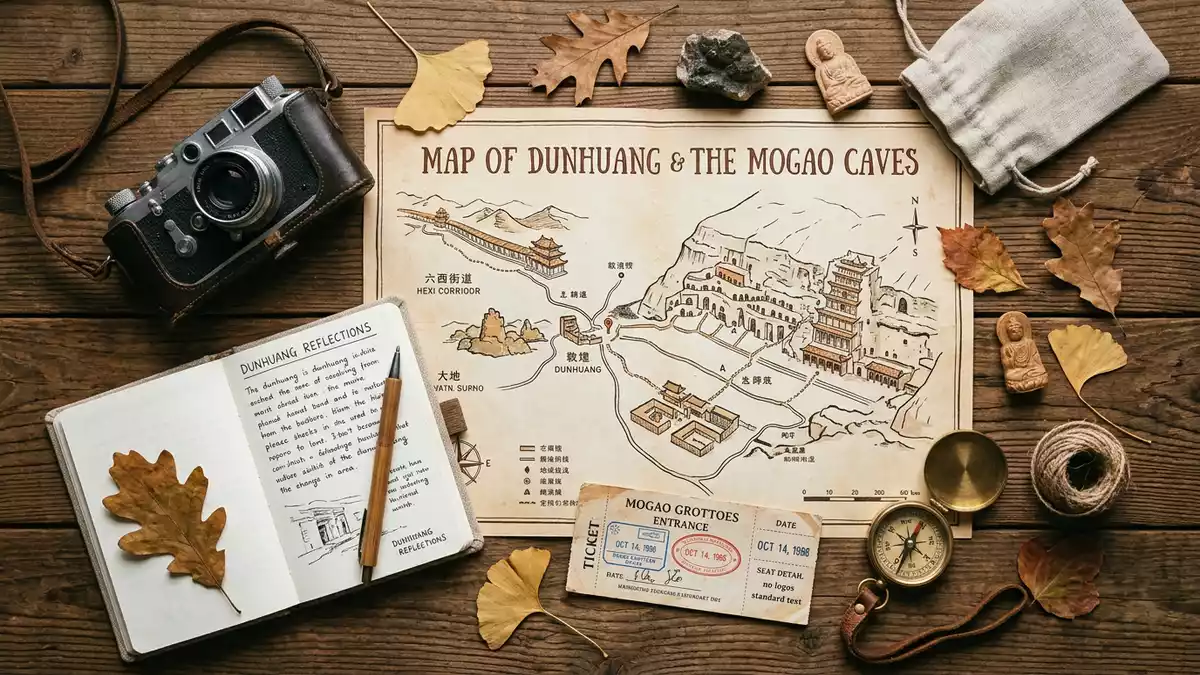
Mogao Ku, better known in English as the Mogao Caves or the Thousand Buddha Grottoes, lines a stretch of cliff south-east of Dunhuang in north-western China. Carved from the rock from 366 AD onwards, the caves preserve an unusually continuous record of Buddhist wall painting and sculpture between the fourth and fourteenth centuries.
Carved cliff, painted interiors
The cliff at Mogao Ku rises above the Dachuan River south-east of the Dunhuang oasis in Gansu province, with man-made openings set in rows one above another along more than 1,600 m (5,250 ft) of rock.The caves extend along the cliff The site lies about 25 km (16 mi) from the centre of Dunhuang, at the edge of the Gobi desert on a historic stretch of the Silk Road.The caves stand south-east of Dunhuang
Inside the rock, hundreds of excavated chambers form a honeycomb of sanctuaries, some little larger than a niche, others rising to the height of small halls. Many caves retain painted sculptures and wall paintings, built up in layers as patrons commissioned fresh decoration under different dynasties between the fourth and fourteenth centuries.Murals and sculptures span a thousand years
A millennium of Silk Road Buddhism
Mogao Ku was first cut in 366 AD, when Buddhist cave temples spread across north-western China under the Former Qin and later dynasties.The first cave dates to 366 The decorated chambers at Dunhuang trace the changing art and devotional practices of Buddhist communities from the Northern Wei and Northern Zhou through the Tang dynasty and into later periods of Chinese history.The caves cover successive dynasties
Wall paintings and sculpture at Mogao Ku record the artistic exchanges that ran along the Silk Road between China, Central Asia and India. The complex contains around 45,000 square metres of murals and more than 2,000 painted sculptures, created and reworked over centuries inside nearly 500 decorated cave-temples.Murals and sculptures fill the sanctuaries In 1987, the Mogao Caves were inscribed on the UNESCO World Heritage List as a cultural property, recognising the site as one of China’s most important repositories of Buddhist art.The caves joined the UNESCO list in 1987
Experiencing the cave complex
Mogao Ku combines religious architecture and landscape in a way that remains immediately legible on arrival. From the valley floor, visitors see stacked timber facades and covered walkways fixed to the cliff, giving access to the different cave levels along the rock face. Behind these structural additions the excavated interiors open into painted chambers, where sculptures and murals surround the viewer on all sides.
Many tours through the site focus on a selection of decorated caves, chosen to illustrate different periods and subjects, from early austerity to the dense narrative scenes of the Tang dynasty. The official signage and interpretation on site emphasise the span from the fourth to the fourteenth century and the role of the caves as a record of Silk Road art and devotion, rather than treating them as a single-period monument.
Visiting Mogao Ku: what travellers from Western Europe should know
- Mogao Ku stands south-east of Dunhuang in Gansu province, China, and is reached from the city by road, with local transport linking the oasis to the cave area.
- The cliff-side layout includes external stairways and elevated walkways, and visiting the caves involves climbing steps and moving along passages fixed against the rock face.
- The surrounding landscape lies at the edge of the Gobi desert near Mingsha Mountain, so the approach combines built paths with sandy terrain and an exposed, arid setting.
- The official language is Chinese and the currency is the renminbi.
- Entry requirements depend on your nationality; UK travellers can check the FCDO travel advice at gov.uk/foreign-travel-advice, Irish travellers the Department of Foreign Affairs at ireland.ie.
Searching for Mogao Ku on social platforms
These links open searches for Mogao Ku on each platform.
Frequently asked questions about Mogao Ku
Where is Mogao Ku?
Mogao Ku stands on cliffs above the Dachuan River south-east of Dunhuang in Gansu province, in north-western China.
What should visitors expect inside the caves?
Visitors enter a series of excavated chambers, where painted sculptures and murals line the walls and ceilings in caves of different sizes and heights.
What makes Mogao Ku distinctive among Buddhist sites?
Mogao Ku combines an extensive series of cliff-side cave temples with a near-continuous sequence of Buddhist art spanning about a thousand years.


