
Mogao Ku: a cliff of painted caves on the Silk Road
Published on 08/24/2026 at 06:57 | Editorial responsibility: Rafael Müller, Editor-in-Chief AD HOC NEWS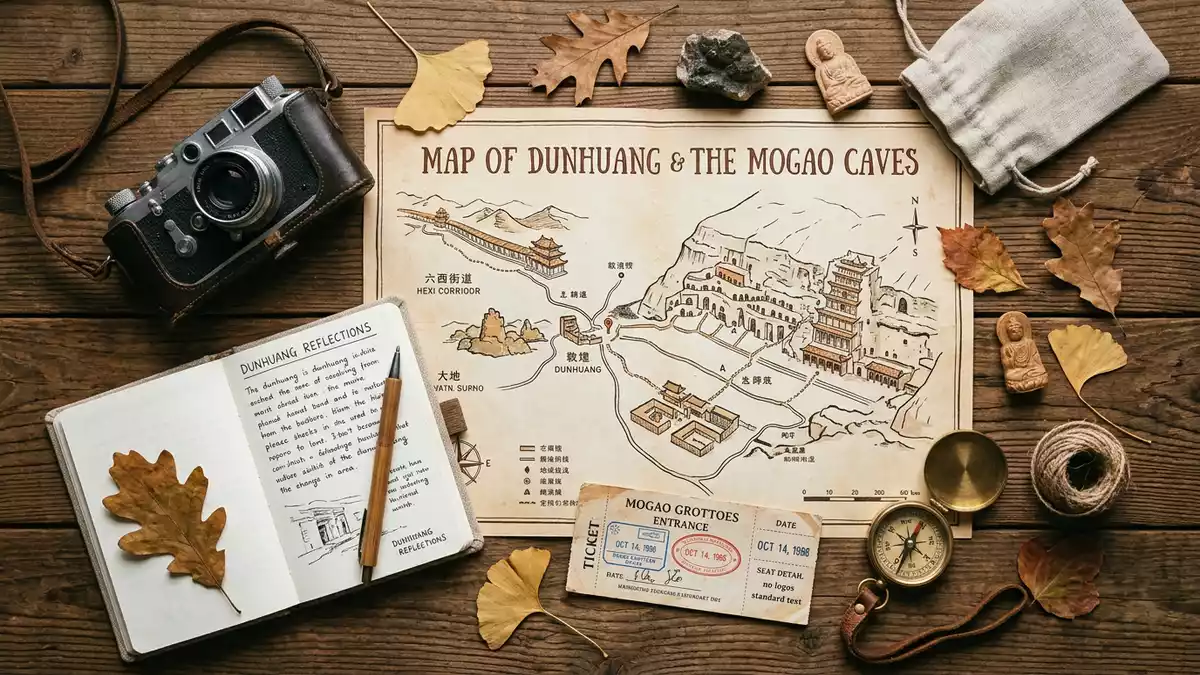
Mogao Ku near Dunhuang is a long line of Buddhist cave temples cut into a desert cliff, where painted walls and sculpted Buddhas trace a millennium of Silk Road history.
A desert cliff turned into a painted sanctuary
Mogao Ku, better known in English as the Mogao Caves or Caves of the Thousand Buddhas, forms a dense band of cave shrines carved into cliffs above the Dachuan River on the edge of the Dunhuang oasis in Gansu province, north-western China.carved into the cliffs above the Dachuan River The earliest caves are reported to have been begun in 366 AD, when Dunhuang stood at a crossroads of caravan routes linking China with Central Asia and beyond.first constructed in 366 AD Over centuries, new caves were cut and decorated, so that Mogao Ku became a stacked landscape of painted chambers, niches and corridors facing the desert.
The caves now extend for more than a kilometre along the cliff, with hundreds of individual spaces forming what is effectively a horizontal temple complex. The site lies around 25 km (16 mi) south-east of central Dunhuang, on the eastern side of Echoing-Sand Mountain, at the point where the oasis gives way to Gobi desert.25 km from downtown Dunhuang From the foot of the cliffs the main elevation is a rhythm of cave entrances, timber facades and walkways built against the rock, with a tall multi-storey structure marking one of the principal Buddha halls.
A millennium of Buddhist art in cave after cave
The enduring fascination of Mogao Ku lies in its concentration of Buddhist murals and sculpture, preserved across caves that were decorated from the fourth to the fourteenth century.from the 4th to the 14th century The cliff holds hundreds of caves, of which more than 490 are classed as cells and sanctuaries; together they contain tens of thousands of square metres of wall painting and thousands of painted figures of Buddhas, bodhisattvas and guardians.45,000 square metres of wall paintings Many chambers are small meditation cells with a single main image, while larger halls carry extensive narrative cycles.
Stylistically, the decoration at Mogao Ku reflects changing dynasties and artistic contacts along the Silk Road. Early caves include simple seated Buddhas in austere settings, while later Tang dynasty and subsequent works show richly robed figures, detailed architecture and processions painted in mineral pigments on plastered rock.dating from the Tang dynasty Ceiling paintings evoke tented canopies, lotus medallions and heavenly scenes, and some caves centre on monumental statues that rise several storeys within timber-fronted halls built against the cliff. Walking between caves, the contrast between the bare desert outside and the dense imagery inside each chamber is one of the defining experiences of Mogao Ku.
Silk Road crossroads and World Heritage status
The position of Mogao Ku beside the Dunhuang oasis was crucial: the site stands at a strategic junction where trade routes led west towards Central Asia and south towards the plateau, bringing merchants, monks and pilgrims through this corner of Gansu.situated at a strategic point along the Silk Route Over roughly a thousand years, successive patrons commissioned caves as places of worship, devotion and commemoration, leaving inscriptions, paintings and statues that document the meeting of Chinese, Central Asian and Indian Buddhist traditions along the Silk Road.treasure trove of Buddhist art
Mogao Ku was inscribed on the UNESCO World Heritage List in 1987 as a cultural property, recognising both the scale of its cave complex and the outstanding collection of Buddhist art it preserves.inscribed on the World Heritage List in 1987 Conservation work focuses on stabilising the cliff, protecting murals and managing visitor access to a selection of caves, while large areas remain closed to safeguard fragile paintings and sculptures. For travellers from Western Europe, Mogao Ku offers a direct encounter with the art and landscape of the historical Silk Road, framed by desert dunes, riverbed and the long, stepped facade of caves cut into rock.
Visiting Mogao Ku: what travellers from Western Europe should know
- Mogao Ku lies south-east of Dunhuang in Gansu province, with access from the town via roads that cross the desert towards the cliffs above the Dachuan River.
- The site consists of caves cut into a rock face, reached by walkways, staircases and platforms; visiting involves walking between cave entrances and climbing internal stairs.
- The surrounding terrain is desert with sand and exposed rock, and the main cave area sits beside the riverbed and near the slopes of Echoing-Sand Mountain.
- The official language is Chinese and the currency is the Chinese yuan.
- Entry requirements depend on your nationality; UK travellers can check the FCDO travel advice at gov.uk/foreign-travel-advice, Irish travellers the Department of Foreign Affairs at ireland.ie.
Searching for Mogao Ku on social platforms
These links open searches for Mogao Ku on each platform.
Frequently asked questions about Mogao Ku
Where is Mogao Ku located?
Mogao Ku is located on cliffs above the Dachuan River south-east of the Dunhuang oasis in Gansu province, north-western China.
What should visitors expect at Mogao Ku?
Visitors encounter a series of Buddhist cave temples cut into a desert cliff, with selected caves open to view murals, painted sculptures and timber-fronted halls.
What makes Mogao Ku distinctive among Silk Road sites?
Mogao Ku is distinctive for its long line of cave shrines, extensive Buddhist murals and sculptures dating from the fourth to the fourteenth century, recognised as World Heritage.


