
Moeraki Boulders, ancient spheres on the Otago coast
Published on 08/25/2026 at 18:17 | Editorial responsibility: Rafael Müller, Editor-in-Chief AD HOC NEWS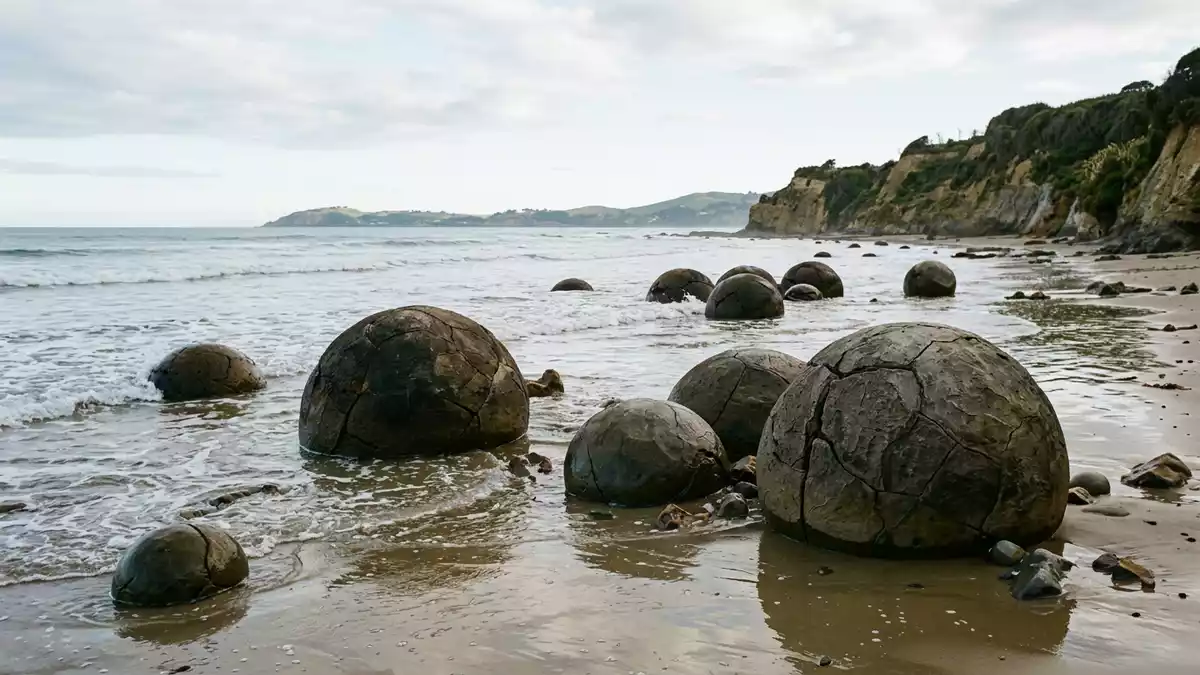
On a stretch of shoreline near Moeraki on New Zealand’s South Island, the Moeraki Boulders lie scattered across the sand like oversized marbles frozen mid-roll. These almost perfectly rounded stones, exposed along Koekohe Beach on the Otago coast, combine striking geometry with a deep geological timescale, making their clustered presence on the tide line one of the most distinctive coastal scenes in New Zealand.
Ancient concretions on Koekohe Beach
Moeraki Boulders occupy a short reach of Koekohe Beach between the settlements of Moeraki and Hampden on the eastern coast of Otago, where low cliffs of dark mudstone back the narrow strip of sand. The boulders sit at and below the foot of these cliffs, partly embedded in the beach as waves and wind steadily strip away the softer rock behind them.grey concretions eroded Because they are harder than the surrounding mudstone, they remain as the cliff line recedes, emerging over time as solitary spheres and clusters at various stages of exposure.
Geologically, these boulders are septarian concretions formed within marine mudstone belonging to the Paleocene Moeraki Formation, a unit of sedimentary rock laid down on an ancient seafloor tens of millions of years ago.Paleocene mudstone formation The mudstone beds dip gently and extend along the Otago shelf, but at Koekohe Beach the combination of coastal erosion and soft cliff material makes the concretions highly visible, concentrating them along one accessible shoreline.
How the spherical boulders formed
The story of Moeraki Boulders begins on the seabed around 60 million years ago, when fine marine mud and silt settled in layers, burying fragments of shell, plant material and other organic particles. Within this accumulating sediment, minerals such as calcite precipitated from pore waters, slowly cementing grains around each fragment and creating small nodules that grew outward as more mineral material crystallised.growth around organic nuclei Over millions of years these nodules developed into sizeable concretions with a harder outer zone and a more fractured interior.
As the inner material contracted and dehydrated, networks of cracks formed inside the concretions, later infilled by calcite crystals and other minerals carried by circulating groundwater. These mineral-filled veins give many Moeraki Boulders the characteristic patterning that appears once their surfaces weather or break open, revealing pale streaks and angular patches against darker stone.septarian veins of calcite Geological studies estimate that the larger boulders took several million years to reach their present size, growing while further tens of metres of marine mud accumulated above them before later uplift and erosion brought them to the surface.formation over four million years
Cultural stories and protected landscape
Alongside their scientific interest, Moeraki Boulders sit within M?ori tradition, where they are associated with the wreck of the Araiteuru canoe and described as calabashes and eel baskets washed ashore. The M?ori name Kaihinaki appears in official use at the site, reflecting its significance within local narratives that link coastal features to ancestral voyaging and settlement.Te Kaihinaki name These stories sit alongside geology, giving the boulders a dual identity as both natural formations and elements in a wider cultural landscape.
The shoreline around Koekohe Beach forms part of a coastal reserve, and Moeraki Boulders are promoted as a key feature within the Waitaki Whitestone Geopark, a UNESCO Global Geopark recognised for its distinctive limestone and mudstone landforms.geopark geological marvels Interpretive material at and near the beach explains their formation and age, while the combination of cliff, sand and scattered spheres makes the short walk along the coast an encounter with both deep geological time and continuing coastal change.
Visiting Moeraki Boulders: what travellers from Western Europe should know
- Moeraki Boulders lie on Koekohe Beach on the east coast of Otago, between the small settlements of Moeraki and Hampden on New Zealand’s South Island. The nearest larger centre is Oamaru, linked by coastal highways.
- The boulders sit directly on the beach at the base of soft mudstone cliffs, so reaching them involves walking on sand that can be firm or wet, with scattered stones and occasional shallow channels cut by small streams.
- The beach is at sea level and the approach from parking areas includes short paths with gentle gradients; the main physical considerations are uneven sand, exposed boulders and the need to be aware of the tideline.
- The official language is English and the currency is the New Zealand dollar.
Searching for Moeraki Boulders on social platforms
These links open searches for Moeraki Boulders on each platform.
Frequently asked questions about Moeraki Boulders
Where are Moeraki Boulders located?
They are on Koekohe Beach on the Otago coast of New Zealand’s South Island, between Moeraki and Hampden, backed by low cliffs of Paleocene mudstone.
What should visitors expect on a visit?
Visitors find clusters of large spherical concretions scattered along a sandy beach at the base of eroding cliffs, with boulders at different stages of exposure and occasional patterned surfaces.
What makes Moeraki Boulders distinctive?
The combination of near-spherical shapes, internal calcite vein patterns, their estimated formation over several million years and their setting on an accessible oceanfront makes this group of concretions distinctive.


