
Mitla’s stone mosaics in the valley of Oaxaca
Published on 09/03/2026 at 17:08 | Editorial responsibility: Rafael Müller, Editor-in-Chief AD HOC NEWS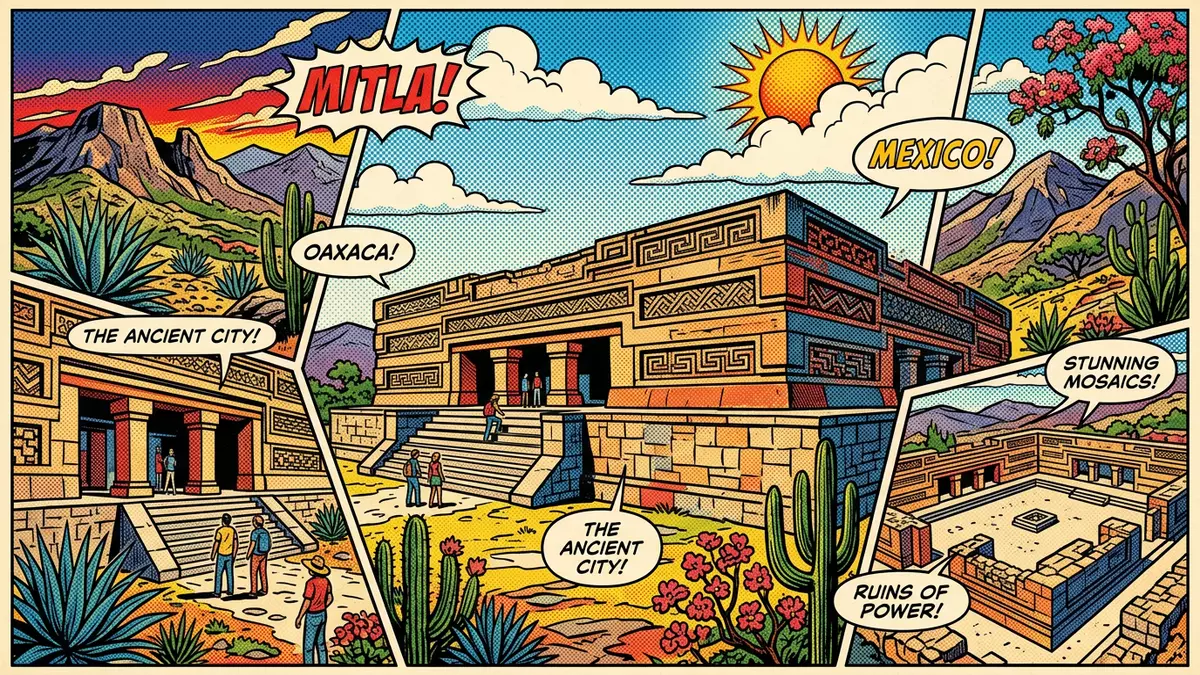
Mitla in southern Mexico is an ancient Zapotec and Mixtec ceremonial centre built into the fabric of the modern town of San Pablo Villa de Mitla. Set in the Tlacolula Valley of Oaxaca, it is known for palace walls covered in intricate geometric stone mosaics that read like carved textiles from a distance.Tlacolula Valley of Oaxaca
Mitla in the valley landscape of Oaxaca
Mitla lies in the eastern part of the Valley of Oaxaca in southern Mexico, surrounded by the mountains of the Sierra Madre del Sur. The archaeological zone stands at an elevation of about 1,480 m (4,855 ft), giving it a highland climate and clear views along the valley floor.eastern part of the Valley of Oaxaca
The ruins sit inside the municipal area of San Pablo Villa de Mitla, where streets, houses and churches come right up to the ancient platforms. The main groups of structures occupy low terraces above the modern town, with cacti and dry scrubland marking the transition to the surrounding hills.San Pablo Villa de Mitla
Zapotec origins and Mixtec splendour
Mitla was an important centre of the Zapotec civilisation in the Valley of Oaxaca, with occupation on the site extending back to the first millennium BC.important centre of the Zapotec civilisation The city gained prominence in the early Postclassic period, around the ninth century AD, after the decline of Monte Albán as the main Zapotec capital.gained prominence in the early Postclassic period
From roughly 900 to 1521, Mitla functioned as a major religious and political centre, with power in the valley shared between Zapotec and Mixtec elites.major religious and political centre The Zapotec name Lyobaá is translated as “place of rest”, while the later Nahuatl name, source of “Mitla”, derives from Mictlan, meaning “place of the dead”.Lyobaá is translated as “place of rest”
Palace groups and stone mosaics
The archaeological zone of Mitla is organised into five main groups of structures: the Columns Group, the Churches Group, the Arroyo Group, the Adobe Group and the Southern Group.five main groups of structures The best known are the Columns Group and the Churches Group, where extensive restoration work has brought courtyards, rooms and façades back into view.Columns Group and the Churches Group
Across these palace compounds, large walls are faced with thousands of carefully cut stone pieces set into complex geometric patterns without mortar.thousands of carefully cut stone pieces In the Columns Group, broad monolithic lintels span doorways and lead into roofed halls where masonry columns once supported heavy stone roofs, giving the complex both scale and a sense of enclosed ceremonial space.masonry columns once supported heavy stone roofs
Visiting Mitla: what travellers from Western Europe should know
- Mitla lies in the Tlacolula Valley east of Oaxaca City, reached by road along Federal Highway 190 through the town of San Pablo Villa de Mitla.
- The archaeological groups stand on low stone platforms above the town, with uneven ground, broad steps and some narrow passageways between palace walls.
- The surrounding landscape is semi-arid, with cacti and sparse trees, so exposed areas around the ruins offer little natural shade.
- The official language is Spanish and the currency is the Mexican peso. Entry requirements depend on your nationality; UK travellers can check the FCDO travel advice at gov.uk/foreign-travel-advice, Irish travellers the Department of Foreign Affairs at ireland.ie.
Searching for Mitla on social platforms
These links open searches for Mitla on each platform.Frequently asked questions about Mitla
Where is Mitla located?
Mitla is in the Tlacolula Valley of Oaxaca in southern Mexico, within the municipality of San Pablo Villa de Mitla, east of Oaxaca City.
What can visitors expect to see at Mitla?
Visitors encounter palace complexes with courtyards, stone columns and extensive geometric stone mosaics, set on low platforms above a living town.
What makes Mitla distinctive among sites in Oaxaca?
Mitla is distinctive for its combination of Zapotec and Mixtec ceremonial architecture and for palace walls faced with intricate, mortarless stone mosaics.


