
Mirski zamok: brick Gothic power on the Belarusian plain
Published on 09/04/2026 at 06:28 | Editorial responsibility: Rafael Müller, Editor-in-Chief AD HOC NEWS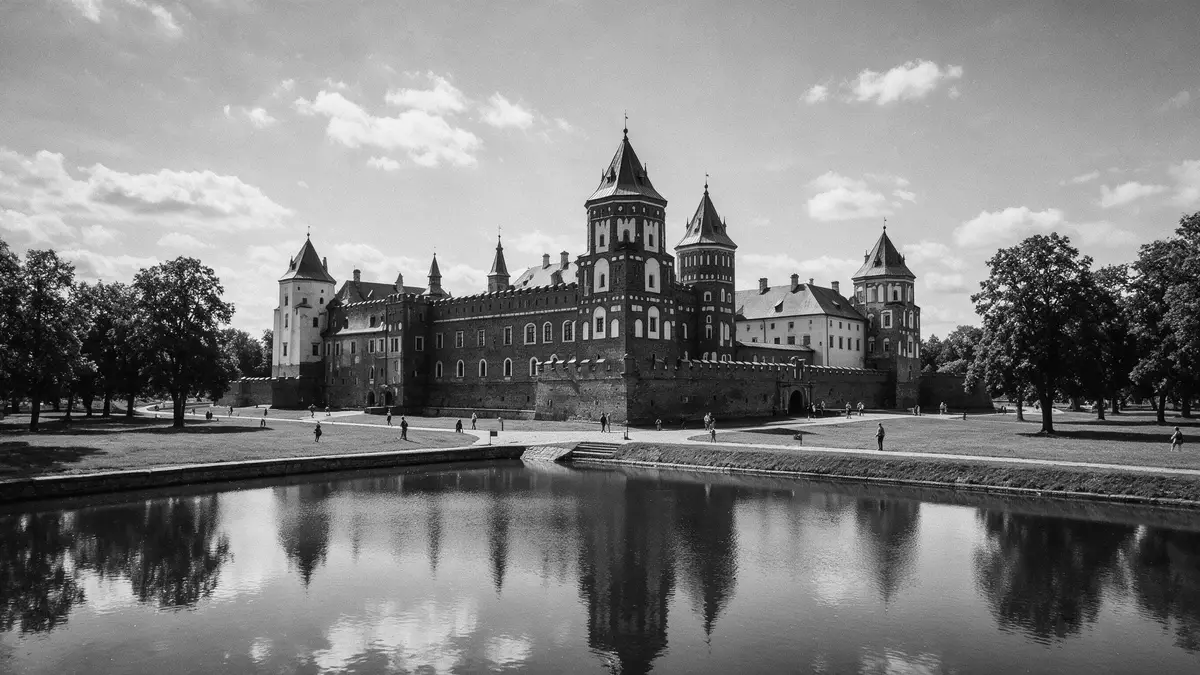
Mirski zamok, known in English as the Mir Castle Complex, rises above the small town of Mir in western Belarus as a compact fortress of brick, towers and walls framed by water and parkland. Erected in the 16th century and later reshaped, it combines Gothic, Renaissance and Baroque architecture in a single ensemble that has earned a place on the UNESCO World Heritage List.
Brick walls, corner towers and a lakeside setting
The castle stands in the Grodno Region of Belarus, in Mir in the Karelichy District, on the right bank of the river Miranka beside a man-made lake. Its fortified core forms a quadrangular layout, with defensive walls linked to prominent towers at the corners and a tower-gate on the side facing the town.Tower-gate from the 16th century The ensemble occupies about 27 ha (66.7 acres), including the castle itself, the surrounding embankments, parks and water.
From the outside, Mirski zamok is characterised by red brick masonry combined with decorative stonework that reflects late Brick Gothic forms. Construction began around the end of the fifteenth century and continued into the early sixteenth century under the Ilinich family, nobles of the former Polish–Lithuanian Commonwealth.Construction at the end of the fifteenth century Later, the Radziwi?? family took over the estate, and over subsequent centuries the castle’s outward appearance evolved as new residential wings and decorative details were added.
Layers of Gothic, Renaissance and Baroque
Mirski zamok illustrates a sequence of architectural styles, visible in its structure and ornament. The original fortification was built in a Gothic idiom, with massive walls and towers suited to defence. As tastes and uses changed, Renaissance elements appeared in the residential ranges and courtyard elevations, followed by Baroque additions that gave parts of the complex a more palatial character.Gothic, Baroque and Renaissance influences
The cultural value of this combination of styles has been formally recognised. In December 2000, Mirski zamok was inscribed on the UNESCO World Heritage List as a monument of international importance, underlining its role as one of the few surviving architectural ensembles linked to the history of the Polish–Lithuanian Commonwealth that lie within present-day Belarus.World Heritage inscription in 2000 The nomination documents emphasise both the integrity of the castle and the harmony between its buildings, earthworks, lake and parks.
From residence and fortress to cultural complex
Over the centuries, Mirski zamok served as an aristocratic residence and a defensive stronghold, and later experienced periods of damage and neglect, including serious impacts during the Napoleonic period in the early nineteenth century.Restoration after the nineteenth century Restoration campaigns towards the end of the nineteenth century and in the twentieth century gradually stabilised the structures, introduced new buildings within the complex and reshaped the surroundings as landscaped parkland.
In its present form, the Mir Castle complex brings together the historic castle, embankments from the seventeenth and eighteenth centuries, the lake laid out in the 1890s, parkland in both regular and landscape styles, and ancillary buildings such as the chapel-tomb of the Sviatopolk-Mirski family and a former manager’s house.Castle, parks and chapel-tomb The castle itself reaches an elevation of about 164 m (538 ft) above sea level, standing out clearly against the surrounding plain.Elevation above sea level
Visiting Mirski zamok: what travellers from Western Europe should know
- Mirski zamok stands in the town of Mir in the Grodno Region of Belarus. It lies in the Karelichy District, on the right bank of the river Miranka close to a small lake.
- The grounds combine embankments, parkland and the lakeside, so walking within the complex involves uneven surfaces and outdoor paths as well as interior staircases in the towers.
- Mir is reached by road from Minsk along the M1 motorway corridor towards Brest, with the castle located a short drive from the main route.
- The official language is Belarusian and the currency is the Belarusian rouble.
- Entry requirements depend on your nationality; UK travellers can check the FCDO travel advice at gov.uk/foreign-travel-advice, Irish travellers the Department of Foreign Affairs at ireland.ie.
Searching for Mirski zamok on social platforms
These links open searches for Mirski zamok on each platform.
Frequently asked questions about Mirski zamok
Where is Mirski zamok located?
Mirski zamok is in the town of Mir in the Karelichy District of the Grodno Region of Belarus, beside the river Miranka and a small lake.
What should visitors expect on a visit?
Visitors encounter a compact fortified castle with towers, courtyard, earthworks, lake and parks, together forming a historic ensemble with both interior museum spaces and open grounds.
What makes Mirski zamok distinctive?
Mirski zamok is distinctive for its blend of Gothic, Renaissance and Baroque architecture within one fortified complex and its recognition as a UNESCO World Heritage Site since 2000.


