
Mirski zamok and its brick Gothic layers in Mir
Published on 09/16/2026 at 09:49 | Editorial responsibility: Rafael Müller, Editor-in-Chief AD HOC NEWS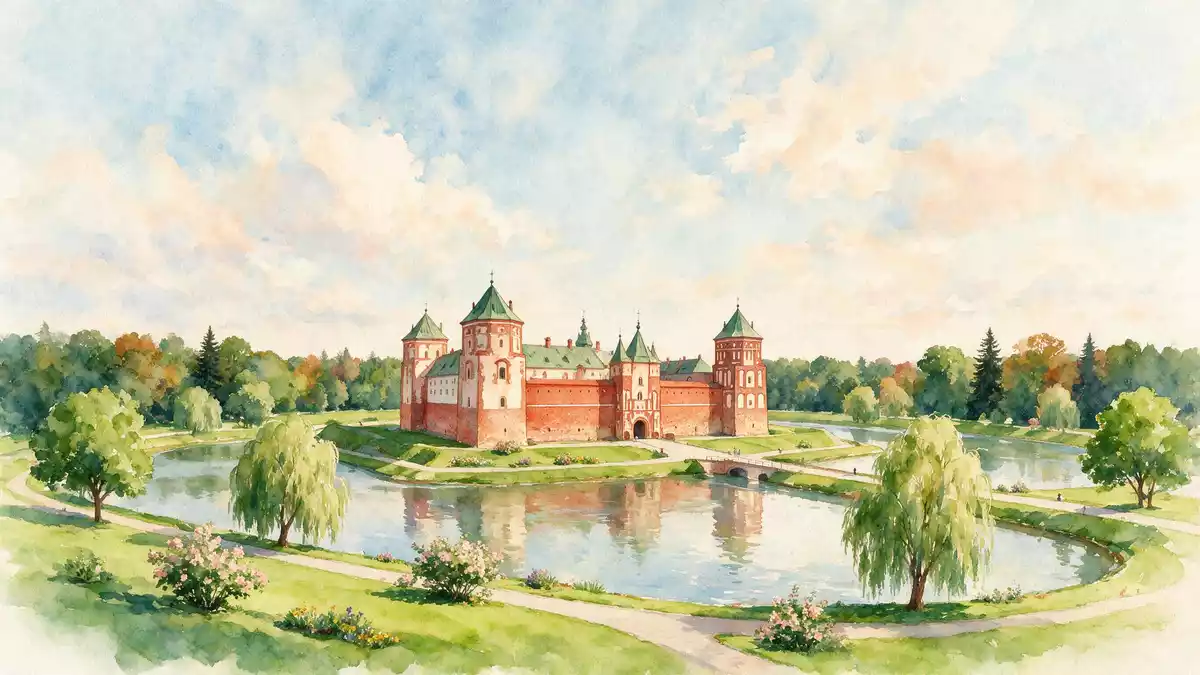
Mirski zamok in Mir is a brick castle complex whose walls, towers and later additions read like a sequence of architectural periods. Its core was begun by Yuri Ilyinich in the early sixteenth century, and the ensemble is listed as a UNESCO World Heritage Site.early sixteenth centuryUNESCO World Heritage Site
Brick Gothic beginnings in the Mir ensemble
The earliest castle belongs to the world of eastern Brick Gothic, with a fortified outline that sits alongside later Renaissance and Baroque layers. The name Yuri Ilyinich remains tied to the first phase, and the complex preserves that medieval foundation within a much broader historic composition.Yuri IlyinichBrick Gothic
The setting in Mir is part of the appeal: a castle in a small town, set among earthworks, parkland and a water landscape that belongs to the wider estate. The ensemble reads as a fortified residence rather than a single isolated tower, and that mixture gives the place its depth.fortified residenceparkland and a water landscape
From stronghold to layered residence
The castle later passed to the Radziwi?? family, one of the best-known magnate houses of the Polish–Lithuanian Commonwealth. Their period left a more elaborate residential character in parts of the complex, alongside the defensive shell that still dominates the exterior.Radziwi?? familyPolish–Lithuanian Commonwealth
The ensemble also carries signs of severe damage and later restoration in its story, which added further layers to the masonry and the plan. That history is visible in the meeting of older walls, repaired sections and later landscape work around the castle precinct.severe damagelater landscape work
Mir castle as heritage landscape
Mirski zamok belongs to a wider Belarusian cultural landscape in which fortification, residence and park design sit together. The UNESCO inscription recognises that combined character, not only the castle's age or its brickwork.Belarusian cultural landscapeUNESCO inscription
The result is a compact complex where castle, park and earthworks belong to the same historic scene. For travellers interested in architecture, the value lies in seeing how one site holds Gothic beginnings and later courtly refinement together.Gothic beginningslater courtly refinement
Visiting Mirski zamok: what travellers from Western Europe should know
- Mirski zamok stands in the town of Mir in the Grodno Region of Belarus. The castle complex lies on the right bank of the Miranka river.town of Mir
- The complex includes a castle, earthworks and park areas. Its setting combines masonry, water and planted ground rather than a single enclosed building.earthworks and park areas
- The site has several historic layers in one precinct, including the medieval core and later residential additions. That makes the plan easy to read as a sequence of phases.historic layers
- The official language is Belarusian and the currency is the Belarusian rouble.
Searching for Mirski zamok on social platforms
These links open searches for Mirski zamok on each platform.
Frequently asked questions about Mirski zamok
Where is Mirski zamok?
It stands in Mir, in the Grodno Region of Belarus, on the right bank of the Miranka river. The castle complex forms part of the town's historic landscape.
What does a visit involve?
The site presents a castle, earthworks and park areas within one complex. Visitors encounter brick walls, towers and later additions rather than a single isolated monument.
What makes Mirski zamok distinctive?
Its strength lies in the visible overlap of Gothic, Renaissance and Baroque phases. The association with Yuri Ilyinich and the Radziwi?? family gives the place a clear historical line.


