
Mirski zamok: a Belarusian castle of brick, water and layered history
Published on 08/20/2026 at 16:46 | Editorial responsibility: Rafael Müller, Editor-in-Chief AD HOC NEWS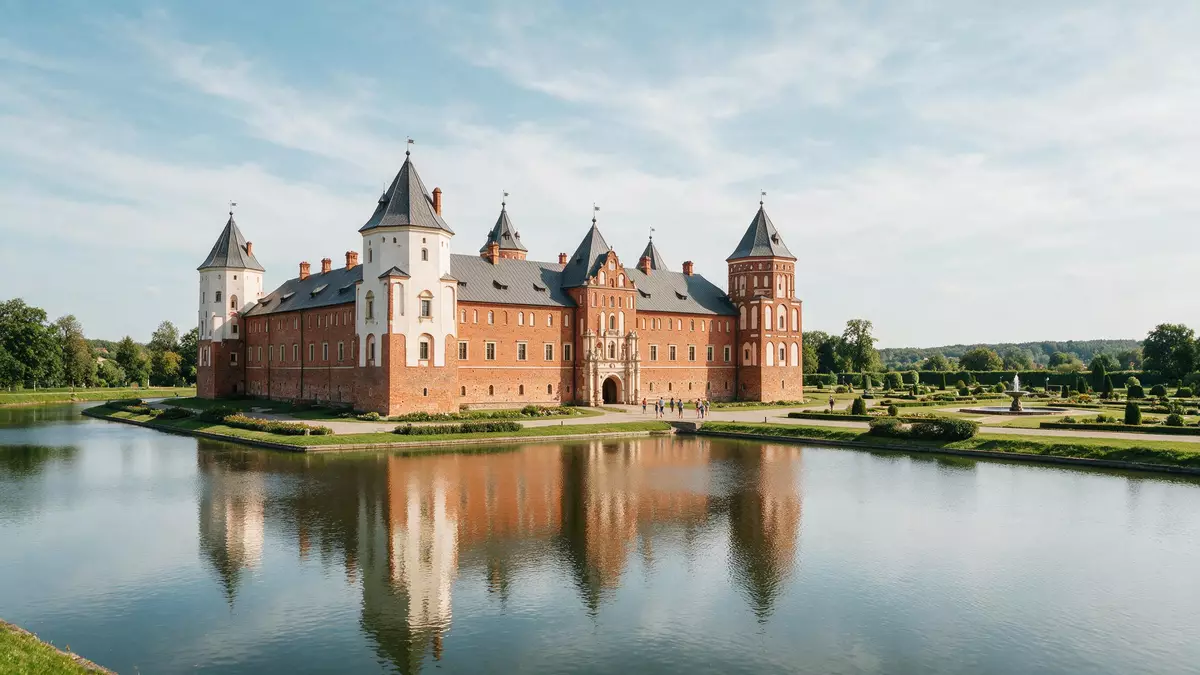
Mirski zamok in the town of Mir in Belarus is a brick-built castle complex where Gothic fortification, Renaissance residence and Baroque decoration share the same walls and moat. Rising above ponds and landscaped parkland in Grodno Region, the castle is one of Belarus’ best-known World Heritage sites, recognised by UNESCO in 2000 for the way several architectural periods are preserved in a single ensemble.
Brick towers on the edge of Mir
Mirski zamok stands on the right bank of the Miranka river in the urban settlement of Mir in Karelichy District, part of Grodno Region in western Belarus.Mir Castle in Grodno Region The castle complex occupies slightly raised ground near a small lake where the Miranka meets a tributary, giving the brick walls and towers clear views across the surrounding village and countryside.situated on the bank of a small lake Its elevation is recorded at around 164 m (538 ft) above sea level, modest in absolute terms but enough to lift its towers above the roofs of Mir.164 metres above sea level
The castle’s earliest stone construction dates to the turn of the sixteenth century, when the nobleman Juryj Ilinich began to replace a wooden residence with brick fortifications.built in the early sixteenth century The resulting ensemble includes corner towers, thick curtain walls and a prominent gate tower, all in red brick relieved by decorative patterns and white stone details.tower-gate preserved authentic The plan reads as a compact stronghold with a central courtyard, enclosed by walls and surrounded in places by earth ramparts and defensive works from later centuries.
From Gothic stronghold to parkland residence
The construction history of Mirski zamok stretches from the late fifteenth century into the twentieth, and its present appearance reflects several architectural phases.construction began at the end of the fifteenth century The earliest building phase at the end of the fifteenth and beginning of the sixteenth century used Gothic forms, with high walls, defensive towers and narrow embrasures suitable for a fortress.reflecting Gothic, Baroque and Renaissance Under the Radziwi?? family, who acquired the property in 1568, the castle was enlarged with Renaissance wings, more domestic interiors and features that made it a magnate residence as well as a stronghold.from Ilinich to Radziwi??
Later centuries added Baroque elements to façades and interiors, while landscaped parkland and a large pond were laid out beside the castle in the late nineteenth century.landscaping of the surrounding area as a park The broader Mir Castle complex now includes not only the sixteenth?century brick castle but also earthen ramparts, an English-style park, an Italian garden, a roadside chapel and the chapel-tomb of the Svyatopolk-Mirski princes with its own gate and watchman’s house.castle and park complex Mir These additions give visitors a sequence of spaces that moves from fortified architecture into landscaped grounds, with the water of the pond reflecting towers and walls.
A World Heritage castle in Belarusian history
Mirski zamok is inscribed on the UNESCO World Heritage List under number 625, recognised as an exceptional example of a central European castle where successive cultural influences are visible in a single site.Mir Castle Complex, UNESCO list 625 The nomination was accepted by the World Heritage Committee in 2000, placing the castle alongside Nesvizh Castle as one of Belarus’ best-known heritage properties.2000 inscription decision The site is listed as a monument of architecture spanning the sixteenth to the beginning of the twentieth century, combining Gothic, Renaissance and Baroque elements within one ensemble.monument of architecture XVI – early XX centuries
The castle’s ownership over the centuries mirrors wider Belarusian and Lithuanian history. Mir itself was first mentioned in written sources in 1395 and belonged to the Grand Duchy of Lithuania, passing from state property to private hands when Grand Duke Žygimont K?stutavi? granted it in 1434 to Sienka Gedygo?davi?.Mir in the Grand Duchy of Lithuania From 1490 to 1568 three generations of the Ilinich family held the estate and oversaw the building of the castle, after which it passed to the Radziwi?? princes, then in the nineteenth century to the families of Wittgenstein and Svyatopolk-Mirski.ownership from Ilinich to Svyatopolk-Mirski The turbulent periods of the Napoleonic wars and the nineteenth century left damage, but restoration campaigns towards the end of that century and into the twentieth brought the castle back into use and led to the present museum functions.
Visiting Mirski zamok: what travellers from Western Europe should know
- Mirski zamok stands in the town of Mir in Karelichy District of Grodno Region in western Belarus, reached by road connections that branch from the main Minsk–Brest M1 motorway.
- The castle complex includes earth ramparts, multi-storey towers and internal staircases, and visiting the fortifications and museum rooms involves climbing steps and moving between uneven historic surfaces.
- The grounds around the castle feature a large pond, lawns and park paths, and walking between the castle courtyard, the chapel-tomb and the gardens requires spending time outdoors on exposed, open terrain.
- The official language is Belarusian and Russian is also widely spoken, while the national currency is the Belarusian rouble.
- Entry requirements depend on your nationality; UK travellers can check the FCDO travel advice at gov.uk/foreign-travel-advice, Irish travellers the Department of Foreign Affairs at ireland.ie.
Searching for Mirski zamok on social platforms
These links open searches for Mirski zamok on each platform.
Frequently asked questions about Mirski zamok
Where is Mirski zamok located?
Mirski zamok is located in the town of Mir in Karelichy District, Grodno Region, in western Belarus, on the right bank of the Miranka river beside a large pond.
What can visitors expect when exploring the castle complex?
Visitors encounter brick towers, fortified walls and a central courtyard, along with museum rooms in the castle, landscaped park paths, the chapel-tomb of the Svyatopolk-Mirski princes and other historic structures.
What makes Mirski zamok distinctive among Belarusian castles?
Mirski zamok combines Gothic, Renaissance and Baroque architecture within one ensemble and pairs its brick fortress with nineteenth-century parkland, a combination recognised through its inscription on the UNESCO World Heritage List.


