
Minar-e Pakistan, Lahore’s concrete memory of a political turning point
Published on 09/04/2026 at 17:09 | Editorial responsibility: Rafael Müller, Editor-in-Chief AD HOC NEWS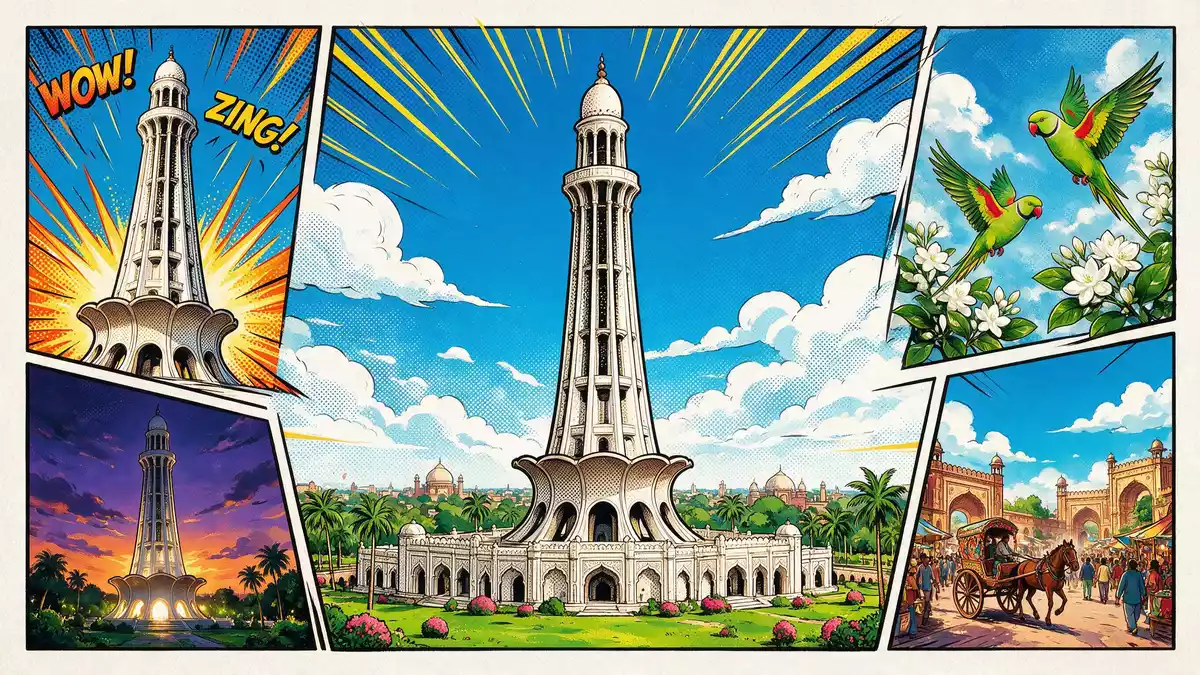
Minar-e Pakistan in Lahore is a tall concrete tower standing within Greater Iqbal Park, marking the ground where the Lahore Resolution was adopted in March 1940 and anchoring Pakistan’s political origin in built form. Completed in the 1960s and designed by architect Nasreddin Murat-Khan, it combines reinforced concrete and stone in a monument that has become closely associated with the country’s creation story.
A tower on the Lahore Resolution ground
The site of Minar-e Pakistan is the former Minto Park, now part of Greater Iqbal Park north of Lahore’s historic core, where the All-India Muslim League held its 34th annual session from 22 to 24 March 1940 and passed the Lahore Resolution calling for a separate Muslim homeland in South Asia.Lahore Resolution site The decision taken here eventually led to the creation of Pakistan in 1947, and the tower fixes that political moment to a specific patch of ground in Lahore.
The monument stands inside Greater Iqbal Park, an urban park bordered by Circular Road and set close to Lahore Fort and Badshahi Mosque, so large Mughal-era walls and domes are within sight of the concrete structure.Greater Iqbal Park location The tower rises from a plinth built on a raised platform, giving it a clear vertical presence over the surrounding lawns and water features of the park.
Design, materials and height
Minar-e Pakistan was designed by Nasreddin Murat-Khan, a Russian-born Pakistani architect whose work also included other major projects in Lahore.Nasreddin Murat-Khan The foundation stone of the monument was laid on 23 March 1960, and construction continued for about eight years until its completion in 1968, under his close supervision.1960 foundation and 1968 completion
The tower combines reinforced concrete with stone facing and ornamental detailing, described by Pakistani sources as blending Mughal influences with more modernist forms.reinforced concrete and Mughal-modern blend Its overall height is given by architectural references as around 60 m (about 197 ft), with other sources stating approximately 70 m (about 230 ft), so it stands well above the treeline and the park’s surrounding structures without reaching the height of the minarets of Badshahi Mosque.monument height figure A series of balconies and projecting elements articulate the shaft, and the base incorporates terraces and steps that visitors use to approach the structure.
A national monument in Lahore’s historic landscape
Minar-e Pakistan is described in Pakistani reference works as a national monument marking the Lahore Resolution and the idea of an independent Pakistan, giving it a symbolic status alongside institutions and texts that emerged from the same political movement.national monument description Its position in Greater Iqbal Park places it within a landscape that also holds Mughal-era monuments and colonial-era structures, so visitors can see the tower framed by Lahore Fort’s walls and Badshahi Mosque’s domes across the park’s open space.relationship to nearby landmarks
The tower has become a visual shorthand for the country’s founding resolution, appearing in media, educational material and commemorative contexts, and its silhouette is recognisable within Lahore’s skyline when viewed from nearby flyovers and river crossings. The monument’s layered base and surrounding paved areas are used for gatherings and public events, while the park’s lawns and water bodies give the wider setting a softer landscape around the vertical concrete form.
Visiting Minar-e Pakistan: what travellers from Western Europe should know
- Minar-e Pakistan stands within Greater Iqbal Park in central Lahore, north of the historic walled city, reached by road around the Circular Road area and close to Lahore Fort and Badshahi Mosque.
- The monument rises on a raised platform with steps; reaching the base involves walking across paved park surfaces and climbing stairways rather than using level paths alone.
- The wider setting is an urban park environment, with lawns, planted areas and water features around the tower, and structures such as causeways and viewing points within walking distance.
- The official language is Urdu and the currency is the Pakistani rupee.
- Entry requirements depend on your nationality; UK travellers can check the FCDO travel advice at gov.uk/foreign-travel-advice, Irish travellers the Department of Foreign Affairs at ireland.ie.
Searching for Minar-e Pakistan on social platforms
These links open searches for Minar-e Pakistan on each platform.
Frequently asked questions about Minar-e Pakistan
Where is Minar-e Pakistan located within Lahore?
Minar-e Pakistan stands inside Greater Iqbal Park in central Lahore, near Circular Road and within walking distance of Lahore Fort and Badshahi Mosque.
What should visitors expect when visiting Minar-e Pakistan?
Visitors encounter a tall concrete tower on a raised platform within an urban park, with steps, paved areas, lawns and water features forming the immediate surroundings.
What makes Minar-e Pakistan distinctive among Lahore’s landmarks?
Its distinctiveness lies in combining a mid-twentieth-century concrete tower with the exact site of the 1940 Lahore Resolution, set beside major Mughal monuments in Greater Iqbal Park.


