
Minar-e Pakistan and the shape of Lahore's memory
Published on 08/26/2026 at 15:04 | Editorial responsibility: Rafael Müller, Editor-in-Chief AD HOC NEWS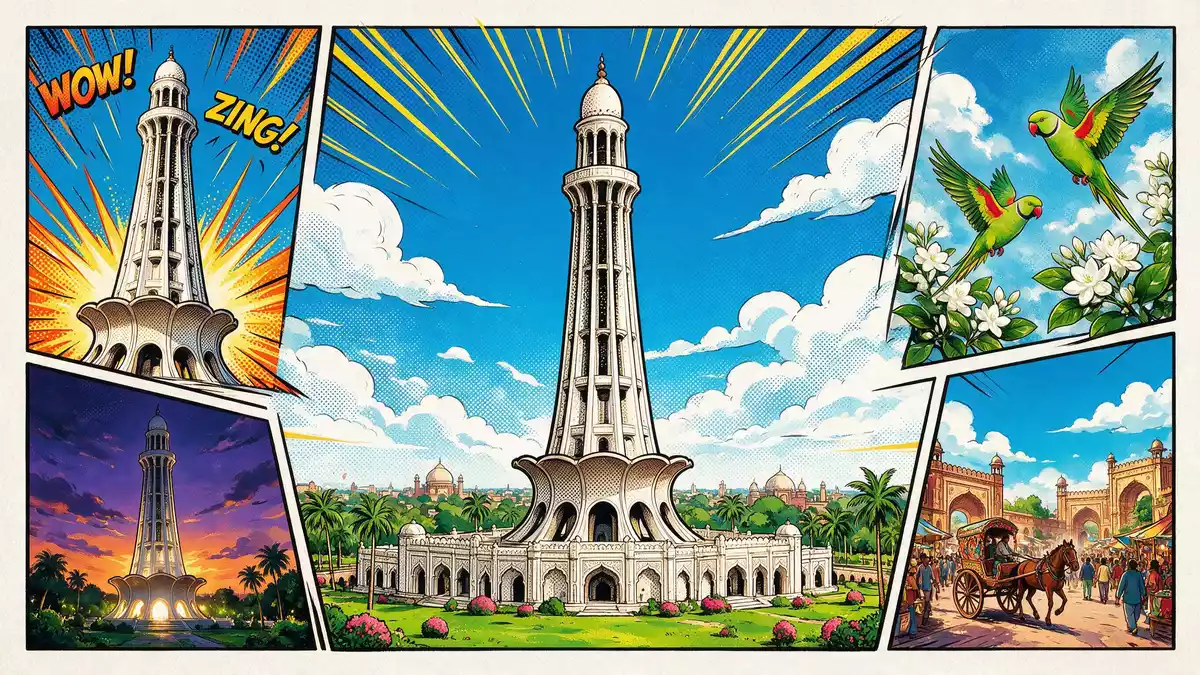
Minar-e Pakistan rises in Greater Iqbal Park in Lahore as a concrete landmark tied to the Lahore Resolution of 23 March 1940. Its form is simple at a glance, but the tower carries more than one historical layer. The monument in Lahore makes that connection visible.
Minar-e Pakistan and the memory of 1940
The tower marks the ground where the All-India Muslim League adopted the Lahore Resolution, a decisive statement in the political history of South Asia. Archnet’s site entry identifies the monument as a memorial to that moment.
Minar-e Pakistan took shape in the 1960s, and the foundation stone was laid on 23 March 1960. The completed monument belongs to the post-independence landscape of Lahore, yet it refers back to an event from 1940 rather than to a dynastic past.
Concrete, height and a layered profile
The tower is built of reinforced concrete and rises from a broad base into a slender shaft. Its overall profile is easy to read from a distance, and the material gives it a sober, modern presence against the park.
Descriptions of the monument usually place its height at about 62 m (203 ft) to 70 m (230 ft). Pakistanpaedia’s account and the Zameen history page both place it in that range.
The architect and the 1960s construction
The monument is linked to Nasreddin Murat-Khan, the architect named in standard accounts of the site. His name matters because the tower belongs to an identifiable design tradition rather than to an anonymous civic project.
The same accounts place completion in 1968, after an eight-year construction period. Minar-e Pakistan therefore belongs to the era when Pakistan was adding new national monuments to its major cities, using architecture to frame recent history in durable materials. Visit Lahore’s page and the AD HOC NEWS feature both place the monument in that historical frame.
Visiting Minar-e Pakistan: what travellers from Western Europe should know
- The monument stands in Greater Iqbal Park, south of Lahore’s older centre. It is reached by city roads, with Circular Road and Azadi Chowk used as nearby reference points.
- The tower rises from open parkland, and the approach is level rather than mountainous. The main practical feature is the scale of the monument itself.
- Badshahi Mosque and Lahore Fort lie close by, placing the tower within Lahore’s major historic district.
- The official language is Urdu and the currency is the Pakistani rupee.
- Entry requirements depend on your nationality; UK travellers can check the FCDO travel advice at gov.uk/foreign-travel-advice, Irish travellers the Department of Foreign Affairs at ireland.ie.
Searching for Minar-e Pakistan on social platforms
These links open searches for Minar-e Pakistan on each platform.
Frequently asked questions about Minar-e Pakistan
Where is Minar-e Pakistan?
It stands in Greater Iqbal Park in Lahore, close to Circular Road. The setting places it within the city’s historic core.
What does a visit involve?
The monument stands in open parkland, so the experience centres on walking around the tower and viewing it from different distances. The park setting also places nearby landmarks within the same urban landscape.
What makes Minar-e Pakistan distinctive?
Its importance comes from the link between the 1940 Lahore Resolution and the 1960s concrete monument. That combination of political memory, named architect and modern form gives it its character.


