
Mezquita-Catedral de Cordoba and its forest of arches
Published on 09/24/2026 at 04:02 | Editorial responsibility: Rafael Müller, Editor-in-Chief AD HOC NEWS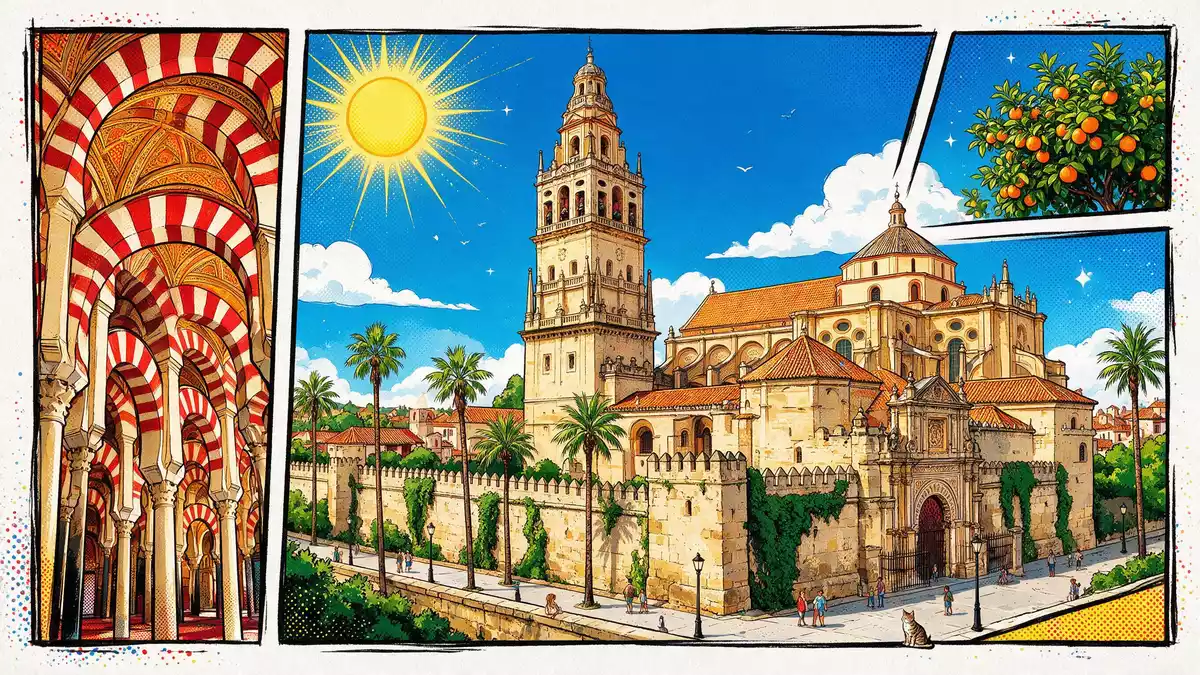
Mezquita-Catedral de Cordoba places an Umayyad prayer hall and a Christian cathedral within one architectural frame. Its repeated arches, coloured voussoirs, courtyards, chapels and cathedral crossing create a building read through layers rather than through a single style.
Mezquita-Catedral de Cordoba: an interior of repeated arches
The most recognisable space is the former mosque’s hypostyle prayer hall. Rows of columns support two levels of arches, producing a strong rhythm across the interior. The lower horseshoe arches and upper semicircular arches use alternating red and pale voussoirs.
The hall extends around the cathedral inserted into its centre. Marble, stone, brick, painted surfaces and carved details appear within the same building. The result is not a reconstruction of one period, but a visible sequence of Umayyad, Gothic, Renaissance and later Christian work.
From Abd al-Rahman I to a cathedral
Construction of the Great Mosque began under the Umayyad ruler Abd al-Rahman I in 784–786. Extensions followed during the ninth and tenth centuries under Abd al-Rahman II, Abd al-Rahman III, al-Hakam II and Almanzor, expanding the prayer hall and its associated spaces. the original mosque belongs to the early Umayyad phase.
Cordoba became a Christian city in 1236, when Ferdinand III took the city and the mosque was consecrated as a cathedral. The building retains chapels, altars, a choir, a transept and a bell tower, while the surrounding prayer hall preserves the earlier Islamic architectural language.
The mihrab, courtyard and cathedral crossing
The mihrab forms the visual focus of the mosque section. Its chamber is framed by a richly ornamented façade, with mosaics and inscriptions associated with the tenth-century enlargement under al-Hakam II. Beside it stands the maqsura, whose interlacing arches and decorated surfaces mark a ceremonial zone.
The Patio de los Naranjos lies beside the prayer hall and contains orange trees, paving, fountains and arcades. The bell tower rises from the former minaret’s location. Inside, the cathedral crossing interrupts the long field of columns with a taller vertical space, ribbed vaults and Renaissance forms.
The monument’s historical status is formal as well as architectural: Mezquita-Catedral de Cordoba entered the UNESCO World Heritage List in 1984. World Heritage status records the building’s place within Cordoba’s historic centre and its long religious use.
Visiting Mezquita-Catedral de Cordoba: what travellers from Western Europe should know
- Mezquita-Catedral de Cordoba stands in the historic centre of Cordoba, beside the Guadalquivir and close to the Roman Bridge. The old centre is explored on foot, with local buses serving the surrounding city.
- The interior combines extensive level floors with steps around chapels, the cathedral crossing and some elevated spaces. The Patio de los Naranjos provides an open courtyard beside the prayer hall.
- The official language is Spanish and the currency is the euro.
- Nearby landmarks include the Roman Bridge, the Torre de la Calahorra and the narrow streets of Cordoba’s historic quarter.
Searching for Mezquita-Catedral de Cordoba on social platforms
These links open searches for Mezquita-Catedral de Cordoba on each platform.Frequently asked questions about Mezquita-Catedral de Cordoba
Where is Mezquita-Catedral de Cordoba?
It stands in Cordoba, Andalusia, beside the Guadalquivir and near the Roman Bridge in the historic centre.
What can visitors expect inside?
The interior contains a former mosque prayer hall, repeated arches, a mihrab, chapels, a cathedral crossing, a choir and a bell tower.
What makes the building distinctive?
Its distinctive character comes from the direct coexistence of Umayyad mosque architecture and a Christian cathedral within one continuous monument.


