
Mezquita-Catedral de Cordoba and its forest of arches
Published on 09/15/2026 at 13:03 | Editorial responsibility: Rafael Müller, Editor-in-Chief AD HOC NEWS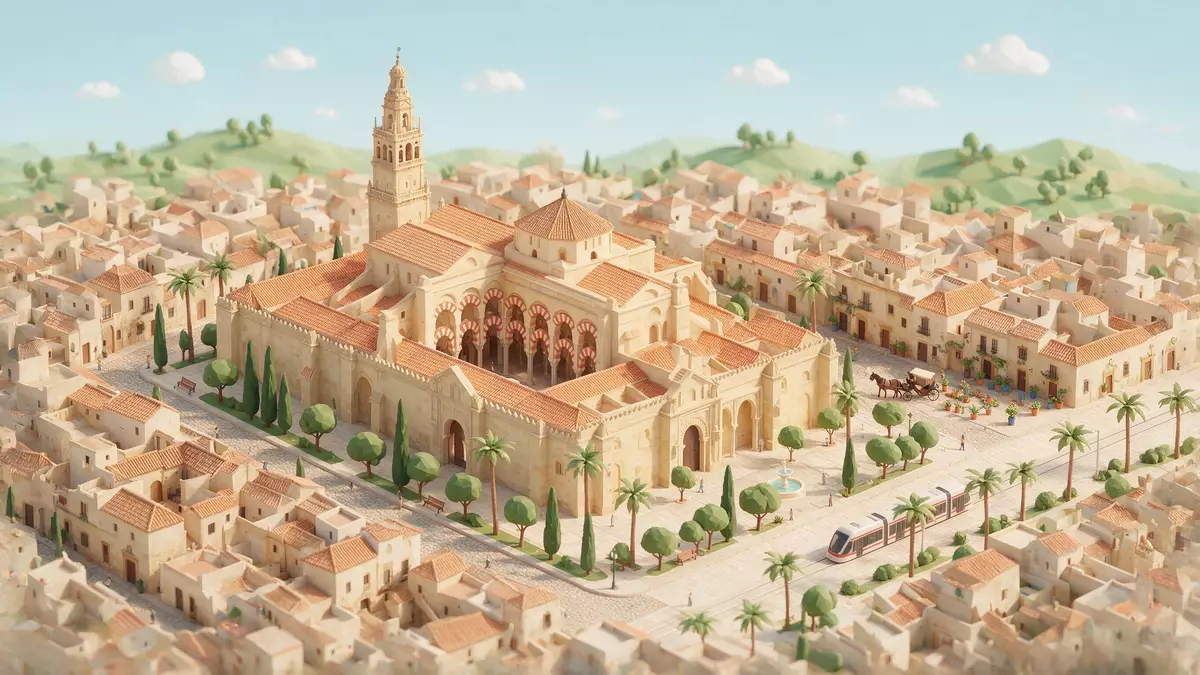
Mezquita-Catedral de Cordoba in southern Spain is a rare building where an early Islamic great mosque and a later Christian cathedral occupy the same stone envelope, creating a single vast interior defined by repeated arches and columns from different centuries of Cordoba’s history. The first mosque was begun in the late eighth century under the Umayyad ruler Abd al-Rahman I, and the building has carried both Islamic and Christian functions since the thirteenth century.
A hypostyle hall of repeating arches
The core of Mezquita-Catedral de Cordoba is a hypostyle prayer hall laid out in a grid of slender columns supporting low arcades that run towards the qibla wall. This hall began to rise in the 780s under Abd al-Rahman I, founder of the Islamic Emirate of Cordoba, when he ordered the construction of a congregational mosque for the growing Andalusi capital.built by Abd al-Rahman I The early structure already combined reused Roman and Visigothic elements with new Islamic forms, setting a pattern of layered materials that continued in later phases.Visigothic building elements
Further Umayyad rulers extended the hall during the ninth and tenth centuries, adding more bays and continuing the rhythm of arches so that the interior became a broad rectangle of repeated stone supports and vaults.extensions in the ninth and tenth centuries The result is a space where the light falls across alternating bands of stone and where the view through the arcades reaches deep into the building, giving a strong sense of scale even though each individual bay remains relatively low.
From mosque to cathedral within one envelope
The building’s function changed in 1236, when Ferdinand III of Castile captured Cordoba and consecrated the mosque as a Catholic cathedral dedicated to Santa Maria.consecrated as a cathedral in 1236 The Islamic hall itself remained standing, and Christian liturgical furnishings and chapels were introduced within and around it rather than replacing the whole structure. Since that year the monument has served as the seat of a Christian chapter while preserving much of its Moorish architectural character.serves as a Christian cathedral
In the sixteenth century a major intervention reshaped the centre of the hall when Charles V authorised the insertion of a cruciform nave and choir into the mosque’s interior, a project carried out from 1523 under the architect Hernán Ruiz I.construction of the cathedral nave in 1523 This tall Renaissance volume rises above the surrounding Islamic arcades, introducing Gothic and Renaissance vaults and a Baroque-inflected liturgical focus into the middle of the earlier hypostyle hall.central high altar and choir
Styles, status and setting in Cordoba
Architecturally, Mezquita-Catedral de Cordoba brings together Moorish forms with later Renaissance, Gothic and Baroque elements in a single complex.Moorish and Renaissance styles The mosque phase developed an Andalusi interpretation of Umayyad architecture, while the cathedral phase added a Latin-cross nave, side chapels and a belfry that replaced the old minaret, all of which can be read as distinct layers when walking through the monument.belfry in place of the minaret
The site stands within Cordoba’s historic centre, close to the Guadalquivir River, and forms part of the ensemble recognised as a World Heritage monument.monumental site of Cordoba Its courtyard of orange trees, arcaded galleries and tower are integral to the experience, marking the transition from the streets of the old city into the layered interior where successive centuries of Iberian religious architecture still stand in dialogue.
Visiting Mezquita-Catedral de Cordoba: what travellers from Western Europe should know
- Mezquita-Catedral de Cordoba stands in Cordoba’s historic centre on the northern bank of the Guadalquivir River and is reached on foot from the surrounding streets and bridges.
- Inside, the monument consists of a large courtyard, cloister-like galleries and an expansive prayer hall, so a visit involves walking across uneven historic paving and through long arcades.
- The bell tower rises above the former minaret at the edge of the courtyard, and visitors who climb it follow narrow passages and stairways enclosed within the tower structure.
- Cordoba lies in southern Spain; the official language is Spanish and the currency is the euro.
Searching for Mezquita-Catedral de Cordoba on social platforms
These links open searches for Mezquita-Catedral de Cordoba on each platform.Frequently asked questions about Mezquita-Catedral de Cordoba
Where is Mezquita-Catedral de Cordoba located?
Mezquita-Catedral de Cordoba stands in the historic centre of Cordoba in southern Spain, close to the Guadalquivir River and the city’s Roman bridge.
What can visitors expect inside the building?
Visitors walk through a courtyard of orange trees into a large hall of repeating arches and columns, with a taller Renaissance nave and Christian chapels rising within the earlier Islamic structure.
What makes Mezquita-Catedral de Cordoba distinctive among European monuments?
It combines an eighth-century Moorish mosque, extended in later Umayyad periods, with a sixteenth-century cathedral nave inserted into its centre, so Islamic and Christian architectures share one continuous interior.


