

Metzada, the desert plateau fortress above the Dead Sea
Published on 08/26/2026 at 07:04 | Editorial responsibility: Rafael Müller, Editor-in-Chief AD HOC NEWS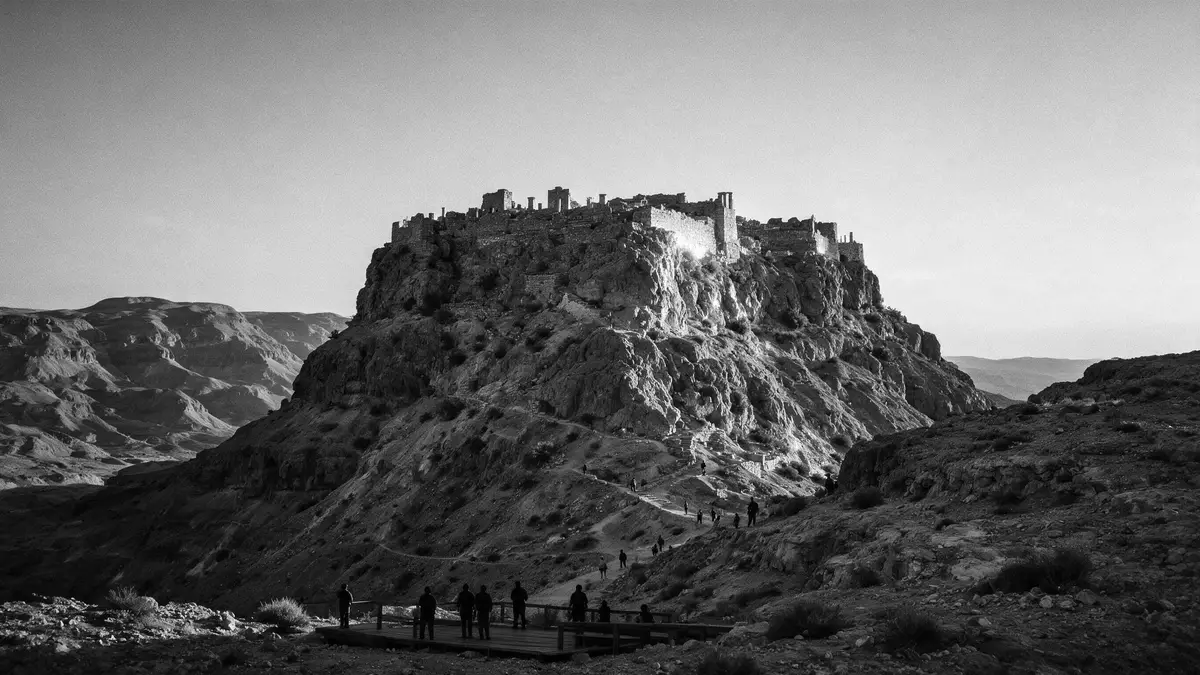
Metzada is an ancient fortress complex on a high desert plateau above the western shore of the Dead Sea in southeastern Israel, combining stark geology with dense layers of history. Rising hundreds of metres above the surrounding Judaean Desert, it forms a flat-topped stronghold whose ruins are closely linked with Herod the Great and the dramatic siege in the first century CE.
A mountain-top stronghold in the Judaean Desert
Metzada occupies an isolated rock plateau at the western edge of the Judaean Desert, overlooking the deep trough of the Dead Sea in southern Israel. The site lies in the Southern District, on cliffs composed of chalk, dolomite and marl strata that drop steeply to the desert plain and the salt lake below, giving the fortress commanding views across the arid landscape.cliffs composed of chalk, dolomite and marl
The plateau itself has a rhomboid, flat form measuring roughly 600 m by 300 m, ringed by fortification walls that follow the edge of the rock.rhomboid, flat plateau It rises over 400 m (1,300 ft) above the surrounding terrain and stands near the route between oases such as Ein Gedi and settlements further south, making its position both remote and strategically placed along desert tracks.over 400 m above the surrounding terrain
Herod the Great’s desert palace fortress
The rock of Metzada carried fortifications before Herod’s time, but the remains visible today largely date to the reign of Herod the Great, the Roman client king of Judea, who expanded the site in the late first century BC.Herod the Great expanded the site Between about 37 and 31 BCE he turned the plateau into a palace-fortress, adding lavish residential quarters alongside military and storage structures.between 37 and 31 BCE
On the western side of Metzada, Herod built a large palace complex and extensive storerooms, while on the northern edge he created a hanging palace arranged on three terraces cut into the rock slope, connected by stairways and supported by retaining walls.three terraces cut into the rock slope Across the plateau, casemate walls enclose the summit, forming a double line of fortifications whose internal spaces were divided into rooms for barracks or storage.casemate wall around the plateau Herod’s builders also cut large water cisterns into the sides of the plateau and laid out bathhouses with heated floors in the Roman style, giving the remote site architectural refinements more often associated with urban villas.bathhouses with heated floors and large cisterns
Siege, symbolism and UNESCO World Heritage status
Decades after Herod’s death in 4 BCE, Metzada became the stage for one of the final episodes of the First Jewish–Roman War. Jewish rebels seized the fortress around the time of Jerusalem’s fall in 70 CE and held out on the plateau for several years against Roman forces.site of the Jews’ last stand against the Romans In 73 CE, legions under the general Flavius Silva encircled Metzada, building an immense siege ramp on the western side to bring battering rams up to the fortification walls.legions led by Flavius Silva
Ancient accounts describe the defenders’ mass death when Roman soldiers finally breached the walls, a story that has made Metzada a powerful symbol in Jewish history and memory.powerful symbol of resistance The fortress was later used briefly by Byzantine monks, then lay largely abandoned for many centuries before systematic excavations uncovered Herod’s palaces, storerooms and fortifications. In 2001 Metzada was inscribed as a UNESCO World Heritage Site for its cultural significance and the combination of historic remains with dramatic desert setting.inscribed as a UNESCO World Heritage Site in 2001
Visiting Metzada: what travellers from Western Europe should know
- Metzada lies in southeastern Israel in the Southern District, overlooking the western shore of the Dead Sea and reached via desert roads such as Route 90 from towns including Arad and Ein Bokek.
- The fortress stands on a high plateau with steep cliffs and exposed desert slopes; access routes involve sustained uphill gradients either on foot or by mechanical lift, and movement on the summit covers uneven stone surfaces and ancient stairways.
- The surrounding terrain is arid and sun-exposed, with minimal natural shade away from built structures, so time spent on the plateau involves bright light, dry air and significant elevation above the Dead Sea basin.
- Hebrew and Arabic are official languages and the currency is the Israeli new shekel (ILS).
- Entry requirements depend on your nationality; UK travellers can check the FCDO travel advice at gov.uk/foreign-travel-advice, Irish travellers the Department of Foreign Affairs at ireland.ie.
Searching for Metzada on social platforms
These links open searches for Metzada on each platform.
Frequently asked questions about Metzada
Where is Metzada located?
Metzada is on an isolated rock plateau in Israel’s Southern District, overlooking the western shore of the Dead Sea in the Judaean Desert.
What can visitors expect on a visit to Metzada?
Visitors encounter extensive ruins of Herodian palaces, fortifications and water systems on a high desert plateau, reached via steep access routes above the Dead Sea basin.
What makes Metzada distinctive among historic sites?
Metzada combines Herod the Great’s palace fortress architecture on a dramatic desert cliff with its role in the first-century CE siege that ended the Jewish rebels’ last stand against Rome.


