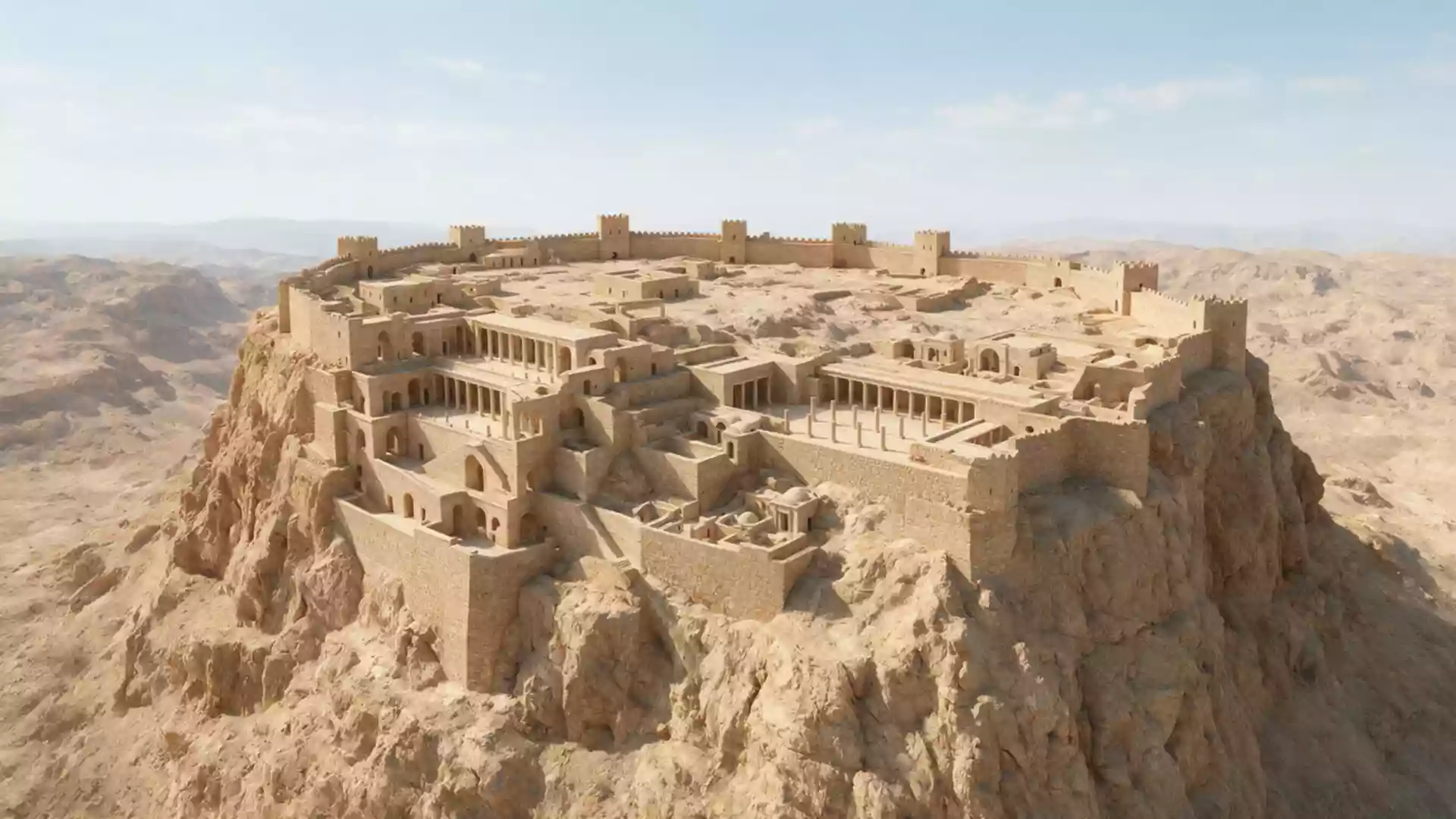
Metzada, the desert fortress plateau above the Dead Sea
Published on 09/09/2026 at 07:56 | Editorial responsibility: Rafael Müller, Editor-in-Chief AD HOC NEWS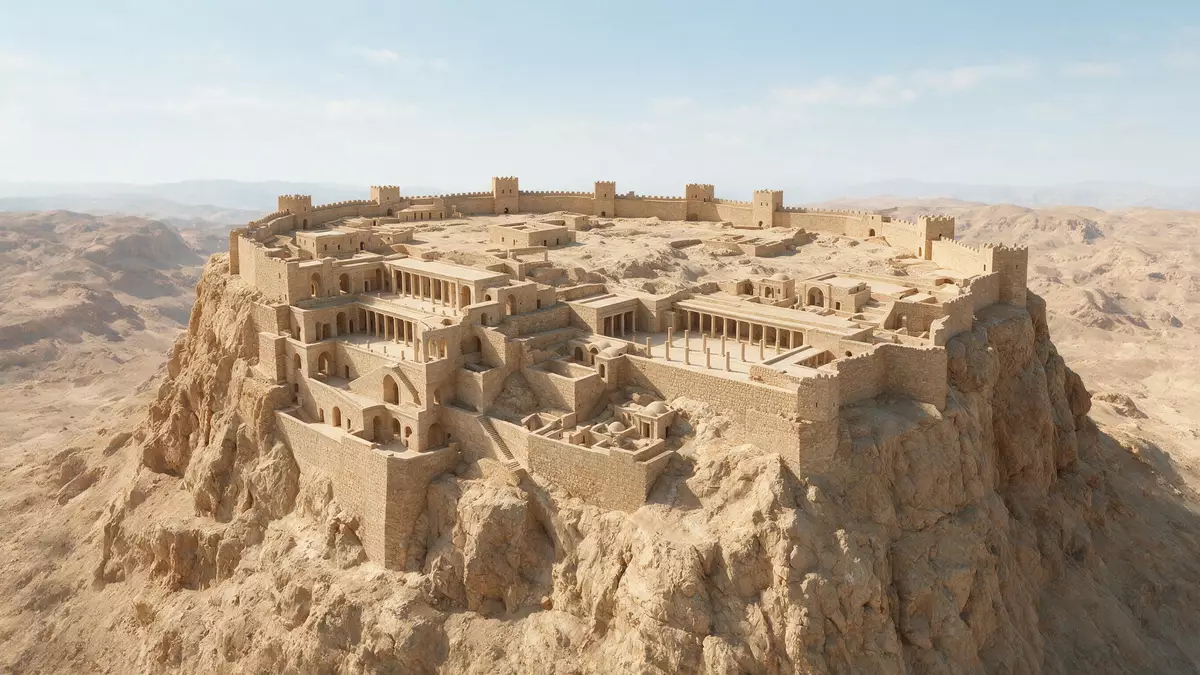
Metzada, known internationally as the mountain-top fortress of Masada, occupies a high desert plateau above the western shore of the Dead Sea in southeastern Israel. Built as a palace and stronghold in the late first century BC under Herod the Great, it later became the site of a dramatic siege during the First Jewish–Roman War in 73 AD.
A fortress on a desert mesa
Metzada crowns the summit of an isolated mesa in the southern Judaean Desert, its rocky sides falling steeply to the surrounding desert floor and towards the salt flats of the Dead Sea. The plateau rises more than 400 m (around 1,300 ft) above the terrain below, giving the fortress commanding views across the desert and towards the mountains that frame the Dead Sea basin.natural plateau rising over 400 m The top of the mesa forms a broad, relatively level surface where the ancient builders laid out palaces, storerooms, fortifications and service areas in stone.
The landscape around Metzada is defined by arid cliffs, deep wadis and the brilliant band of the Dead Sea to the east. From the plateau, the drop towards the Dead Sea is especially pronounced, as the water surface lies far below sea level while the mesa rises high above it.mesa near the southwest coast of the Dead Sea Metzada lies in the southern part of the Judaean Desert, in Israel’s Southern District, some distance southeast of Jerusalem and near other Dead Sea sites such as Ein Gedi.Southern District, Israel
Herod’s palace complex above the Dead Sea
In the late first century BC, Herod the Great, king of Judaea, ordered Metzada to be developed as a palace complex in classical Roman style. Over his reign from 37 to 4 BC, Herod transformed the isolated mesa into a fortified retreat, adding strong walls, towers, palatial residences and extensive water and storage facilities.palace complex by Herod the Great The northern end of the plateau carried a series of terrace palaces, arranged one below another on the cliff face, while the interior of the mesa’s summit held barracks, service courts and large cisterns cut into the rock.
The architectural style at Metzada reflects early Roman influences adapted to desert conditions. Stone-built casemate walls run around the edge of the plateau, creating a defensive ring with internal chambers that double as storage and living spaces.casemate wall around the plateau Inside, the remains of bathhouses, storerooms and reception halls show the level of comfort intended for Herod’s residence. The water system, centred on large rock-hewn cisterns and channels, allowed substantial reserves to be collected and stored on the plateau despite the arid surroundings.sophisticated water collection system
Siege, memory and World Heritage
Metzada entered history most decisively during the First Jewish–Roman War. In 66 AD, a group of Jewish rebels took control of the fortress, using its remote position and fortifications as a stronghold against Roman rule.rebels occupied the site in 66 AD After the fall of Jerusalem in 70 AD, Metzada became the last centre of organised resistance in Judaea. In 73 AD, Roman forces completed a siege of the mesa, building ramparts and siege works that can still be traced around the base of the plateau.Roman siege works preserved
The episode at Metzada, in which the defenders chose death over capture when the Romans breached the defences, has given the site a lasting place in Jewish cultural memory.last remnant of Jewish rule in Palestine The combination of a dramatic desert setting, extensive ruins of Herod’s palaces and fortifications, and visible Roman siege structures led to Metzada being inscribed as a cultural UNESCO World Heritage site in 2001.World Heritage inscription in 2001 The plateau and its surroundings cover an area of roughly 276 hectares, giving an idea of the scale of the protected landscape and archaeological remains.area of 276 hectares
Visiting Metzada: what travellers from Western Europe should know
- Metzada lies in the southern Judaean Desert of Israel, near the western shore of the Dead Sea and south-east of Jerusalem, and is reached by roads serving Dead Sea sites including Ein Gedi.
- The fortress stands on a high, steep-sided plateau; approaches from the desert floor involve sustained uphill walking on exposed paths, while movement on the summit includes stretches across uneven stone surfaces and steps among the ruins.
- The surrounding region is arid desert at low elevation relative to sea level, with strong sun exposure around the Dead Sea basin; shade among the structures on the plateau is limited and the ground underfoot is predominantly rock and compacted soil.
- The official language is Hebrew and the currency is the Israeli shekel.
- Entry requirements depend on your nationality; UK travellers can check the FCDO travel advice at gov.uk/foreign-travel-advice, Irish travellers the Department of Foreign Affairs at ireland.ie.
Searching for Metzada on social platforms
These links open searches for Metzada on each platform.
Frequently asked questions about Metzada
Where is Metzada and what kind of place is it?
Metzada is a mountain-top fortress on an isolated desert mesa in the southern Judaean Desert of Israel, overlooking the western shore of the Dead Sea.
What should visitors expect on a visit to Metzada?
Visitors encounter extensive stone ruins of Herod’s palaces and fortifications on a high, exposed plateau, with wide views over the Dead Sea and surrounding desert.
What makes Metzada distinctive among historic sites in Israel?
Metzada combines a dramatic desert setting, a substantial palace-fortress built by Herod the Great in the first century BC and well-preserved Roman siege works from the events of 73 AD.