
Metzada, the desert fortress above the Dead Sea
Published on 09/12/2026 at 16:38 | Editorial responsibility: Rafael Müller, Editor-in-Chief AD HOC NEWS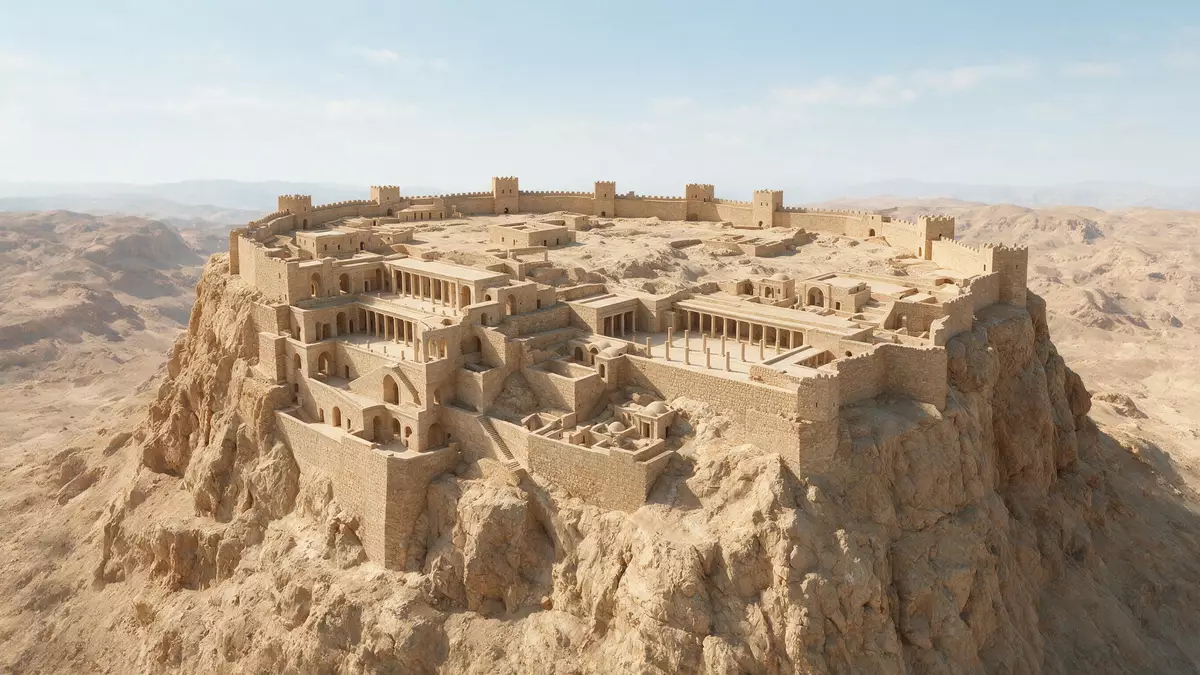
Metzada, known internationally as Masada, is an ancient fortress complex crowning an isolated plateau in the Judaean Desert in southeastern Israel, overlooking the western shore of the Dead Sea. Built as a royal stronghold in the late first century BC under Herod the Great, its ruins and surrounding siege works have turned this desert mesa into one of Israel’s clearest encounters between dramatic geology and layered history.
A rock plateau turned fortress
Metzada occupies the entire top of a flat-topped mesa that rises high above the surrounding desert and the level of the Dead Sea at its foot. The mountain stands around 434 m (1,424 ft) above the Dead Sea, giving the summit broad views across the water and the Judean hills beyond.The mesa’s elevation above the Dead Sea is one of the fixed anchors of the site’s character. The summit covers an area of about 18 acres (7 hectares), large enough to hold palaces, storerooms, barracks and water systems on a single defended rock.The summit area makes it clear that this was planned as more than a single tower or outpost.
The cliff itself rises above chalk, dolomite and marl strata exposed on its sides, giving the plateau steep, pale faces that drop to the desert floor and to the shore of the Dead Sea.Descriptions of the cliffs’ rock layers underline how much the fortress is tied to its geology. From the summit, the ground falls away sharply on all sides, leaving a narrow, winding ascent from the east and a broad natural drop towards the Dead Sea basin.
Herod’s palace complex in the early Roman period
In the last century BC, Herod the Great, king of Judaea from 37 to 4 BC, transformed Metzada into a palace fortress combining lavish residential quarters with extensive defensive works and provisions.Herod’s role as builder of a palace complex is a central fact of the site. He arranged the complex in the classical style of the early Roman Empire, with palatial residences, bathhouses and administrative buildings laid out across the plateau. On the northern side, a multi-level palace cascades down the slope in a sequence of terraces set into the rock, a rare combination of Roman architecture and cliff-edge construction.
Around the edge of the summit, a casemate wall encloses Metzada, forming a continuous defensive line punctuated by towers and gateways.The casemate wall and associated structures frame the plateau as a single fortified platform rather than separate buildings. Within this enclosure, Herod’s builders laid out storerooms and an armory, together with a system of large cisterns cut into the rock and fed by channels that captured scarce desert rainfall. The scale of these water installations, and their position below the summit but within the defensive perimeter, show how Metzada was equipped to sustain a substantial garrison and court in an otherwise arid landscape.
Siege works and the story of resistance
Metzada’s later history in the first century AD is inseparable from the massive Roman siege works that remain visible around the base of the plateau. During the Great Revolt against Rome, beginning in 66 AD, Jewish rebels held the fortress after Jerusalem had fallen, turning Herod’s palace complex into a last stronghold.The role of the fortress during the revolt anchors its place in regional history. Roman forces encircled the mountain with camps and built a broad earthen ramp on the western side, driving it up against the cliff to bring siege machinery to the level of the walls.Accounts of the Roman ramp and siege explain why these earthworks are treated as part of the site itself.
The revolt ended in 73 AD, when Roman troops breached the defences and entered the plateau after the prolonged siege.The date of the fortress’s fall appears across historical summaries of Metzada. In later centuries, reports by the Romano-Jewish historian Josephus about mass suicide among the defenders gave the site a particular place in Jewish memory, tying the physical ruins and siege works to a narrative of resistance and loss. When Metzada was inscribed as a UNESCO World Heritage site in 2001, the listing noted both its architectural value as Herod’s palace complex and the completeness of the Roman siege works preserved around the plateau.The UNESCO inscription and its reasoning mark this combination of fortress and siege landscape as a cultural property of international significance.
Visiting Metzada: what travellers from Western Europe should know
- Metzada lies in the Southern District of Israel in the Judaean Desert, near the south-western shore of the Dead Sea and south of Ein Gedi, reached by desert roads from Jerusalem or other Israeli cities.
- The summit stands several hundred metres above the Dead Sea basin, and access on foot involves sustained ascent on exposed desert paths or stairways, with steep gradients and extended sections without shade.
- The official language is Hebrew and the currency is the Israeli shekel.
- Entry requirements depend on your nationality; UK travellers can check the FCDO travel advice at gov.uk/foreign-travel-advice, Irish travellers the Department of Foreign Affairs at ireland.ie.
Searching for Metzada on social platforms
These links open searches for Metzada on each platform.Frequently asked questions about Metzada
Where is Metzada and what kind of place is it?
Metzada is an ancient fortress complex on a high rock plateau in the Judaean Desert in southeastern Israel, overlooking the western shore of the Dead Sea.
What should visitors expect on a visit to Metzada?
A visit brings extensive ruins of Herod’s palace fortress, massive Roman siege works and broad desert views from the summit, reached either by steep paths or mechanical ascent.
What makes Metzada distinctive among desert sites?
Metzada combines a large early Roman palace complex, a fortified summit and intact Roman siege camps and ramp, all concentrated on and around a single isolated mesa.


