
Metzada and the fortress above the Dead Sea
Published on 09/08/2026 at 15:52 | Editorial responsibility: Rafael Müller, Editor-in-Chief AD HOC NEWS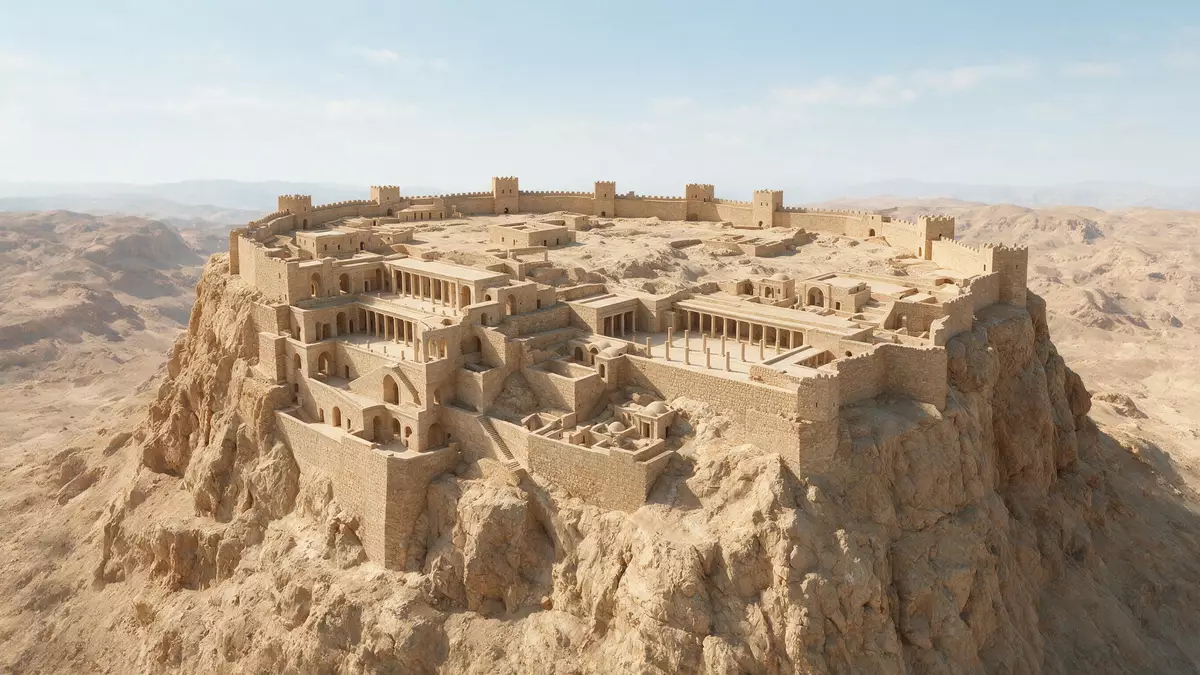
Metzada is the ancient mountain-top fortress known in English as Masada, rising above the Judaean Desert and the western shore of the Dead Sea in southeastern Israel. Set on an isolated plateau, it combines harsh desert rock with the remains of palaces built by Herod the Great in the first century BC, and the siege works left by the Roman army after the Jewish revolt in the first century AD.
A fortress carved into a desert plateau
Metzada occupies the summit of a mesa whose flat top forms a natural stronghold ringed by steep cliffs that drop to the desert floor and towards the Dead Sea. The rhomboid-shaped mountain reaches about 434 m (1,424 ft) above the level of the Dead Sea, giving clear views across the water and the surrounding Judaean Desert, and its summit covers roughly 7 ha (18 acres), large enough to hold an entire fortified settlement.Summit height and area The cliffs and plateau are formed from layers of chalk, dolomite and marl, creating pale, stratified rock faces that stand out against the blue of the Dead Sea and the darker desert hills beyond.Chalk, dolomite and marl strata
The fortress lies in the Southern District of Israel, between the desert oasis of Ein Gedi and the salt formations around Sodom, close to the southwest coast of the Dead Sea. From the plateau the view stretches across the water to Jordan and back along the line of desert wadis that cut through the Judaean hills, underlining how remote the site is from major towns.Location above the Dead Sea The combination of isolation, elevation and sheer rock made Metzada a natural refuge in antiquity, long before fortifications were added.
Herod’s palaces and Roman siege works
In the late first century BC, Herod the Great, king of Judaea under Roman patronage, transformed the plateau into a palace complex built in the classical style of the early Roman Empire.Herod’s palace complex The remains include palace foundations, bathhouses and storerooms laid out across the summit, together with substantial fortification walls that followed the edges of the mesa. Archaeologists have identified features such as terraced palaces on the northern side and extensive water systems that collected and stored scarce desert rainfall in large cisterns cut into the rock.Palaces and cisterns
After Judaea became a province of the Roman Empire, Metzada took on a new role during the Jewish revolt in the first century AD, serving as the stronghold of rebel groups resisting Roman rule.Role in the Jewish Revolt The Roman army encircled the mountain with camps, fortifications and an attack ramp, and these siege works survive around the base of the plateau as some of the most complete Roman military remains of their kind. The line of Roman camps and the broad earthen ramp on the western side can still be traced from above, forming a stark visual counterpoint to the ruined walls and buildings on the summit.Roman camps and ramp
Metzada as World Heritage and desert destination
Metzada is inscribed on the UNESCO World Heritage List as a cultural site, recognised for its combination of palace architecture, desert landscape and nearly intact Roman siege works.UNESCO listing and criteria The inscription in 2001 emphasised its value as testimony to the ancient kingdom of Israel and to events during the first century AD when the fortress became the last major holdout of Jewish resistance to Roman forces. The plateau’s height, the surrounding desert and the view over the Dead Sea give the site a striking setting that reinforces its role in modern cultural memory.
For visitors, Metzada combines archaeological remains with an austere natural environment in the Judaean Desert. The summit paths run among stone foundations, remnants of walls and cistern openings, while the edges of the plateau fall away towards dry wadis and salt-encrusted shores. From the northern palaces the Dead Sea lies below in shades of pale blue and turquoise, framed by the cliffs and the barren expanse of desert rock. The site’s mixture of palace ruins, fortifications and encircling Roman camps makes it a place where the human-made structures and the surrounding landscape are closely intertwined.
Visiting Metzada: what travellers from Western Europe should know
- Metzada stands in the Judaean Desert in the Southern District of Israel, on a plateau near the southwest coast of the Dead Sea, between Ein Gedi and Sodom. It is reached by roads that cross the desert from cities such as Jerusalem and Tel Aviv, with car access and public transport links to the visitor facilities at the foot of the mountain.
- The approach to the summit involves a substantial ascent from the desert floor to the plateau. Paths such as the eastern Snake Path and the western ramp climb through exposed desert terrain with long stretches of steps and gravel underfoot before reaching the ruins on top.
- The climate around Metzada is arid, with strong sun and high temperatures during the hotter months. The combination of elevation and exposed rock faces means limited shade on the plateau and along most of the ascent routes.
- The official language is Hebrew and the currency is the Israeli new shekel.
- Entry requirements depend on your nationality; UK travellers can check the FCDO travel advice at gov.uk/foreign-travel-advice, Irish travellers the Department of Foreign Affairs at ireland.ie.
Searching for Metzada on social platforms
These links open searches for Metzada on each platform.
Frequently asked questions about Metzada
Where is Metzada located?
Metzada is in the Judaean Desert of southeastern Israel, on an isolated mesa near the southwest coast of the Dead Sea, between Ein Gedi and Sodom.
What should visitors expect on a visit to Metzada?
Visitors encounter an elevated desert plateau with extensive archaeological remains, including palace foundations, fortification walls, cisterns and surrounding Roman siege works, reached by steep paths or a cable car.
What makes Metzada distinctive among historic sites?
Metzada combines Herod’s early Roman-style palace complex, the dramatic cliff-top setting above the Dead Sea and one of the most complete sets of surviving Roman siege works encircling a single fortress.


