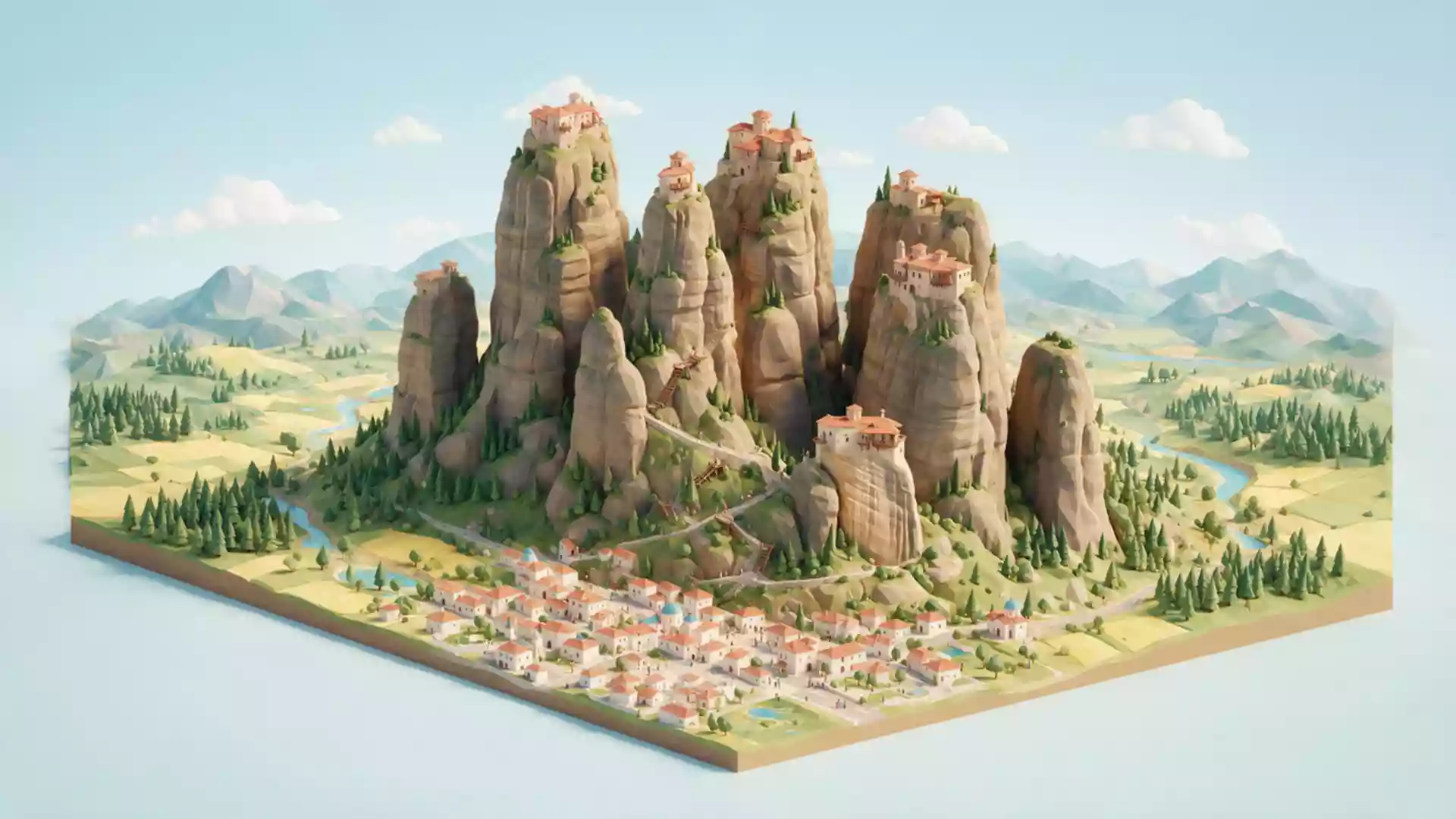
Meteora’s stone pillars and sky?high monasteries
Published on 09/08/2026 at 19:36 | Editorial responsibility: Rafael Müller, Editor-in-Chief AD HOC NEWS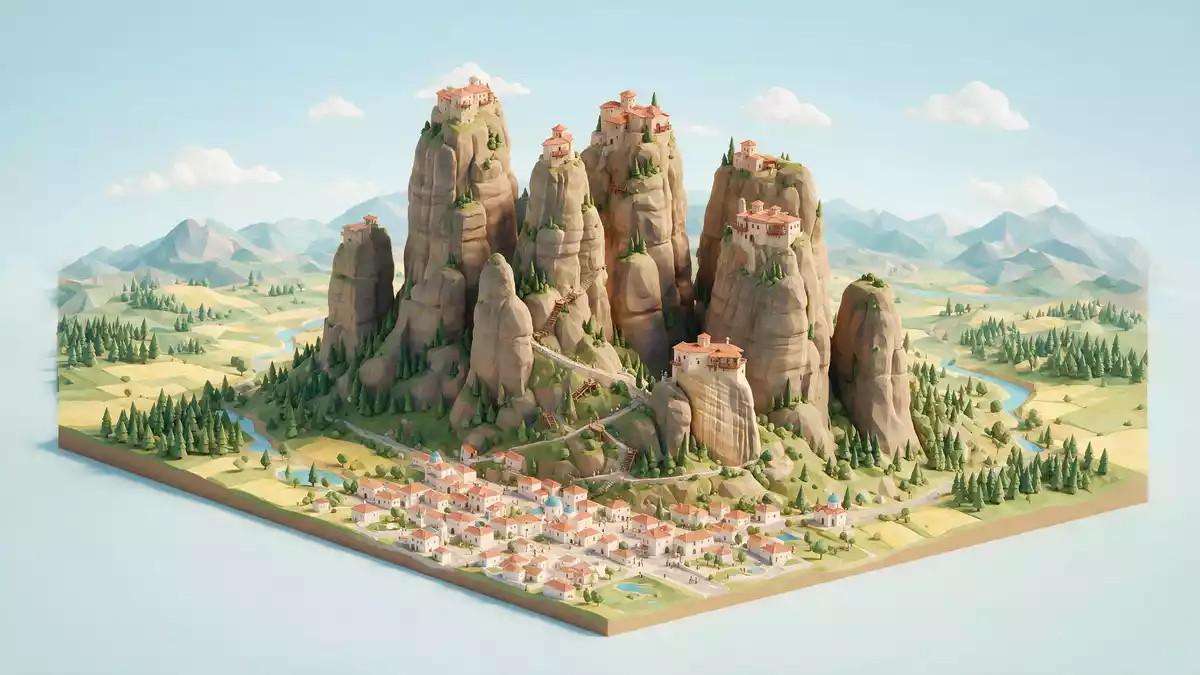
Meteora in central Greece is a landscape where geology and monastic architecture meet in full view: sandstone and conglomerate pillars rise above Kalambaka, crowned with Orthodox monasteries dating back to the fourteenth century.
Rock pillars above the Thessalian plain
Meteora stands at the north-western edge of the Thessalian plain, between the town of Kalambaka and the village of Kastraki, with the Pindus Mountains forming a distant backdrop and the Pineios river flowing nearby.north-western edge of the Plain of Thessaly The landscape is defined by steep, narrow rock pinnacles that rise abruptly from farmland and low hills, turning the approach into a sequence of sudden stone walls and isolated towers.
Geologically the pillars belong to the Pentalophos Formation of Upper Oligocene to Lower Miocene age, built from thick beds of sandstone and conspicuous conglomerates deposited in the Mesohellenic trough.Pentalophos Formation of Upper Oligocene – Lower Miocene age Each pillar is composed of rounded river pebbles and cobbles locked into a sandstone and marl matrix, a hardened accumulation of molassic sediments that has been carved into individual towers by erosion.
From hermits to a monastic complex
Religious life on the rocks began long before the present monasteries took shape: hermit dwellings were established on lesser peaks in the region from about 1,000 CE, turning caves and small chapels into early retreats for solitary prayer.hermit dwellings were established from about 1000 CE In the fourteenth century Athanasios Koinovitis, a monk from Mount Athos, climbed a broad rock known as plathy lithos and founded the first monastery of Great Meteoron, establishing communal buildings on a summit that had previously been reached only by climbers and hermits.Athanasios Koinovitis founded Great Meteoron in the fourteenth century
Over the following centuries more monasteries were built on neighbouring pillars, forming a complex that eventually comprised 24 individual monasteries and hermitages across the area.originally consists of 24 individual monasteries and hermitages Six monasteries remain active on the rocks today, including Great Meteoron, Varlaam, Roussanou, St Nicholas Anapafsas, Holy Trinity and St Stephen, which share the cliffs with smaller chapels, terraces and monastic paths linking the buildings to the surrounding countryside.six of which are still in use and open to visitors
UNESCO recognition and sacred landscape
Meteora is inscribed as a mixed UNESCO World Heritage Site, recognised in 1988 for both the geological value of its rock formations and the cultural significance of the monastic ensemble atop them.inscribed as a mixed UNESCO World Heritage Site in 1988 The designation highlights how the Byzantine monasteries and their post-Byzantine frescoes sit directly on the sandstone pinnacles, turning a complex of molassic sediments into a sacred landscape where stone towers and religious buildings form a single visual whole.Byzantine monasteries were built on the top of many of these rocks pillars
The site lies in Thessaly and is part of the Meteora Pyli UNESCO Global Geopark, which places the monastic complex within a wider network of geological features such as slender columns like Adrachti Rock and tafoni patterns near Kalambaka.Meteora Pyli UNESCO Global Geopark Within this protected area the combination of sandstone pillars, conglomerate outcrops and monastic structures has become a reference landscape for understanding both the Hellenic orogen and the history of Orthodox monasticism in mainland Greece.
Visiting Meteora: what travellers from Western Europe should know
- Meteora rises above Kalambaka in Thessaly, central Greece, and is reached by road from the town, which sits between the pillars and the Pineios river.
- The monasteries stand on elevated rock pillars, and approaches to them include stairways and paths that climb steep terrain with many steps.
- The surrounding countryside combines farmland, low hills and isolated stone towers, so walking routes can involve exposed sections on rock and earth rather than paved surfaces.
- Greek is the official language and the currency is the euro.
Searching for Meteora on social platforms
These links open searches for Meteora on each platform.
Frequently asked questions about Meteora
Where is Meteora located?
Meteora is in Thessaly in central Greece, above the town of Kalambaka and near the village of Kastraki at the north-western edge of the plain.
What should visitors expect on a visit?
Visitors encounter steep rock pillars with monasteries on their summits, stairways and paths climbing to monastic terraces, and views across farmland, river and surrounding mountains.
What makes Meteora distinctive among monastic sites?
Meteora combines Orthodox monasteries dating from the fourteenth century with tall sandstone and conglomerate pillars, forming a recognised mixed UNESCO World Heritage landscape.