
Meteora’s monasteries on the stone pillars of Kalambaka
Published on 09/21/2026 at 16:03 | Editorial responsibility: Rafael Müller, Editor-in-Chief AD HOC NEWS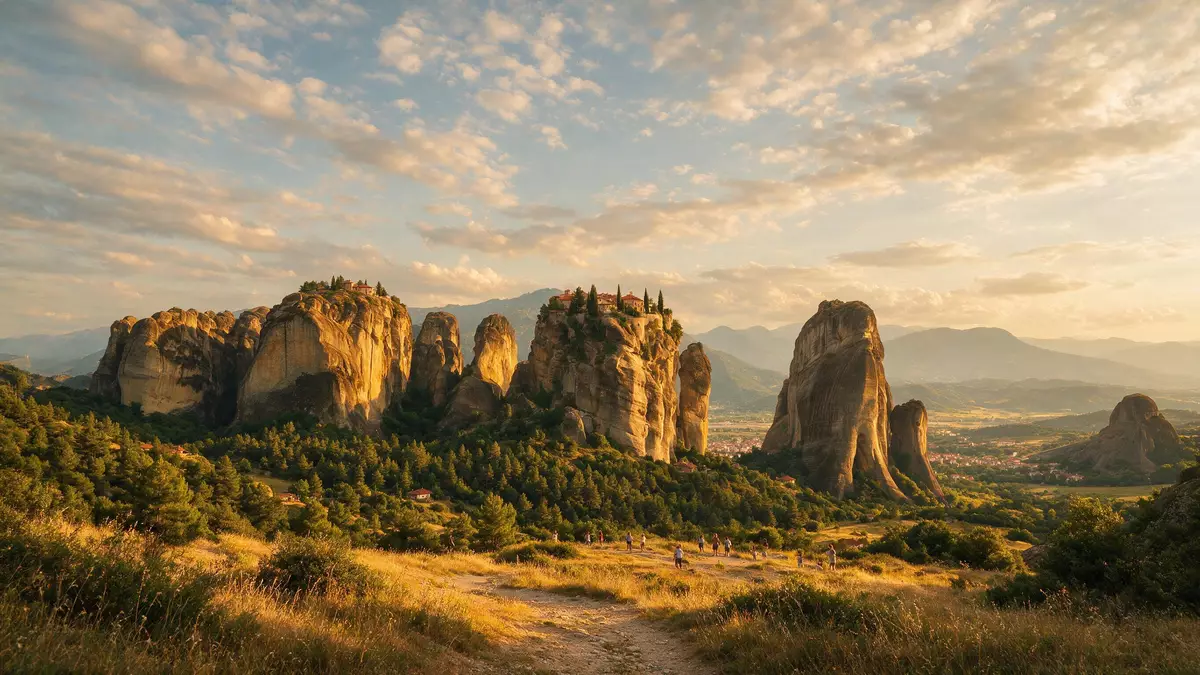
Meteora above Kalambaka in Greece is a landscape where stone pillars rise from the Thessalian plain and carry Eastern Orthodox monasteries on their summits. The complex of monasteries was largely formed between the fourteenth and sixteenth centuries, when communities moved onto the rocks and built churches, cells and refectories in stone and timber. In 1988 Meteora was inscribed on the UNESCO World Heritage List as a site of combined cultural and natural significance, recognising both the monastic heritage and the striking rock landscape.
Stone pillars turned into a monastic landscape
Meteora lies just north of Kalambaka in Thessaly, in the upper valley of the Pineios River at the foot of the Pindus Mountains. The rock pinnacles rise above the town and surrounding fields, forming steep towers and cliffs separated by gullies and narrow ridges. Geologists describe the Meteora rocks as sandstone and conglomerate belonging to the Pentalophos Formation, a thick sequence of sedimentary deposits laid down in the Mesohellenic Trough during the Oligocene and Miocene, tens of millions of years ago.sandstone and conglomerate The conglomerate is built from rounded river pebbles and cobbles cemented within a matrix of finer sand and marl, creating a rock that reads almost like natural concrete along exposed faces.rounded river pebbles and cobbles
Over geological time, tectonic uplift and erosion cut this formation into separate columns, with many pillars reaching heights of around 300 m (984 ft) above the surrounding landscape.pillars reaching heights of around 300 m Their surfaces show rough conglomerate textures and honeycomb-like tafoni patterns, where small cavities and ridges have been carved by weathering. Paths and minor roads thread among the rocks, and from many points the cliffs rise almost directly above lanes, fields and the outskirts of Kalambaka, giving Meteora an immediate presence in the everyday landscape as well as at the level of the monasteries themselves.
From Athanasios’s summit monastery to a UNESCO site
The story of Meteora as a monastic centre begins in late medieval Thessaly. In the fourteenth century the Athonite monk Athanasios, later known as Athanasios the Meteorite, founded a monastery on one of the high summits, a foundation that became known as the Great Meteoron. The church at the Great Meteoron is dedicated to the Transfiguration of Christ, and over time further buildings were added around it, including cells, storerooms and refectories for the community.Athanasios founded the Great Meteoron Other monasteries followed on neighbouring pillars, forming a cluster of Byzantine and post-Byzantine foundations across the rocks of Meteora.
In its mature form the Meteora group consisted of several monasteries with individual churches, chapels and monastic quarters built in stone, brick and timber along the crowns and flanks of different pillars.the Meteora group consisted of several monasteries Many of these churches carry fresco cycles from the sixteenth century that mark important stages in post-Byzantine painting, with depictions of Christ, the Virgin, saints, martyrs and scenes from scripture arranged along walls and vaults.sixteenth-century frescoes The ensemble of monasteries on the pillars, together with the surrounding landscape, was inscribed on the UNESCO World Heritage List in 1988 as a mixed site of cultural and natural importance, recognising both the artworks and the dramatic geological setting.inscribed on the UNESCO World Heritage List in 1988
Visiting the monasteries above Kalambaka
Meteora stands in central Greece in the Thessaly region, with the town of Kalambaka directly below the pillars and the village of Kastraki on their western side.north of Kalambaka, south of Kastraki Roads from Kalambaka lead towards the monasteries, and from the town the pillars are visible in several directions, rising above houses, streets and farmland. The Pindus range forms a backdrop to the valley, and the Pineios River flows nearby, giving Meteora both a mountain and a river setting. The site also forms part of the Meteora Pyli UNESCO Global Geopark, a designation that highlights individual formations such as the slender Adrachti Rock and tafoni surfaces near Kalambaka and Kastraki.Meteora Pyli UNESCO Global Geopark
The monasteries themselves occupy several pillars, some with extensive terraces and courtyards, others with compact clusters of buildings perched close to the cliff edges. Visitors encounter a mixture of stone stairways, paths and entrance routes built into or against the rock faces, reflecting the practical need to reach the churches and monastic quarters. Inside the monastic compounds, chapels and refectories carry painted decoration and carved fittings, while external walls show layers of stonework and masonry clearly distinguished from the natural conglomerate below. Even from outside the monastic enclosures, the combination of rough natural rock and structured buildings is visible, giving a clear sense of how communities adapted to the pinnacles.
Visiting Meteora: what travellers from Western Europe should know
- Meteora lies in Thessaly in central Greece, with Kalambaka directly below the rock pillars and Kastraki nearby; trains and roads link the town with other Greek regions.
- Approaches to the monasteries involve walking sections on paved paths and stairways that climb the rock slopes, and some routes use narrow staircases within the stone.
- The terrain around Meteora combines steep conglomerate cliffs, wooded slopes and agricultural land, so footwear suitable for uneven ground is useful on the paths and viewpoints.
- The official language is Greek and the currency is the euro.
Searching for Meteora on social platforms
These links open searches for Meteora on each platform.
Frequently asked questions about Meteora
Where is Meteora and what surrounds it?
Meteora is in Thessaly in central Greece, just north of Kalambaka and south of Kastraki, with the Pindus Mountains and the Pineios River forming its wider setting.
What can visitors expect when exploring Meteora?
Visitors encounter steep rock pillars carrying monasteries, with paths and stairways on the slopes, churches and courtyards on the summits, and views over the Thessalian plain and surrounding mountains.
What makes Meteora distinctive among monastic sites?
Meteora combines Eastern Orthodox monasteries with vertical sandstone and conglomerate pillars, sixteenth-century frescoes and a valley landscape, giving it both geological and artistic character within one compact area.


