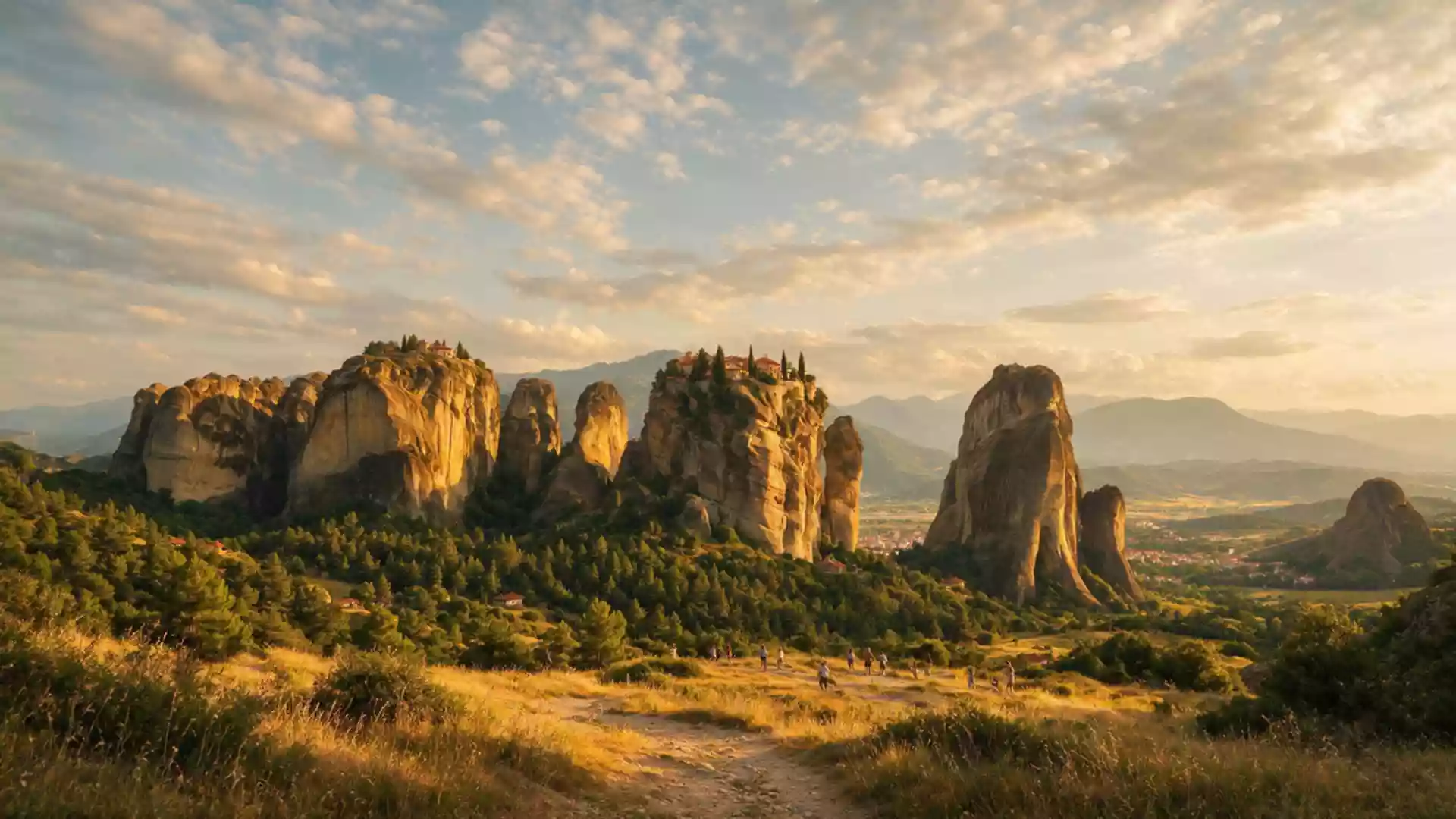
Meteora’s monasteries on the stone pillars of Kalambaka
Published on 08/30/2026 at 12:17 | Editorial responsibility: Rafael Müller, Editor-in-Chief AD HOC NEWS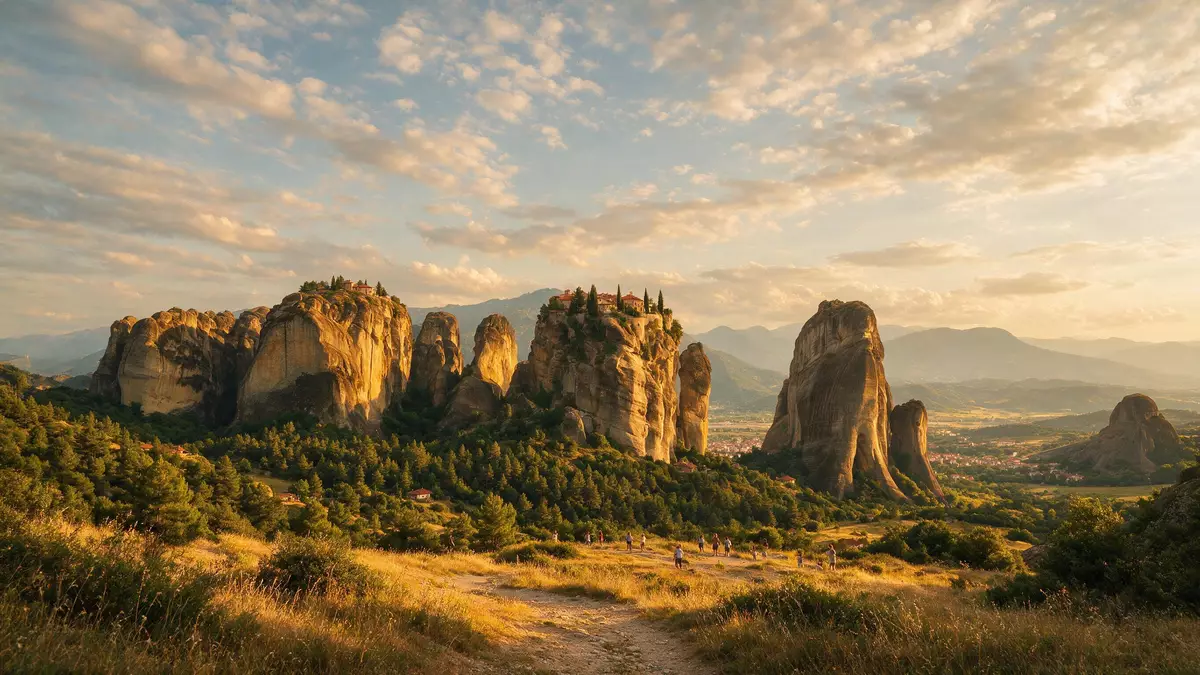
Meteora above Kalambaka in Greece is a landscape where sheer rock pillars carry Eastern Orthodox monasteries high above the Thessalian plain, bringing architecture, geology and monastic life together in a single view of stone and sky.
Sandstone pillars and a high plateau above Thessaly
Meteora occupies the north-western edge of the Thessalian plain, between the town of Kalambaka and the village of Kastraki, with the Pindus mountains rising to the west and the valley of the Pineios river stretching away to the east.To the east of the Pindus range the protected area extends north of Kalambaka for several kilometres as the famous cliffs begin to dominate the horizon.The protected area extends
The rock pillars themselves are composed of sandstone and conglomerate, formed from ancient deposits of stone, sand and mud laid down by streams entering a lake or shallow sea and compacted over millions of years.The rocks are composed of sandstone and conglomerate Around 60 million years ago during the Paleogene period, tectonic movements lifted this former seabed to create a high plateau and fractured the thick layer of sandstone, leaving vertical fault lines that erosion later turned into isolated columns and steep pinnacles.About 60 million years ago during the Paleogene period
From hermit caves to a monastic centre on the cliffs
Human settlement on these pillars began with hermit monks who chose hollows and caves in the rock faces for seclusion, with traces of ascetic life dating to the tenth and eleventh centuries as individual dwellings appeared above the plain.The first evidence of ascetic life Over the following centuries organised communities formed, and Meteora developed into the most significant monastic centre in Greece after Mount Athos, bringing a cluster of monasteries into a single landscape of stone and prayer.The most significant monastic centre in Greece after Mount Athos
More than twenty monasteries were founded on the pillars, though only six survive in use today, each with its own rock summit, church and courtyards linked to the world below by paths, stairways and bridges.Through the centuries more than 24 monasteries were found These six operating monasteries are Great Meteoron, Varlaam, Rousanou, St Nicholas Anapafsas, Holy Trinity and St Stephen, forming the core of the living monastic community on the cliffs.The Six Operating Monasteries
Monasteries, frescoes and World Heritage recognition
The largest and highest of the monasteries is the Holy Monastery of Great Meteoron, founded in 1340 by Saint Athanasios the Meteorite, whose katholikon church dedicated to the Transfiguration was erected in the fourteenth century and decorated with frescoes in the fifteenth and sixteenth centuries.Founded in 1340 by Saint Athanasios the MeteoriteThe church was erected in the middle of the 14th c. Varlaam, Rousanou, St Nicholas Anapafsas, Holy Trinity and St Stephen each have their own katholikon, refectory and monastic buildings, with post-Byzantine fresco cycles that illustrate saints, liturgical scenes and theological themes within compact church interiors on the rocks.The Holy Monastery of Varlaam is the second
Meteora was inscribed on the UNESCO World Heritage List in 1988 for its combination of outstanding monastic architecture, cultural significance and striking natural setting, under cultural criteria i, ii, iv and v together with natural criterion vii.1988: Inscribed on the World Heritage List The wider landscape has also been recognised as the Meteora Pyli UNESCO Global Geopark, linking the monasteries to the geological story of the sandstone pillars and the broader terrain of western Thessaly.Meteora Pyli UNESCO Global Geopark
Visiting Meteora: what travellers from Western Europe should know
- Meteora rises just north of Kalambaka in north-western Thessaly, reached by road from Trikala and by regional trains that serve Kalambaka station at the foot of the cliffs.
- The monasteries stand on high sandstone pillars above the plain, and visiting their precincts involves stairways with many steps, exposed paths on rock and short climbs between parking areas and entrances.
- The wider Meteora landscape lies near the Pindus mountains, where weather can change quickly; sturdy footwear and clothing for rock paths and variable conditions help for walking between viewpoints.
- Greek is the official language and the currency is the euro; signage at the monasteries and along the access road includes Greek text and transliterated names.
Searching for Meteora on social platforms
These links open searches for Meteora on each platform.Frequently asked questions about Meteora
Where is Meteora and what is it?
Meteora is a group of Eastern Orthodox monasteries set on sandstone pillars near Kalambaka in north-western Thessaly in mainland Greece.
What should visitors expect on a visit to Meteora?
Visitors encounter monasteries perched on high cliffs, access paths with many steps, chapels decorated with frescoes and wide views over the Thessalian plain and nearby mountains.
What makes Meteora distinctive among monastic sites?
Meteora brings together long-running monastic communities, post-Byzantine churches and a dramatic sandstone landscape, all recognised in its UNESCO World Heritage inscription.