
Meteora’s monasteries on the stone pillars above Kalambaka
Published on 09/14/2026 at 15:42 | Editorial responsibility: Rafael Müller, Editor-in-Chief AD HOC NEWS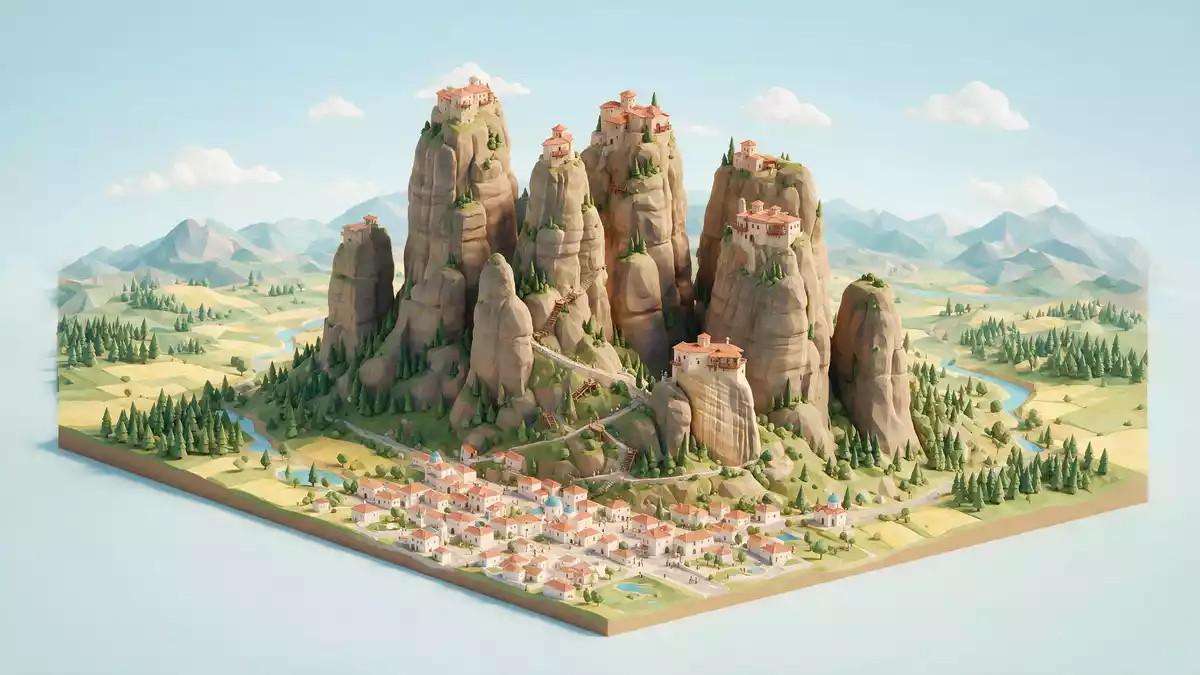
Meteora is a dramatic sandstone rock formation above the town of Kalambaka in mainland Greece, where Orthodox monasteries stand on the tops of towering pillars that drop steeply to the plain below. The site lies in the Thessaly region, between Kalambaka and the village of Kastraki, close to the Pineios river and the Pindus mountains.
Sandstone pillars and monasteries in the sky
The core of Meteora is a cluster of steep sandstone and conglomerate pillars that rise from the Thessalian plain near Kalambaka, forming narrow mounds and cliffs with almost vertical faces. The protected area lies to the east of the Pindos range, with the rock forest extending for several kilometres around Kalambaka and Kastraki.The World Heritage datasheet describes Meteora’s extent and confirms its position in northeastern Thessaly.
On top of the pillars stand monasteries that give Meteora its distinctive silhouette. By the height of the monastic community in the sixteenth century, a total of 24 monasteries and hermitages had been built on the rock summits and ledges, turning the formation into one of the most concentrated groups of Orthodox monastic buildings in Greece.A Meteora monasteries overview traces this growth to its sixteenth-century peak.
From early hermits to Great Meteoron
Religious life at Meteora is traced to the medieval period, when hermit monks began using the lesser peaks and caves of the rock mounds for solitary dwelling. Hermit settlements developed from about the eleventh century, with individual monks occupying caves and hollows scattered across the cliffs.A historical overview places these early hermit dwellings around 1000 CE.
The transition from scattered hermit caves to organised summit monasteries came in the fourteenth century. Athanasios Koinovitis, a monk from Mount Athos, climbed a broad rock known as the Great Meteoron and founded a monastic community that became the most prominent monastery at Meteora.The Byzantine Legacy account identifies Athanasios as the founder of Great Meteoron in the late fourteenth century. Under Athanasios and his pupil Ioasaf, Great Meteoron grew in wealth and influence, and further monasteries such as Varlaam and Rousanou followed in the fifteenth and sixteenth centuries.
UNESCO status and the six active monasteries
Meteora is inscribed on the UNESCO World Heritage List as both a cultural and natural site. The inscription, made in 1988, recognises the combination of the sandstone pillars and the monastic complexes as having outstanding universal value under several cultural criteria and one natural criterion.The World Heritage listing records this 1988 inscription and the criteria used.
From the original cluster of monasteries, six remain active and are associated directly with the organised monastic life on the pillars. Guides to the site consistently identify Great Meteoron, Varlaam, Holy Trinity, Saint Stephen, Saint Nicholas Anapausas and Rousanou among the extant monasteries on the rock summits.A World Heritage guide notes that six monasteries are active and open and summarises their role as Byzantine monastic foundations.
Visiting Meteora: what travellers from Western Europe should know
- Meteora lies near the town of Kalambaka in Thessaly, in central Greece, with the rock pillars rising to the north and west of the town and around the neighbouring village of Kastraki.
- The terrain of Meteora is steep and rocky, with approaches to the monasteries involving uphill paths, stairways cut into the rock and sections of roadway along the ridge above Kalambaka.
- Kalambaka is reached by rail and bus services linking it to cities such as Athens, Thessaloniki and Volos, and from there roads climb towards the Meteora viewpoints and monastery entrances.Travel information for Kalambaka outlines these rail and bus connections.
- The official language in Kalambaka and Meteora is Greek and the national currency is the euro.
- Entry requirements depend on your nationality; UK travellers can check the FCDO travel advice at gov.uk/foreign-travel-advice, Irish travellers the Department of Foreign Affairs at ireland.ie.
Searching for Meteora on social platforms
These links open searches for Meteora on each platform.Frequently asked questions about Meteora
Where is Meteora and what is it?
Meteora is a sandstone rock formation with monasteries on its pillars in the Thessaly region of central Greece, near the town of Kalambaka and the village of Kastraki.
What should visitors expect on a visit to Meteora?
Visitors encounter steep rock pillars with monasteries on their summits, reached by uphill roads and stairways, with views across the Thessalian plain and towards the Pindus mountains.
What makes Meteora distinctive among monastic sites?
Meteora combines a cluster of medieval Orthodox monasteries with towering sandstone pillars and holds UNESCO World Heritage status as both a cultural and natural site.


