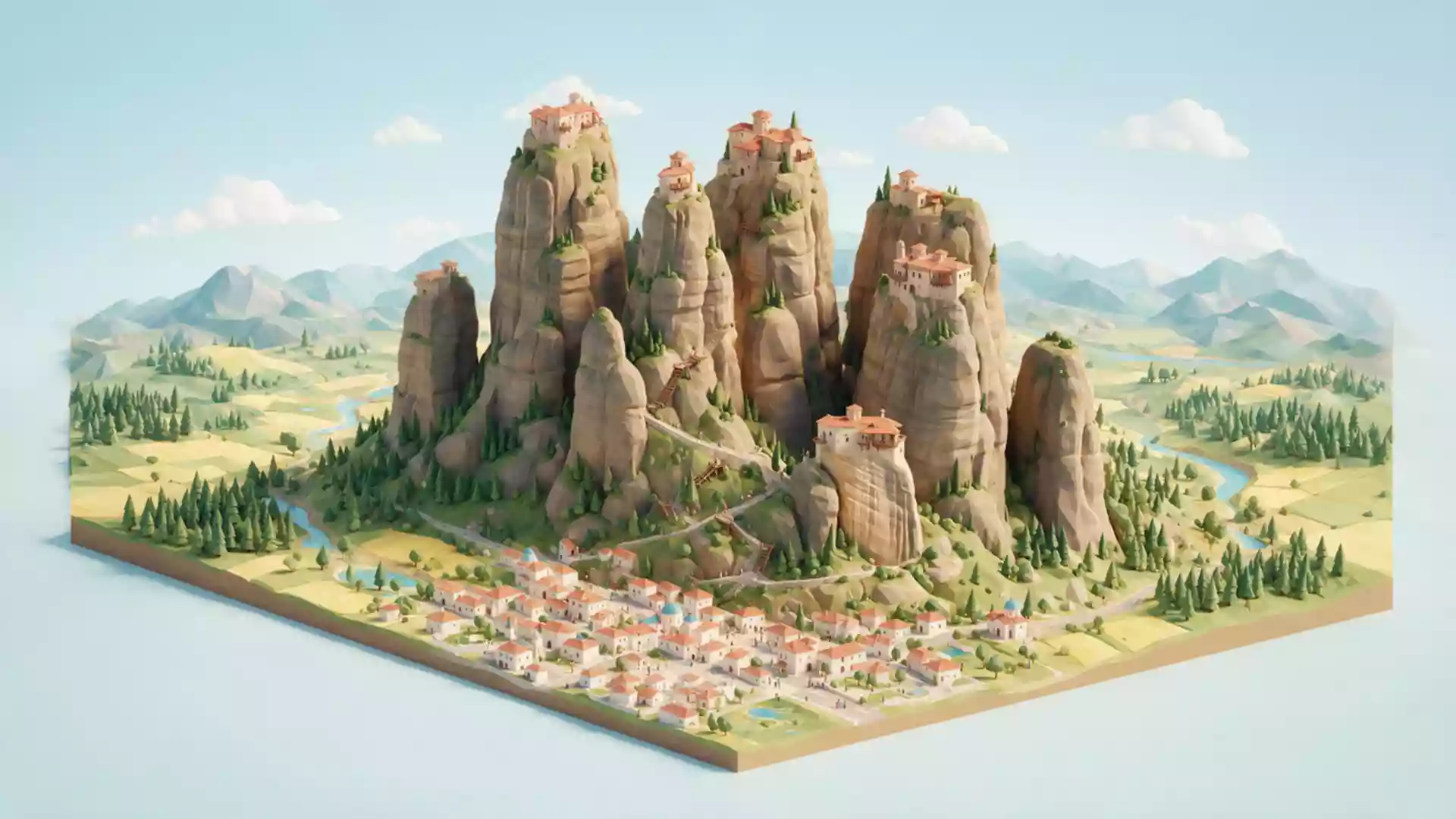
Meteora’s monasteries on the stone pillars above Kalambaka
Published on 08/27/2026 at 13:33 | Editorial responsibility: Rafael Müller, Editor-in-Chief AD HOC NEWS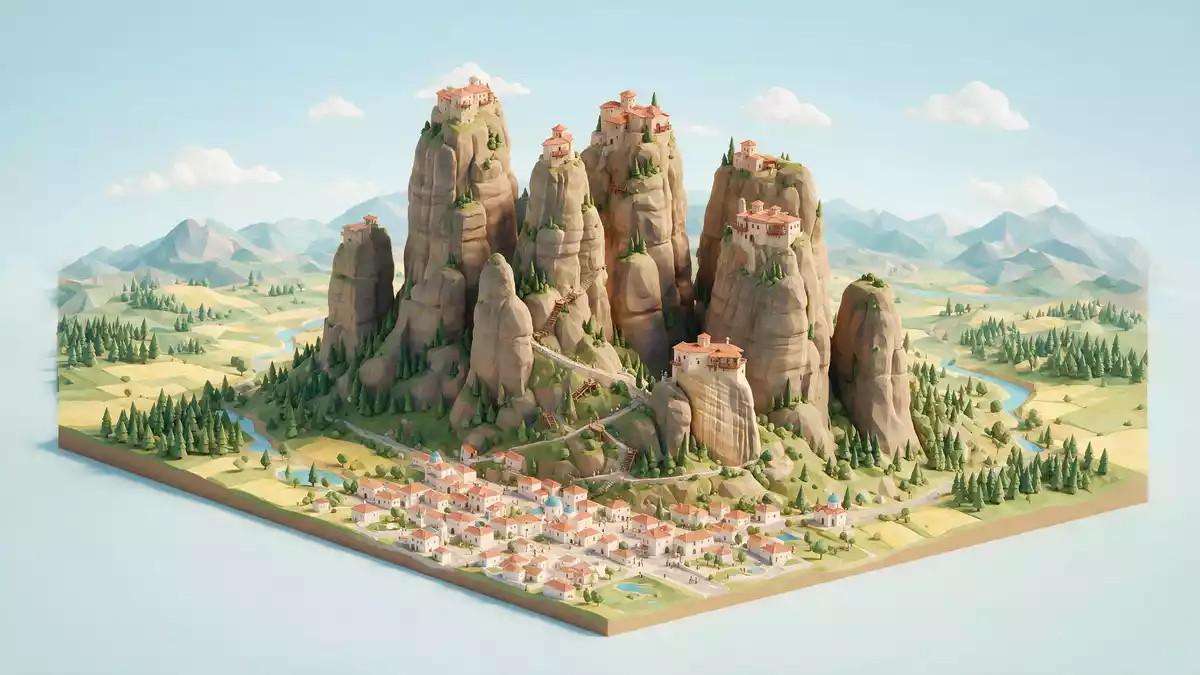
Meteora is a dramatic group of sandstone pillars near Kalambaka in Greece, crowned by Eastern Orthodox monasteries that seem to hover over the Thessalian plain. The complex is part of a wider monastic landscape that took shape between the eleventh and sixteenth centuries, turning a geological curiosity into a spiritual stronghold.
Sandstone pillars above the Thessalian plain
Meteora stands in the regional unit of Trikala in Thessaly, in the centre of mainland Greece, east of the Pindus Mountains and close to the Pineios river. The pillars rise from the edge of the plain between the town of Kalambaka and the village of Kastraki, creating a band of rock that forms a distinct skyline above the surrounding agricultural land.Trikala in Thessaly The rock mass is formed mainly of sandstone and conglomerate, weathered into separate towers by erosion over long geological periods.sandstone and conglomerate
The protected core of the Meteora World Heritage area covers around 271 ha (671 acres), with a buffer zone that extends over a wider belt of hills and valleys.271 ha of protected area Pillars rise from a mean altitude of roughly 300 m (984 ft) to heights above 700 m (2,297 ft), giving the monasteries broad views across the plain and towards the mountain ranges to the west.mean altitude around 300 m
From hermits’ caves to a monastic stronghold
Monastic life on the Meteora rocks is thought to date from the eleventh century, when hermits began to settle in natural caves and hollows high above the Thessalian plain.monks first settled there In the fourteenth century Athanasios of Meteora, also known as Athanasios the Meteorite, founded the Great Meteoron Monastery on a broad summit, which became the leading community on the rocks and set the pattern for later foundations.Athanasios the Meteorite
Between the thirteenth and sixteenth centuries the monastic community expanded to a peak of around twenty-four monasteries, each occupying its own pillar or ledge above the plain.twenty-four monasteries were built Foundations from this period include Great Meteoron, Varlaam, Roussanou, St Nicholas Anapausas, Holy Trinity and St Stephen, with churches, refectories and monks’ cells arranged around courtyards on the summit plateaux.group of monasteries on vertical rock Six monasteries remain active on the rocks, continuing Orthodox liturgical life in settings that retain frescoes from the sixteenth century and later.six historic monasteries remain active
Meteora as World Heritage landscape
Meteora was inscribed on the UNESCO World Heritage List in 1988 under cultural criteria i, ii, iv and v and natural criterion vii, recognising both the monastic architecture and the geological setting as a combined heritage landscape.inscribed on the World Heritage List in 1988 The designation highlights the fresco cycles that mark a key stage in post-Byzantine painting and the adaptation of religious communities to an environment shaped by towering rock surfaces and narrow ledges.Meteora as a UNESCO World Heritage Site
The monasteries function as religious institutions and cultural monuments, preserving artefacts and manuscripts within buildings that are integrated into the pillars. Steps, footpaths and bridges link the chapels, refectories and viewpoints on each rock, while the wider landscape combines Mediterranean vegetation with exposed sandstone faces. From Kalambaka and Kastraki, roads and paths climb towards the pillars, bringing travellers into a setting where geological scale and monastic architecture meet in a single panorama.
Visiting Meteora: what travellers from Western Europe should know
- Meteora lies to the north of Kalambaka in central Greece, with the rock pillars stretching between the town and the village of Kastraki; road approaches reach the monasteries from the valley below.
- The terrain consists of steep sandstone pillars with monasteries on their summits; visiting often involves stone stairways, gradients on footpaths and exposed viewpoints above the plain.
- The wider setting includes the Pineios river and the Pindus Mountains to the west, so views from the monasteries take in both the Thessalian plain and the distant ranges.
- The official language is Greek and the currency is the euro.
Searching for Meteora on social platforms
These links open searches for Meteora on each platform.
Frequently asked questions about Meteora
Where is Meteora in Greece?
Meteora is in the regional unit of Trikala in Thessaly, near the town of Kalambaka and the village of Kastraki in central Greece.
What do travellers encounter on a visit to Meteora?
Travellers encounter sandstone pillars with Orthodox monasteries on their summits, stone stairways and viewpoints over the Thessalian plain and surrounding hills.
What makes Meteora distinctive among monastic sites?
Meteora combines a large group of Eastern Orthodox monasteries with towering sandstone pillars, forming a single cultural and natural landscape recognised as World Heritage.