
Mesa Verde National Park and its cliff dwelling world
Published on 08/28/2026 at 13:46 | Editorial responsibility: Rafael Müller, Editor-in-Chief AD HOC NEWS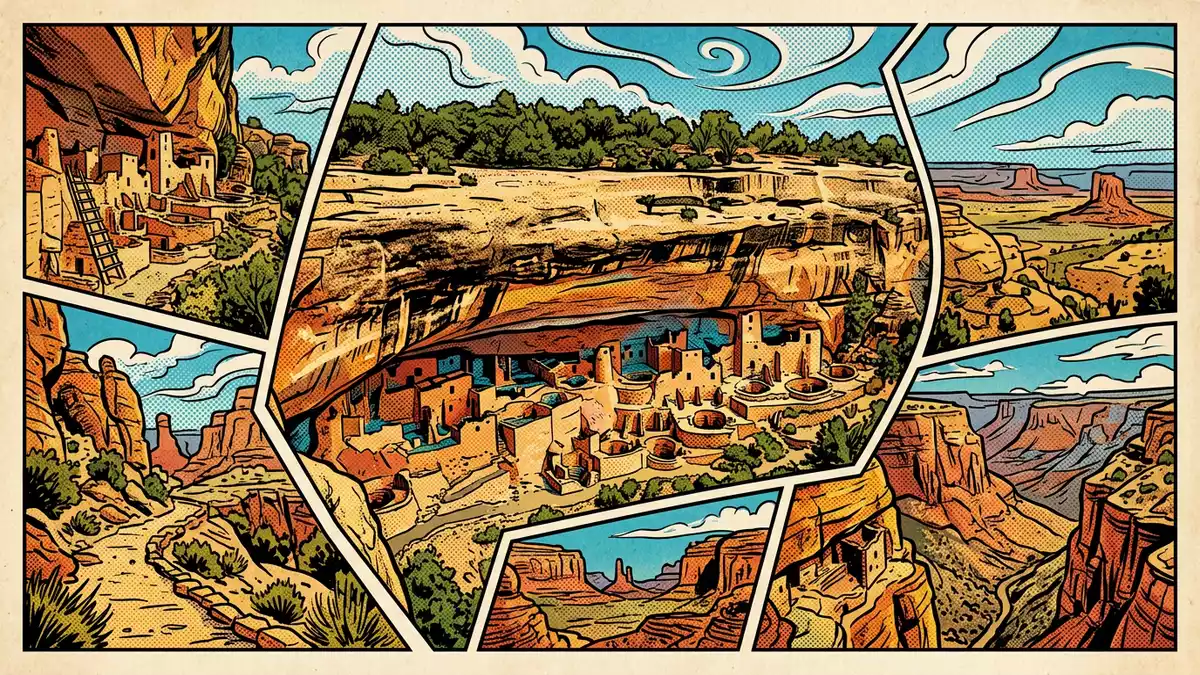
Mesa Verde National Park in south-western Colorado rises as a broad plateau above the Four Corners region, with canyons cut deep into its flanks and ancient stone villages tucked into their sheltered walls. Established as a United States national park in 1906 under President Theodore Roosevelt, it was later recognised as a UNESCO World Heritage Site for its concentration of well-preserved Ancestral Pueblo settlements and cliff dwellings dating from the period between around 550 and 1300 CE.
A high “green table” above the canyons
The name Mesa Verde, Spanish for “green table”, describes the park’s broad upland form: a high tableland edged by steep slopes and dissected by canyons that open towards the surrounding lowlands. The protected area covers just over 52,000 acres (around 210 km²), giving space to a dense pattern of ancient settlements spread across the mesa tops and the alcoves in the canyon walls.The park occupies 52,485 acres The plateau lies east of Cortez in Montezuma County, reached from U.S. Route 160, with the entrance road climbing from the highway onto the higher ground of the mesa.
Archaeological surveys have identified thousands of prehistoric sites across this landscape, including extensive farming villages, towers, reservoirs and cliff dwellings arranged beneath overhanging canyon walls.There are more than 5,000 archeological sites including 600 alcove dwellings The altitude and relief give wide views across south-western Colorado, yet much of the ancient architecture remains tucked into sheltered positions where stone, earth and vegetation form a layered terrain.
Ancestral Pueblo settlement from mesa tops to cliff dwellings
Human settlement on Mesa Verde began around the middle of the first millennium CE, when Ancestral Pueblo people moved onto the plateau and built pithouses in small communities on the mesa tops.Ancestral Pueblo people first arrived around 550 CE Over the following centuries these communities developed into larger masonry villages, with stone rooms grouped in blocks, kivas sunk into the ground and fields laid out on the flatter parts of the mesas. Farming of crops such as maize, beans and squash supported a settled way of life across the plateau.
The most visually striking phase of this settlement history came later, when many villages were built in alcoves within the canyon walls. Most of the cliff dwellings in Mesa Verde date between about 1180 and 1300 CE, forming compact stone settlements aligned along the edges of the alcoves and close to seep springs that provided permanent water.Most cliffside villages were constructed between 1180 and 1280 CE These cliff dwellings, together with the mesa-top sites, represent the later centuries of occupation before the communities left the region around 1300 CE.
Stone villages in the cliffs: Cliff Palace and its neighbours
Among the many cliff dwellings preserved within Mesa Verde National Park, several large villages stand out for their scale and complexity. Cliff Palace, located on Chapin Mesa, is the largest cliff dwelling in the park, with ranges of sandstone rooms arranged beneath a broad canyon-wall alcove and towers rising within the settlement.Cliff Palace is the largest cliff dwelling in Mesa Verde National Park Nearby, sites such as Balcony House and Spruce Tree House also show dense clusters of rooms and plazas, built with carefully shaped stone blocks and mortar.
The architecture of these cliff dwellings combines practical features and ceremonial spaces. Multi-storey blocks of rooms stand beside circular kivas cut into the ground, with doorways and small openings linking the different parts of the settlements. Ladders and carved routes connect terrace levels within the alcoves and link the cliff dwellings to the mesa tops above. Across the park, these cliff villages form part of a wider network of Ancestral Pueblo sites, which include mesa-top pueblos, field systems and towers spread across the plateau.Today the park protects nearly 5,000 known archeological sites
Visiting Mesa Verde National Park: what travellers from Western Europe should know
- Mesa Verde National Park lies east of Cortez in south-western Colorado, with access from U.S. Route 160 and an entrance road that climbs onto the high plateau.
- The approach into the park involves driving on mountain roads with bends and gradients, followed by walking on uneven ground and stairways in the cliff dwelling areas.
- The terrain combines high-altitude mesa tops and steep canyon slopes, so conditions can vary between exposed viewpoints on the plateau and more sheltered alcoves in the canyon walls.
- The official language is English and the currency is the United States dollar.
- Entry requirements depend on your nationality; UK travellers can check the FCDO travel advice at gov.uk/foreign-travel-advice, Irish travellers the Department of Foreign Affairs at ireland.ie.
Searching for Mesa Verde National Park on social platforms
These links open searches for Mesa Verde National Park on each platform.
Frequently asked questions about Mesa Verde National Park
Where is Mesa Verde National Park located?
Mesa Verde National Park lies in Montezuma County in south-western Colorado, east of Cortez and reached from U.S. Route 160 across the high plateau.
What can visitors expect to see in the park?
Visitors encounter a high mesa landscape cut by deep canyons, with Ancestral Pueblo pithouse sites, stone pueblos and dramatic cliff dwellings such as Cliff Palace built into canyon-wall alcoves.
What makes Mesa Verde National Park distinctive?
The park combines a large protected upland with thousands of well-preserved Ancestral Pueblo archaeological sites, including hundreds of cliff dwellings, recognised together as a UNESCO World Heritage cultural landscape.


