
Mercado de Chichicastenango and its layered highland culture
Published on 09/23/2026 at 03:21 | Editorial responsibility: Rafael Müller, Editor-in-Chief AD HOC NEWS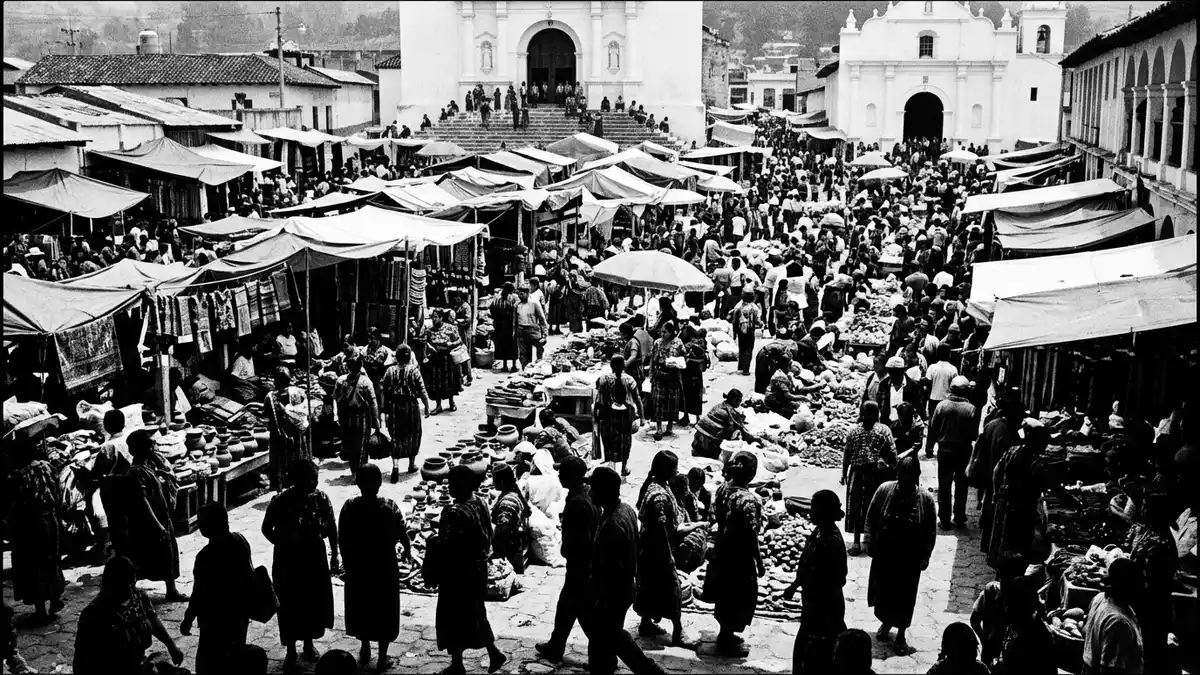
Mercado de Chichicastenango occupies the central square of Chichicastenango in Guatemala’s western highlands. Stalls, church steps, woven clothing and ceremonial objects share the same urban space, creating a market whose character is both commercial and religious.
Mercado de Chichicastenango around Plaza y Mercado
The market centres on Plaza y Mercado and extends into the streets around Iglesia de Santo Tomás. Produce, flowers, pottery, leather goods and textiles appear beside household merchandise and food sold for everyday use. The market is therefore not a single enclosed hall, but a network of trading spaces around the town’s principal square.
The setting is closely associated with the K’iche’ Maya communities of the surrounding highlands. K’iche’ and Spanish are heard in the town, while clothing, craftwork and agricultural products connect the square with villages across the department of El Quiché. Chichicastenango’s market centre has served communities in the neighbouring highlands for centuries.
Textiles, masks and the K’iche’ Maya tradition
Handwoven textiles form one of Mercado de Chichicastenango’s most recognisable groups of goods. Huipils, the traditional garments worn by Indigenous women and girls in Guatemala, carry regional patterns and colours. Woven lengths of cloth, belts and other garments sit alongside carved wooden masks, pottery and leatherwork.
The masks have a ceremonial connection to Maya dance traditions, while the market also handles practical goods such as vegetables, fruit, herbs and clothing. These categories sit together without a sharp division between craft and daily commerce. K’iche’ Maya textiles and masks provide a visible link between local production and cultural practice.
Iglesia de Santo Tomás and Maya-Catholic practice
Iglesia de Santo Tomás stands beside the market square and dates from 1540. Its long staircase rises directly from the plaza, placing Catholic architecture within a setting connected to pre-Columbian Maya religious practice. The church and market are consequently read together as parts of Chichicastenango’s cultural landscape.
Copal incense, candles, flowers and prayers appear around the church, while Catholic worship takes place inside. The coexistence of these practices is known as Maya-Catholic syncretism. The market’s goods include objects used in ceremonies, and the square remains a place where trade, social contact and religious observance meet. Iglesia de Santo Tomás is a sixteenth-century landmark beside the trading area.
Visiting Mercado de Chichicastenango: what travellers from Western Europe should know
- Mercado de Chichicastenango lies in the centre of Chichicastenango, in Guatemala’s department of El Quiché. Buses and road transport connect the town with Guatemala City, Antigua, Panajachel and Los Encuentros.
- The market spreads across Plaza y Mercado and nearby streets. The church staircase and uneven paved areas form part of the walking route through the central area.
- Chichicastenango stands in the western highlands at about 1,965 m (6,447 ft) above sea level. The altitude forms part of the town’s physical setting.
- The official language is Spanish and the currency is the Guatemalan quetzal.
- Market activity shares space with Iglesia de Santo Tomás, where Catholic worship and Maya ritual practice are visible in the same setting.
Searching for Mercado de Chichicastenango on social platforms
These links open searches for Mercado de Chichicastenango on each platform.
Frequently asked questions about Mercado de Chichicastenango
Where is Mercado de Chichicastenango?
It is in the centre of Chichicastenango, a highland town in Guatemala’s department of El Quiché. The market surrounds Plaza y Mercado and Iglesia de Santo Tomás.
What can be found at the market?
Textiles, huipils, carved masks, pottery, leather goods, flowers, produce, herbs and food are among the goods associated with the market. The selection combines household commerce with handmade and ceremonial objects.
What makes the market distinctive?
Its trading spaces share the central square with a sixteenth-century Catholic church and Maya ritual practices. This visible overlap gives Mercado de Chichicastenango its layered cultural character.


