
Meiji Jingu and the forest built into Tokio
Published on 09/24/2026 at 02:42 | Editorial responsibility: Rafael Müller, Editor-in-Chief AD HOC NEWS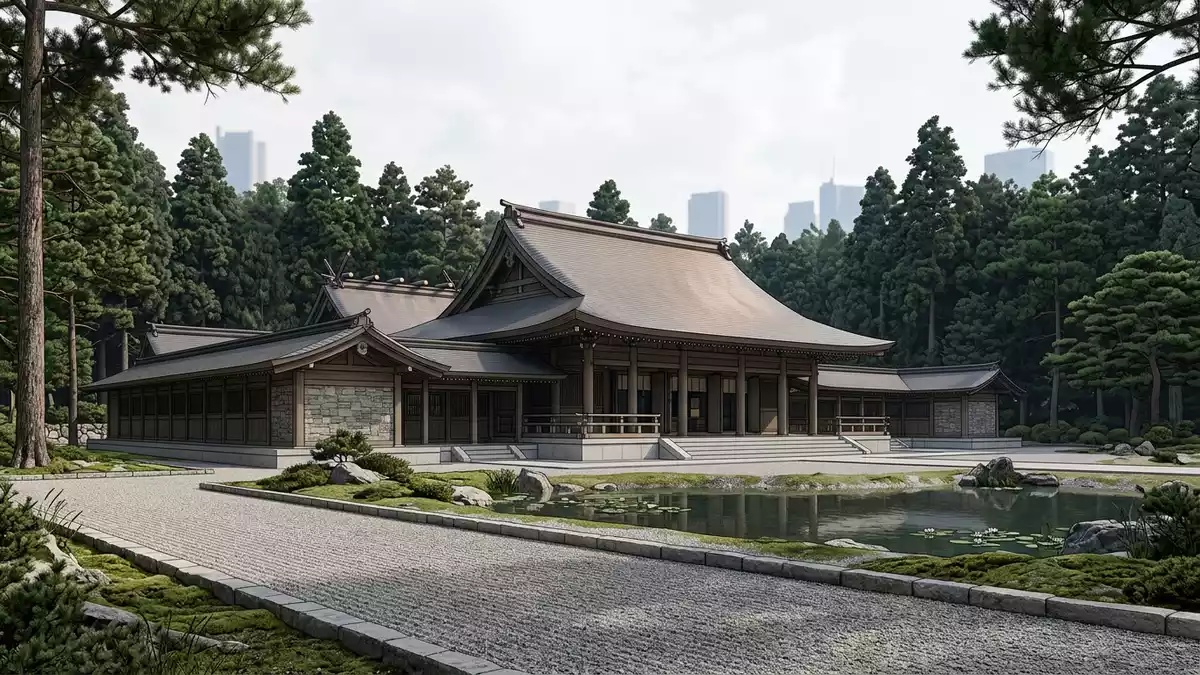
Meiji Jingu is a Shinto shrine in Tokio surrounded by a broad woodland precinct. Its defining feature is the meeting of unpainted Japanese cypress buildings, timber torii gates and a forest planted during the shrine’s creation in 1920.
The shrine is dedicated to Emperor Meiji and Empress Shoken. Its approaches pass through trees before reaching the central sanctuary, creating a distinct sequence of gravel paths, gates, canopy and timber architecture.
Meiji Jingu: a shrine beneath a planted forest
The woodland is not a remnant of untouched countryside. Trees were donated from regions across Japan, and volunteers helped establish the forest around the shrine precinct. The planting included many varieties of trees, arranged as woodland rather than as a formal ornamental garden.
The forest covers about 70 hectares and surrounds the main shrine buildings. Its character comes from the combination of dense planting, broad gravel approaches and glimpses of shrine roofs between the trunks. The official Meiji Jingu forest description records the woodland’s planted origin and its range of tree varieties.
Emperor Meiji, Empress Shoken and the 1920 foundation
Meiji Jingu was established on 1 November 1920, after the deaths of Emperor Meiji and Empress Shoken. The shrine commemorates both figures within a complex associated with the transformation of Japan during the Meiji period.
Emperor Meiji was born in 1852 and died in 1912. Empress Shoken was born in 1849 and died in 1914. Their names remain part of the shrine’s formal identity, while the forest and sanctuary express the religious setting of the site. The 1920 establishment of Meiji Jingu links the completed precinct with nationwide donations of trees and voluntary labour.
The shrine belongs to the Shinto tradition. Its central buildings are arranged within the inner precinct, where the approach narrows into a sequence of gates, courtyards and sacred structures. Visitors encounter a religious complex rather than a single isolated monument.
Cypress, copper roofs and the long approach
Japanese cypress gives the main shrine buildings their pale timber surfaces. Copper roofing covers the principal structures, and broad eaves extend above heavy wooden columns. The architectural language is restrained, with natural wood carrying much of the visual character.
Chuta Ito is associated with the design of Meiji Jingu. He was born in 1867 and died in 1954, and his work belongs to the period when Japanese architecture combined established forms with new national institutions. The shrine’s Japanese cypress architecture includes the main shrine structures and the large torii on the approach.
The principal southern torii is made from Japanese cypress and rises about 12 m (39 ft). Its timber frame marks the transition from the surrounding urban districts into the forested precinct.
Meiji Jingu’s strongest visual contrast is therefore contained within its own grounds. Tall trees form the setting, gravel defines the routes, and cypress buildings appear at the centre. The shrine and forest are not separate attractions; they are the two visible parts of one sacred landscape.
Visiting Meiji Jingu: what travellers from Western Europe should know
- Meiji Jingu lies in Shibuya, Tokio. The shrine is reached through approaches near Harajuku Station and Meiji-jingumae Station.
- The precinct includes long gravel approaches beneath trees. Comfortable footwear suits the uneven gravel and extended walk towards the sanctuary.
- The shrine is a Shinto religious site. The main sanctuary, torii gates, courtyards and forest are arranged along the route through the inner precinct.
- The official language is Japanese and the currency is the Japanese yen.
- Entry requirements depend on your nationality; UK travellers can check the FCDO travel advice at gov.uk/foreign-travel-advice, Irish travellers the Department of Foreign Affairs at ireland.ie.
Searching for Meiji Jingu on social platforms
These links open searches for Meiji Jingu on each platform.
Frequently asked questions about Meiji Jingu
Where is Meiji Jingu?
Meiji Jingu is in Shibuya, Tokio, beside the districts of Harajuku and Yoyogi. Its grounds occupy a large wooded precinct within the capital.
What can visitors expect at Meiji Jingu?
The route includes gravel approaches, large torii gates, dense woodland and a central Shinto sanctuary. The setting combines religious buildings with a planted forest.
What makes Meiji Jingu distinctive?
Meiji Jingu joins a 1920 Shinto foundation with a forest planted from trees donated across Japan. Japanese cypress buildings and woodland form one continuous precinct.


