
Meiji Jingu and its vast forest sanctuary in Tokio
Published on 09/18/2026 at 07:32 | Editorial responsibility: Rafael Müller, Editor-in-Chief AD HOC NEWS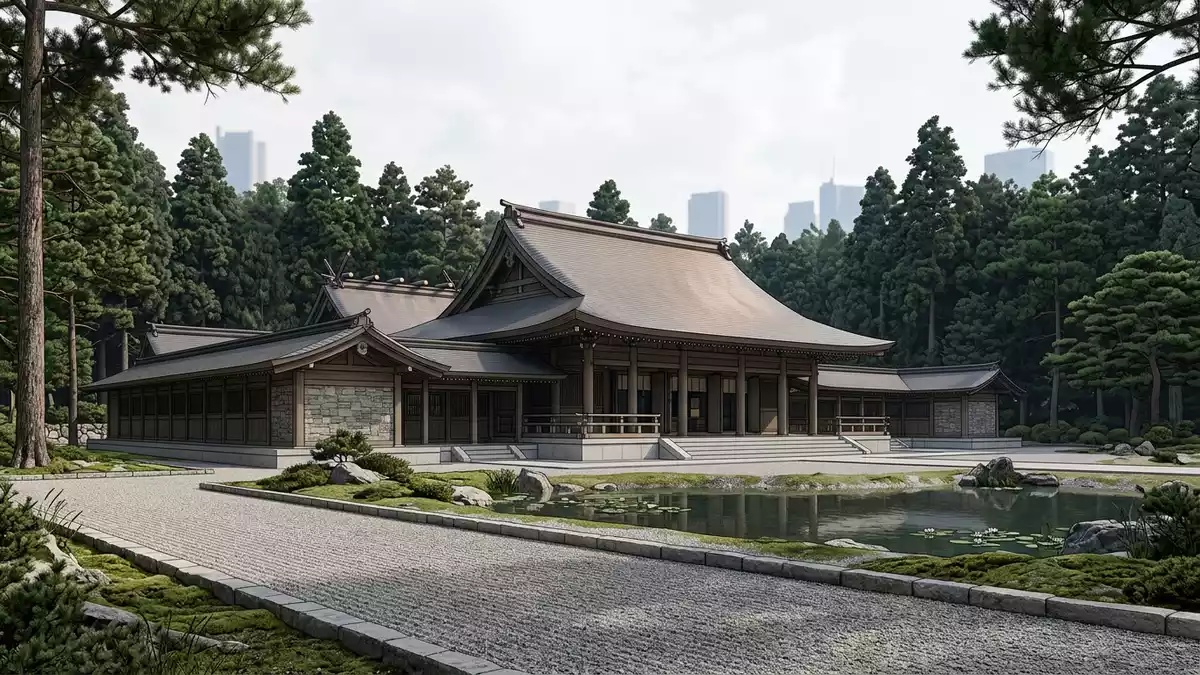
Meiji Jingu in Tokio is a Shinto shrine dedicated to Emperor Meiji and Empress Shoken, set inside a broad man-made forest that has grown into dense woodland over the course of the twentieth century. Open gravel approaches, timber buildings and towering trees together form a calm enclave between the busy districts of Shibuya and Harajuku, making the shrine one of the clearest contrasts between city and sanctuary in Japan’s capital.
A twentieth-century shrine for the Meiji era
Meiji Jingu was built in the early twentieth century to honour Emperor Meiji, who reigned from 1867 to 1912, and Empress Shoken, whose lives marked Japan’s transition through the Meiji Restoration.Meiji Jingu is a fairly modern shrine, established in 1920 The main shrine complex stands in Shibuya ward, on land that once lay at the edge of the city and has since been surrounded by transport hubs and shopping streets.Meiji Shrine is located in a forest right in the heart of Tokyo
The shrine’s architecture follows traditional Shinto forms, and the principal buildings are constructed from Japanese cypress with copper elements.Construction began in 1915 under It? Ch?ta, and the shrine was built in the traditional nagare-zukuri style, using primarily Japanese cypress and copper Courtyards, colonnades and broad gates organise the complex, while lanterns and offering boxes mark the sacred areas. The original buildings were destroyed during air raids in the Second World War and were rebuilt in the late 1950s, so visitors walk through structures that preserve the earlier layout in a post-war reconstruction.
The planned forest surrounding the shrine
What most clearly defines Meiji Jingu is the forest that encircles the shrine buildings, forming a continuous belt of greenery between the city streets and the inner courtyards. When the shrine was established, foresters designed a large evergreen woodland with a long horizon in mind, aiming for a forest that would mature into near-natural woodland over a century.Spanning approximately 700,000 square meters, the forest was planted with roughly 100,000 trees donated from across Japan The result is a thick canopy and shaded paths that now feel like established woodland rather than a young plantation.
The forest covers around 70 hectares and includes more than 100,000 trees from many different species, all donated from across Japan and planted by volunteers when the shrine was founded.Covering 70 hectares, it currently has 234 different varieties of trees, which were donated from all over Japan Paths of packed earth and gravel lead through this woodland towards the main shrine, passing under large wooden torii gates that mark the transition into the sacred precincts. On either side, the forest absorbs city noise and traffic, so only the sound of footsteps on gravel and occasional voices carries along the route.
Inner garden and surrounding cityscape
Alongside the main shrine complex, Meiji Jingu includes an inner garden that predates the shrine itself and preserves earlier layers of the site’s history. The garden, known as Meiji Jingu Gyoen or Yoyogi Gyoen, was once part of a suburban residence in the Edo period and later became an imperial garden during the Meiji period.During the Meiji period, the garden came under the supervision of the Imperial Household Agency and was frequently visited by Emperor Meiji and Empress Shoken Today it forms a separate enclosure within the wider forest, with its own paths, water features and planting.
The inner garden contains a tea house, a rest structure and an iris garden laid out around ponds and lawns, offering a different kind of green space from the wilder shrine forest.Kakuun-tei tea house, dating back to 1900 and rebuilt as an exact replica in 1958, stands within the garden alongside a thatched-roof gazebo Beyond the forest edge, Meiji Jingu is bordered by Yoyogi Park and the neighbourhoods of Harajuku and Shibuya, so train lines, fashion streets and wide park lawns all lie within walking distance of the shrine approaches.
Visiting Meiji Jingu: what travellers from Western Europe should know
- Meiji Jingu stands in Shibuya ward in central Tokyo, between Harajuku and Shibuya, with access on foot from JR Harajuku Station and subway stations serving the Chiyoda and Fukutoshin lines.
The shrine’s postal address uses Yoyogikamizonocho in Shibuya City, a name that also appears on local maps. - The main approaches to the shrine follow wide gravel paths through forest, and the route to the inner courtyard passes under large timber torii gates.
Surfaces are mostly level but unpaved, so footwear suited to walking on gravel is helpful. - Yoyogi Park lies beside the forest, and the shrine grounds connect visually with the park’s lawns and trees.
The area around Harajuku Station combines transport facilities with dense shopping streets, so the transition from platforms to woodland is abrupt. - The official language is Japanese and the currency is the Japanese yen.
Entry requirements depend on your nationality; UK travellers can check the FCDO travel advice at gov.uk/foreign-travel-advice, Irish travellers the Department of Foreign Affairs at ireland.ie.
Searching for Meiji Jingu on social platforms
These links open searches for Meiji Jingu on each platform.Frequently asked questions about Meiji Jingu
Where is Meiji Jingu located in Tokio?
Meiji Jingu stands in Shibuya ward in central Tokyo, between the districts of Harajuku and Shibuya, on land adjoining Yoyogi Park and served by JR and subway stations.
What can visitors expect during a visit to Meiji Jingu?
Visitors walk along long gravel paths through evergreen forest, pass under wooden torii gates and enter timber shrine courtyards, with the option of exploring an inner garden with ponds and a tea house.
What makes Meiji Jingu distinctive among shrines in Japan?
Meiji Jingu combines a twentieth-century Shinto shrine dedicated to Emperor Meiji and Empress Shoken with a large planned forest of donated trees, creating an unusual expanse of woodland at the centre of Tokyo.


