
Meenakshi Amman Temple and Madurai’s sculpted gateways
Published on 09/22/2026 at 23:31 | Editorial responsibility: Rafael Müller, Editor-in-Chief AD HOC NEWS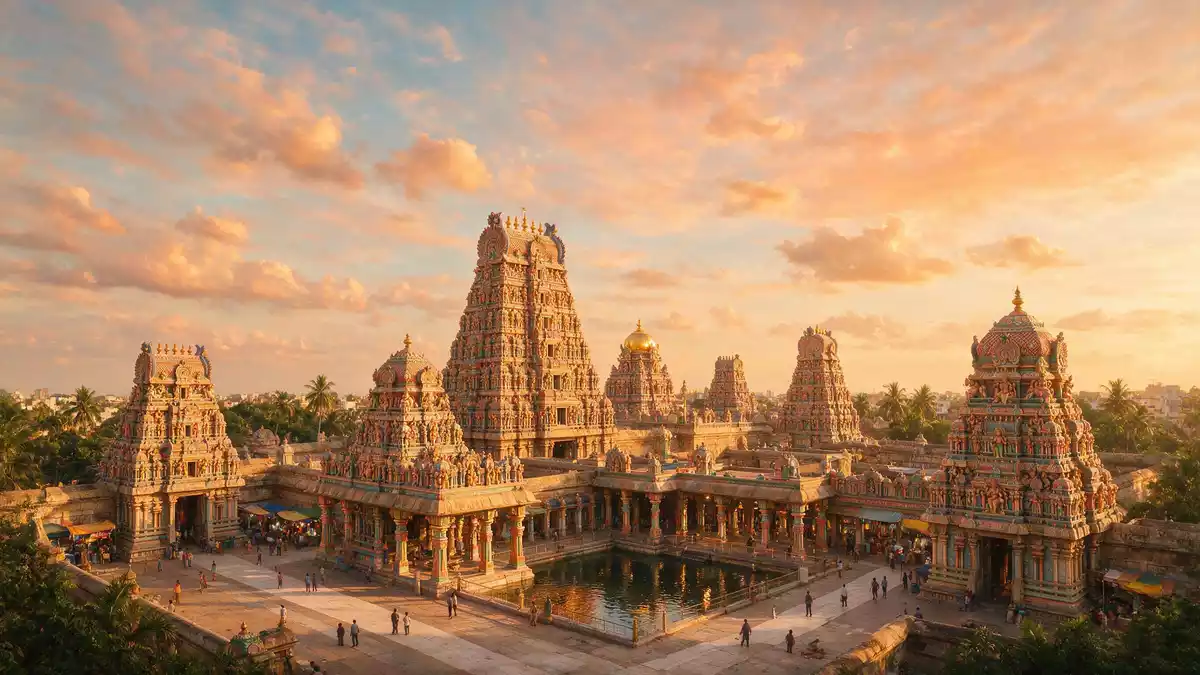
Meenakshi Amman Temple fills the centre of Madurai with sculpted gateways, painted figures and pillared halls. Its present form belongs largely to the sixteenth and seventeenth centuries, when the Nayak dynasty expanded an older Pandyan shrine into a vast Dravidian complex.
Madurai’s temple city behind sculpted gateways
Meenakshi Amman Temple is dedicated to Meenakshi and Sundareshwarar, the goddess and Shiva in their forms worshipped at Madurai. The complex is enclosed by streets and entered through gopurams, the monumental gateway towers associated with South Indian temple architecture.
The towers carry dense rows of brightly coloured divine figures, guardians, animals and ornamental details. Their surfaces turn the gateways into vertical fields of sculpture, while the precincts contain sanctuaries, courtyards, shrines and mandapams, or pillared halls. The temple’s architecture is therefore encountered as a sequence of enclosed spaces rather than as a single freestanding building.
From Pandyan foundations to Nayak expansion
References to the shrine reach into the early history of Madurai, while the earliest surviving masonry is associated with the Pandyan ruler Sadayavarman Kulasekaran I, who reigned from 1190 to 1216. the temple’s present form dates mainly from the sixteenth and seventeenth centuries.
The complex was damaged during the Delhi Sultanate campaign led by Malik Kafur in the early fourteenth century. Reconstruction and enlargement followed under the Vijayanagara Empire and the Madurai Nayaks. Vishwanatha Nayak began a major phase of rebuilding, while Thirumalai Nayak continued the work during the seventeenth century.
The Nayak period supplied much of the architectural character visible across the precincts. Ariyanatha Mudaliar is associated with the Hall of 1000 Pillars, completed in 1569. the Hall of 1000 Pillars contains 985 pillars, each contributing to the hall’s ordered stone interior.
Gopurams, mandapams and sacred interiors
The gopurams form the most recognisable elements of Meenakshi Amman Temple. The south tower rises to about 52 m, and its surface is covered with tiers of painted sculpture. Other gateways mark different approaches into the complex, creating a series of monumental thresholds.
Inside, stone columns support halls used for ritual, gathering and movement through the temple. Carved surfaces show deities, mythical creatures, floral patterns and scenes from Hindu religious traditions. The Golden Lotus Tank occupies a central place within the precinct, beside spaces connected with temple worship and literary tradition.
The temple’s central shrines belong to Meenakshi and Sundareshwarar. Their presence gives the complex its religious focus, while the surrounding halls and gateways express the architectural language of Tamil Nadu. The result is a sacred compound combining sculpture, colour, processional routes and enclosed courtyards.
Visiting Meenakshi Amman Temple: what travellers from Western Europe should know
- Meenakshi Amman Temple stands in central Madurai, Tamil Nadu, within the historic city formed around the temple precinct.
- Madurai Junction railway station connects the city with the wider Indian rail network. The temple lies within the central urban area, where approach streets lead towards its gopurams.
- The visit moves through gateways, courtyards and pillared halls. Stone flooring, steps and changing levels occur within the large complex.
- The official language is Tamil and the currency is the Indian rupee.
Searching for Meenakshi Amman Temple on social platforms
These links open searches for Meenakshi Amman Temple on each platform.
Frequently asked questions about Meenakshi Amman Temple
Where is Meenakshi Amman Temple?
Meenakshi Amman Temple is in Madurai, a city in Tamil Nadu in southern India. The complex occupies the historic centre of the city.
What can visitors expect inside?
The complex contains gopurams, shrines, courtyards, sculpted pillars, painted surfaces and the Golden Lotus Tank. Movement takes place through several enclosed architectural spaces.
What makes the temple distinctive?
Its distinctive character comes from the combination of Nayak-era expansion, towering sculpted gateways and the paired shrines of Meenakshi and Sundareshwarar. The Hall of 1000 Pillars adds a major stone interior to the complex.


