
Meenakshi Amman Temple and its painted towers of Madurai
Published on 09/19/2026 at 15:08 | Editorial responsibility: Rafael Müller, Editor-in-Chief AD HOC NEWS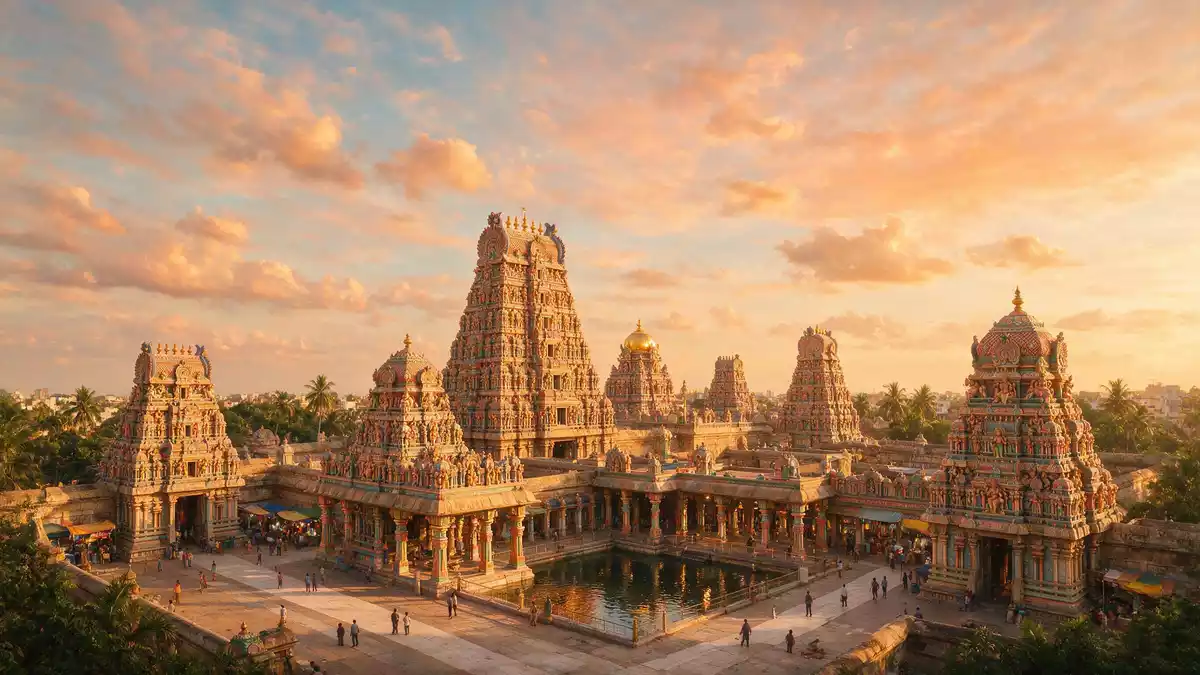
Meenakshi Amman Temple in Madurai is a vast Dravidian temple-city, a walled rectangle of towers, halls and courtyards whose present form belongs above all to the Nayak rulers of the sixteenth and seventeenth centuries. The complex is dedicated to the goddess Meenakshi and her consort Sundareswarar, a form of Shiva, and it stands in the historic core of Madurai in Tamil Nadu, India.
Painted gateway towers over a temple-city
From the streets around Meenakshi Amman Temple, the most striking elements are its gopurams, the steeply rising gateway towers covered with layers of sculpted figures picked out in vivid colours against masonry. These towers punctuate the outer walls of the complex, forming entrances that mark the transition from the busy urban grid of Madurai into the dense sequence of courtyards and halls inside the temple precinct.towering gopuram gatehouses The sculptures on the gopurams include deities from the Shaiva and Shakta traditions, mythological beings and ornamental motifs, arranged in horizontal tiers that climb towards the summit of each tower.
The present temple-city stands on an ancient sacred site that textual and inscriptional evidence link to the Pandya dynasty, but the majority of the built fabric visitors see today dates from the Nayak period.in its present form built in the 16th–17th centuries Many of the towering gateways and major mandapams, or pillared halls, were raised under rulers such as Vishwanatha Nayak and Thirumalai Nayak, whose projects turned the temple into a kind of city within the city, with concentric streets radiating around the sanctums.Vishwanatha Nayak and Ariyanatha Mudaliar laid out the temple and city
Layers of history in stone
Meenakshi Amman Temple is traditionally dated to an early phase of Madurai’s history, with references in Sangam-era Tamil literature and seventh-century Shaiva hymns, but the surviving stone structures show clear phases of rebuilding.references in Sangam literature and Thevaram hymns Archaeological and textual accounts point to substantial Pandya-period work in the late twelfth and early thirteenth centuries, followed by a destructive invasion under the Delhi Sultanate general Malik Kafur in the early fourteenth century that left the complex damaged and worship interrupted for years.Malik Kafur sacked Madurai in 1311
Control of Madurai later passed to the Vijayanagara Empire, under whose rule the temple was reconsecrated and its precincts rebuilt with defensive walls and renewed shrines.rebuilding under Vijayanagara rule The most extensive expansion followed under the Madurai Nayaks from the sixteenth century onwards, when rulers such as Vishwanatha Nayak and Thirumalai Nayak oversaw a programme that added many of the present gopurams and large halls, including the celebrated thousand-pillar hall whose completion is dated to 1569.Hall of 1000 Pillars completed in 1569 Inscriptions on foundations and gateways record donations and building campaigns from successive dynasties, so the temple’s stone surfaces carry both religious imagery and documentary traces of its history.
Dravidian layout, sacred tank and pillared halls
The plan of Meenakshi Amman Temple follows Dravidian architectural conventions, with a series of concentric rectangular enclosures, or prakarams, around the innermost sanctums. Within these rings, processional paths lead past shrines and mandapams, while the outermost walls hold the gopurams that define the temple’s skyline.three concentric prakarams Near the centre of the complex lies a sacred tank, around which devotional and ritual life is organised, and whose presence is a characteristic feature of major South Indian Shaiva temples.
Among the many mandapams inside Meenakshi Amman Temple, the thousand-pillar hall is one of the most documented and architecturally significant. Despite its name, surveys count 985 pillars, but the hall’s effect comes from the long vistas of aligned stone columns with carved capitals and bases, framing open floor space used for gatherings and ceremonial movement.985 pillars in the Thousand Pillar Hall Across the complex, stone surfaces carry reliefs of deities, narrative scenes and decorative patterns, while the gopurams bear stucco forms renewed with colour on a regular repainting cycle.
Visiting Meenakshi Amman Temple: what travellers from Western Europe should know
- Meenakshi Amman Temple stands in the centre of Madurai, a city in the state of Tamil Nadu in southern India, and is reached along the dense street network of the old city.
- Within the complex, movement between levels and towers involves climbing staircases that can be narrow in sections, particularly in upper parts of some structures.
- Madurai lies on the fertile plain of the Vaigai River, and the temple’s precincts are integrated into the surrounding urban fabric, with markets and streets abutting the outer walls.
- The official language is Tamil and the currency is the Indian rupee.
- Entry requirements depend on your nationality; UK travellers can check the FCDO travel advice at gov.uk/foreign-travel-advice, Irish travellers the Department of Foreign Affairs at ireland.ie.
Searching for Meenakshi Amman Temple on social platforms
These links open searches for Meenakshi Amman Temple on each platform.
Frequently asked questions about Meenakshi Amman Temple
Where is Meenakshi Amman Temple located?
Meenakshi Amman Temple stands in the city of Madurai in the Indian state of Tamil Nadu, in the south of the country.
What should visitors expect inside the temple complex?
Visitors encounter a dense sequence of courtyards, shrines, pillared halls and a central sacred tank, all enclosed within high walls and entered through tall gopurams.
What makes Meenakshi Amman Temple distinctive among South Indian temples?
The temple is notable for its concentration of towering painted gateway towers, its Nayak-period thousand-pillar hall and its role as a temple-city laid out with concentric streets around twin sanctums.


