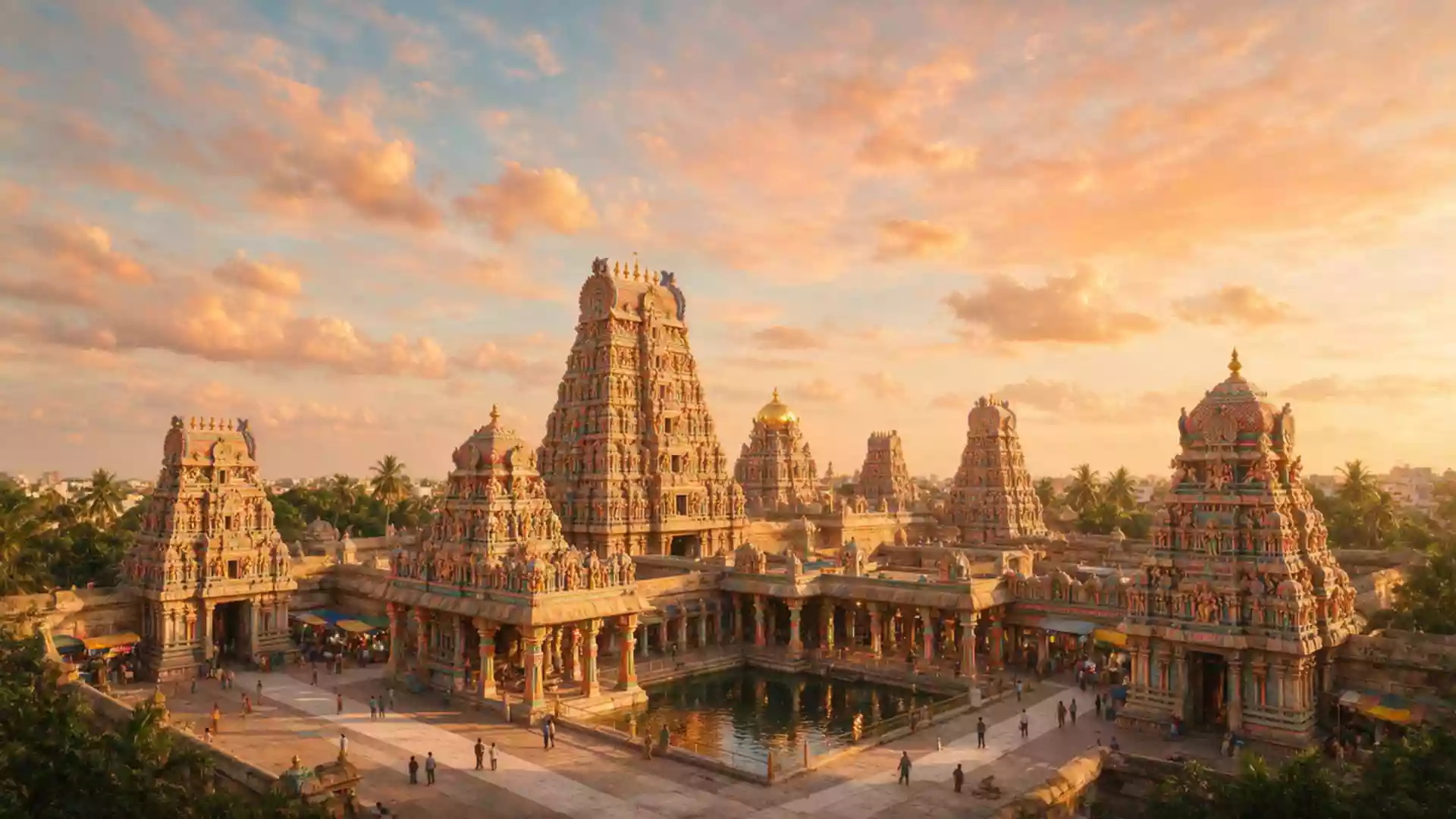
Meenakshi Amman Temple and its painted towers of Madurai
Published on 09/09/2026 at 09:52 | Editorial responsibility: Rafael Müller, Editor-in-Chief AD HOC NEWS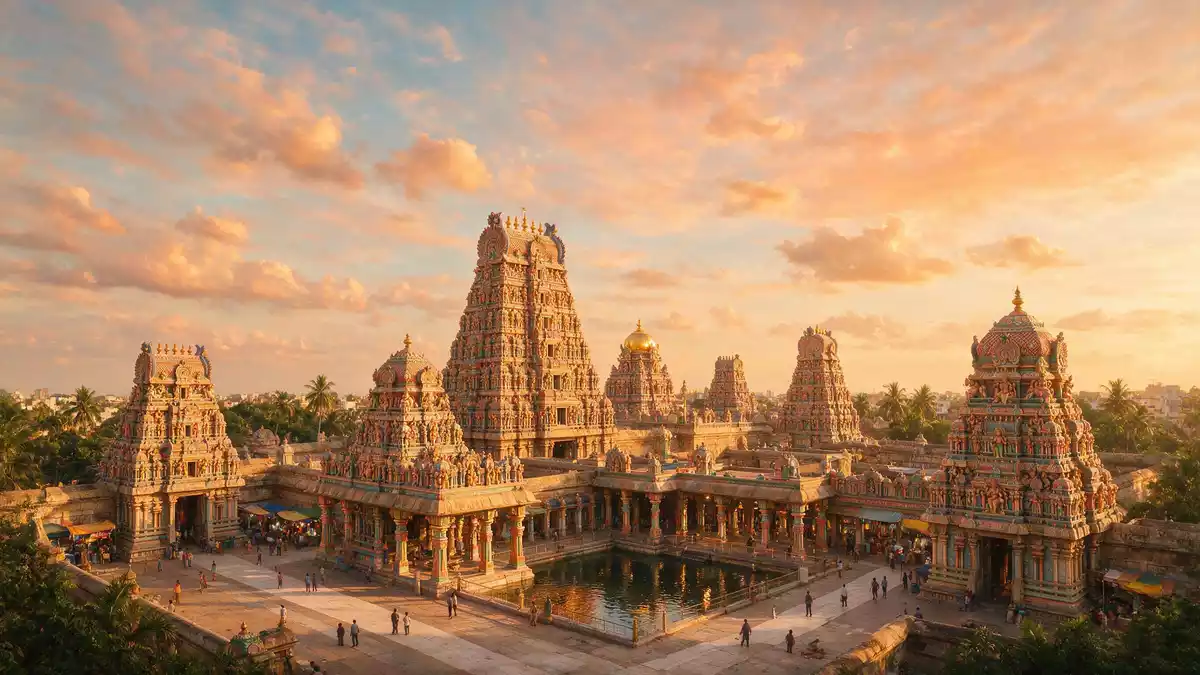
Meenakshi Amman Temple in Madurai is a vast Dravidian temple-city where brightly painted gateway towers, pillared halls and shrines form a dense, sculptural landscape of stone and colour. Rooted in ancient Pandyan Madurai yet largely reshaped under the Nayak dynasty in the sixteenth and seventeenth centuries, it offers an encounter with South Indian temple architecture on an urban scale.
A temple-city shaped by dynasties and legend
Meenakshi Amman Temple stands on the southern bank of the Vaigai River in the Tamil Nadu city of Madurai, a historic capital of the Pandya rulers of southern India.historic Hindu temple in Madurai The complex is dedicated to Meenakshi, a form of the goddess Parvati, and Sundareswarar, a form of Shiva, whose union is central to the temple’s ritual and narrative life.dedicated to Meenakshi and Sundareswarar
The sacred origins of the site reach back many centuries, with literary references linking Meenakshi worship to the Pandyan period and Tamil Sangam poetry.early references in Sangam literature In its present form, however, the temple is in large part a creation of the sixteenth and seventeenth centuries, when the Madurai Nayaks rebuilt and dramatically expanded the complex after earlier destruction.rebuilt by Vishwanatha Nayak and Tirumala Nayak Under figures such as Vishwanatha Nayak and King Tirumala Nayak, the great gateways, mandapams and processional streets were laid out, turning the temple into a walled city within the wider urban fabric.
Painted gopurams and the Dravidian temple form
The most striking feature of Meenakshi Amman Temple is its cluster of towering gopurams, the sculpted gateway towers that mark the entrances and inner enclosures of the complex.towering gopurams and halls These structures rise above the surrounding streets in steep tiers covered with stucco figures of deities, guardians, animals and mythic scenes, all finished in vivid pigments that give the stone an almost textile-like surface. From a distance they form a dense crown over the temple-city, while close up they resolve into thousands of individual sculptural episodes.
Meenakshi Amman Temple is a textbook example of Dravidian temple architecture, with concentric enclosures, high outer walls and stone mandapams aligned along processional axes.prime example of Dravidian architecture The complex extends across about 14 acres (around 5.7 ha), enclosing multiple courtyards and subsidiary shrines.temple complex covers around 14 acres Stone corridors frame sacred tanks and link the main sanctuaries with smaller spaces devoted to particular deities, festival images and ritual functions. The architectural language is consistent: granite and other stones form the structural skeleton, while stucco and paint bring the surfaces to life.
Inner courts, sacred tank and the thousand-pillar hall
Within the outer walls, the temple is organised around a series of precincts leading towards the twin sanctums of Meenakshi and Sundareswarar. In one central courtyard lies the Golden Lotus Tank, a square water basin lined with steps, which acts as a quiet visual counterpoint to the vertical drama of the gopurams.Golden Lotus Tank within the complex Around this tank, colonnaded walks frame views back towards the painted towers and provide a sense of the temple’s layered construction.
Among the halls, the so-called thousand-pillar hall is one of the best-known architectural set pieces of Meenakshi Amman Temple. Raised in the sixteenth century, it brings together an array of carved stone columns, each bearing sculpted deities, guardians or ornamental motifs along its length.corridors and the thousand-pillar hall The hall’s regular grid and rhythmic bays make it one of the clearest demonstrations of how structural logic and decorative richness are woven together in South Indian temple building.
Visiting Meenakshi Amman Temple: what travellers from Western Europe should know
- Meenakshi Amman Temple stands in the centre of Madurai in Tamil Nadu, in southern India, not far from the Vaigai River, and is reached through the city’s streets and junctions.
- The temple complex is extensive, with multiple courtyards, long stone corridors and stairways down to the Golden Lotus Tank; moving between its precincts involves walking over stone floors and climbing steps.
- Madurai is served by Madurai Junction railway station and Madurai Airport on the edge of the city, both providing access to the wider region of Tamil Nadu.
- The official language of Tamil Nadu is Tamil and the currency is the Indian rupee.
- Entry requirements depend on your nationality; UK travellers can check the FCDO travel advice at gov.uk/foreign-travel-advice, Irish travellers the Department of Foreign Affairs at ireland.ie.
Searching for Meenakshi Amman Temple on social platforms
These links open searches for Meenakshi Amman Temple on each platform.
Frequently asked questions about Meenakshi Amman Temple
Where is Meenakshi Amman Temple located?
Meenakshi Amman Temple is in Madurai, in the state of Tamil Nadu in southern India, on the southern side of the Vaigai River.
What can visitors expect when exploring the temple?
Visitors encounter a large, enclosed temple-city of painted gopurams, stone mandapams, shrines and the Golden Lotus Tank, with movement largely on foot along stone corridors.
What makes Meenakshi Amman Temple distinctive among South Indian temples?
The combination of multiple towering, painted gateway towers, the twin sanctums for Meenakshi and Sundareswarar, and extensive mandapams gives the Madurai complex a particularly dense and urban character.