
Medina of Tunis and its layered old city streets
Published on 09/08/2026 at 10:09 | Editorial responsibility: Rafael Müller, Editor-in-Chief AD HOC NEWS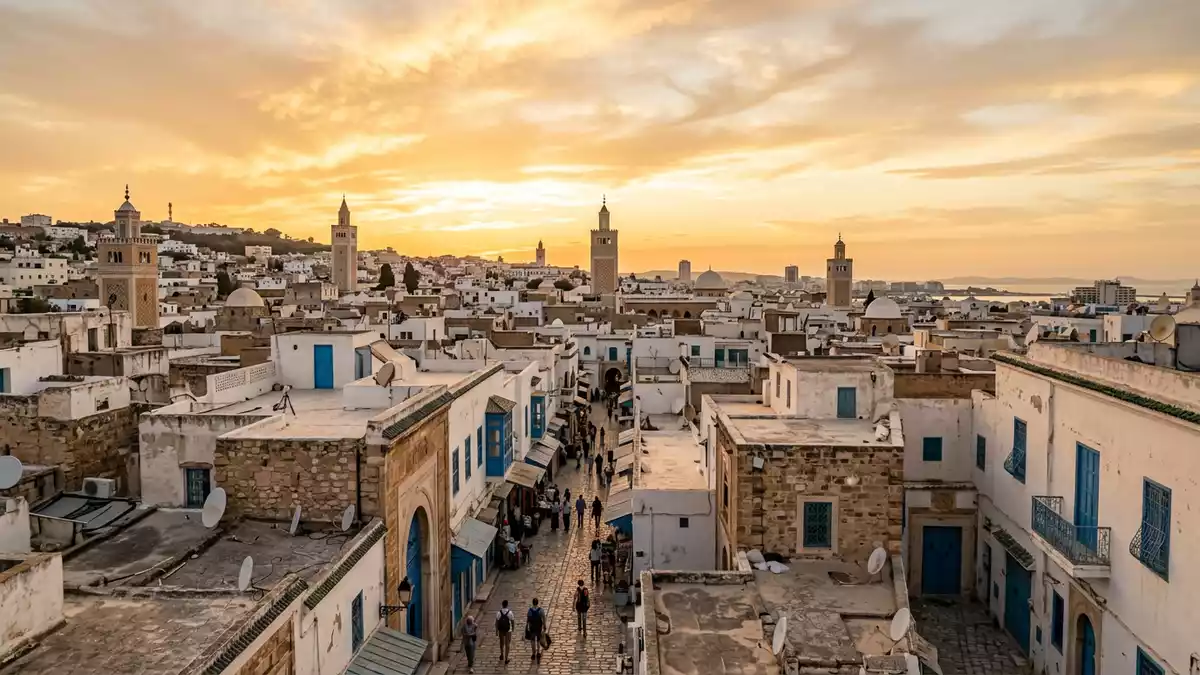
Medina of Tunis is the old city at the centre of Tunis, shaped by an 8th-century core and later quarters to the north and south. It is a UNESCO World Heritage site, and its streets still hold mosques, palaces, gates and markets within a dense urban fabric.
The old city core of Medina of Tunis
The medina belongs to the first Arabo-Muslim towns of the Maghreb and is linked to 698 A.D. as a formative date. The World Heritage property includes the central medina and the northern and southern suburbs, with some 700 monuments spread through the historic fabric.
Its architectural character combines religious buildings, domestic quarters and commercial spaces. Named elements such as the Zitouna Mosque, the Kasbah Mosque, Bab Bhar Gate and the Souq el-Attarine give the district its historic rhythm.
Dynasties, monuments and urban fabric
The medina is tied to the Almohads and the Hafsids, and Tunis stood among the major cities of the Islamic world from the twelfth to the sixteenth century. That period left a city of mosques, mausoleums, madrasas, fountains and houses that still structure the old quarter.
The UNESCO description links the place to several dynasties, including the Banu Khurassan and the Husseinits, and notes its role as a capital under different powers. It also records the medina as an example of an urban settlement that has kept its overall form, including its narrow, twisting streets.
Gates, souqs and domestic courts
Bab Jedid and Bab Bhar are among the surviving gates, while Souq ech-Chaouachia and Souq el-Attarine remain part of the historic market network. Dar el-Bey, Dar Hussein, Dar Ben Abdallah and Dar Lasram show the range of palace and noble-house architecture associated with the medina.
The same urban ensemble also includes the Tourbet el Bey, the Medrasa Es-Slimanya, El-Mouradia and the El Attarine military barracks. Together they give Medina of Tunis a rare concentration of civic, religious and residential buildings within one compact historic district.
Visiting Medina of Tunis: what travellers from Western Europe should know
- The medina lies in Tunis, in north-eastern Tunisia, a few kilometres from the sea. It is part of the city centre and is reached on foot, by taxi or through the wider street network around the old walls.
- The historic streets are narrow and irregular, and the district includes gates, souqs and enclosed courtyards. Walking routes turn through a dense built-up quarter rather than an open grid.
- The official language is Arabic and the currency is the Tunisian dinar.
- Entry requirements depend on your nationality; UK travellers can check the FCDO travel advice at gov.uk/foreign-travel-advice, Irish travellers the Department of Foreign Affairs at ireland.ie.
Searching for Medina of Tunis on social platforms
These links open searches for Medina of Tunis on each platform.
Frequently asked questions about Medina of Tunis
Where is Medina of Tunis?
Medina of Tunis lies in the centre of Tunis, the capital of Tunisia. It sits in north-eastern Tunisia and includes the old city core plus adjoining historic quarters.
What should a visit feel like?
Expect a dense historic district of gates, souqs, mosques, houses and courtyards. The streets are narrow and twisting, so the place reads as a lived-in urban quarter rather than a single monument.
What makes Medina of Tunis distinctive?
Its strength is the survival of a layered Islamic city with a long historical span, from the 8th century to later dynastic additions. The concentration of monuments, markets and noble houses gives it a rare urban completeness.


