
Medina of Tripoli: Libya’s walled harbour quarter
Published on 09/04/2026 at 16:24 | Editorial responsibility: Rafael Müller, Editor-in-Chief AD HOC NEWS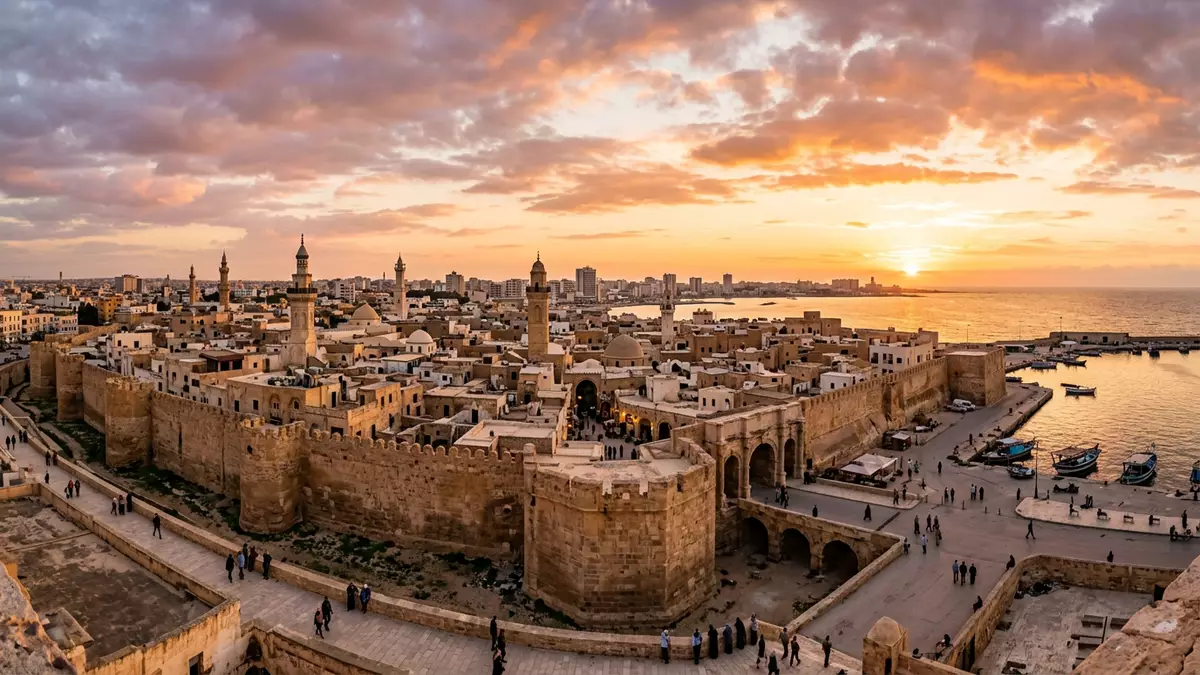
Medina of Tripoli is the historic old city of Tripolis in Libya, a compact walled quarter between the Mediterranean harbour and the newer districts of the capital. Its dense lanes and enclosed courtyards preserve a layered urban fabric that reaches back to ancient Oea and later Ottoman rule, giving this harbour-side district a character distinct from the broad avenues around it.
The old city between harbour and castle
Medina of Tripoli forms the ancient walled centre of Tripolis along the harbour, bounded by stretches of fortification that mark the edge between the old and new quarters of the city.The ancient walled city From the waterfront, the old town rises in a compact mass of buildings, their roofs and walls packed tightly behind the harbour embankment and the traffic of the coastal road.
On the harbour side, Medina of Tripoli is dominated by a fortified complex often described as a castle, whose origins lie in sixteenth-century Spanish works and later Ottoman additions.a 16th-century Spanish castle Close by stands the Roman arch of Marcus Aurelius, a marble triumphal arch dating from 163 CE that survives as one of the most visible Roman remains in the city and anchors the medina’s connection to its ancient past.the Marcus Aurelius triumphal arch
Layers from Phoenician Oea to Ottoman Tripoli
Tripoli began as the Phoenician port of Oea before later Roman development, and the street pattern and building fabric of Medina of Tripoli reflect this long history in stone and plaster.the city's old town Roman columns and capitals reappear as spolia, reused in later structures where coloured shafts and carved marble fragments stand in arcades, doorways and interior courtyards.Roman spolia in the Medina These elements sit alongside Arab–Islamic and Ottoman-era buildings, making the medina a compact record of successive Mediterranean cultures.
The overall form of Medina of Tripoli owes much to fortification works undertaken in the sixteenth century, when Spanish and later Ottoman powers refortified the town and gave the old city a roughly pentagonal outline.a pentagonal form created by Spanish fortifications Within this frame, streets twist through residential quarters, trading areas and religious complexes, and the resulting plan expresses centuries of growth, adaptation and rebuilding rather than a single planned scheme.
Gates, mosques and markets within the walls
Medina of Tripoli is entered through historic gateways that once punctured the city walls, including Bab Hawwara towards the south-east, Bab Zenata to the west and Bab al-Bahr close to the sea.gates such as Bab Hawwara, Bab Zenata and Bab al-Bahr From these points, passages lead into a network of lanes that still carry a pre-modern scale, with routes that turn under arches and between closely spaced houses. Many streets are narrow, with uneven paving and occasional covered segments where buildings bridge the way overhead.
Within the walls, Medina of Tripoli contains mosques, markets and religious schools, as well as caravanserais and former consular buildings from European presence in the city.archaeological and historical buildings Notable religious landmarks include the Gurgi Mosque, completed in 1883, and the Karamanli Mosque, dating to the eighteenth century and distinguished by its octagonal minaret, both of which stand within or close to the old quarter.Gurgi and Karamanli mosques Souks specialising in textiles, household goods and jewellery occupy streets and small squares, where shops face directly onto the passageways.
Visiting Medina of Tripoli: what travellers from Western Europe should know
- Medina of Tripoli lies along the harbour in central Tripolis on Libya’s Mediterranean coast and is reached from the wider city by road and local streets.
- The old quarter consists of narrow streets and uneven surfaces, with some routes passing under arches and through constricted passages that require steady footing when walking.
- The historic gates of Bab Hawwara, Bab Zenata and Bab al-Bahr mark traditional entry points to the old city, and nearby modern streets lead from these areas towards Martyrs’ Square and the coastal road.
- The official language is Arabic and the currency is the Libyan dinar.
- Entry requirements depend on your nationality; UK travellers can check the FCDO travel advice at gov.uk/foreign-travel-advice, Irish travellers the Department of Foreign Affairs at ireland.ie.
Searching for Medina of Tripoli on social platforms
These links open searches for Medina of Tripoli on each platform.
Frequently asked questions about Medina of Tripoli
Where is Medina of Tripoli located?
Medina of Tripoli is the historic walled old city of Tripolis, Libya, lying along the harbour on the country’s Mediterranean coast and forming the centre of the capital.
What should visitors expect inside the old city?
Visitors encounter narrow streets, arches and covered passages, with mosques, souks, historic houses and small squares forming a dense urban fabric within the surrounding walls.
What makes Medina of Tripoli distinctive among old Mediterranean ports?
The medina combines a roughly pentagonal fortified outline, Roman remains such as the Marcus Aurelius arch and Ottoman-period mosques and markets, all concentrated beside the harbour.


