
Medina of Marrakesh and the red walls of an Almoravid city
Published on 09/14/2026 at 15:05 | Editorial responsibility: Rafael Müller, Editor-in-Chief AD HOC NEWS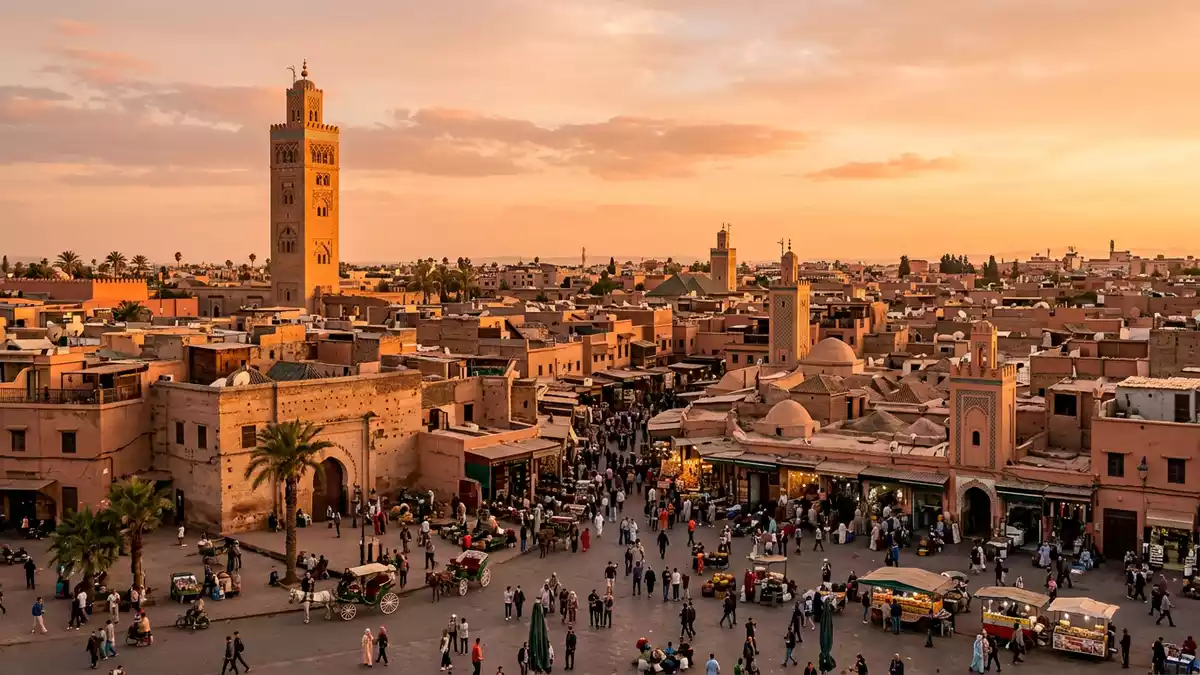
The Medina of Marrakesh is the historic walled core of Marrakesch in Morocco, founded as an Almoravid capital in the eleventh century and later shaped by Almohad rulers.founded in the early Almoravid period It is inscribed as a cultural UNESCO World Heritage Site, recognising a dense fabric of ramparts, gates, mosques, palaces, souks and gardens within its historic area.UNESCO World Heritage inscription
Red ramparts, monumental gates and an urban outline
The Medina of Marrakesh is enclosed by extensive ramparts of red clay, a material that helped give the wider city its “Red City” identity.walls of red clay These fortifications date back to the twelfth century, when Almoravid and Almohad builders established substantial walls around the city, creating a defined boundary between the medina and the surrounding Haouz plain.twelfth-century walls
The circuit of walls is punctuated by monumental gates, including Bab Agnaou, which formed part of the Almohad kasbah ensemble and marked an entrance to a royal quarter within the medina.Bab Agnaou gate Within the walls lies a network of lanes, small squares and neighbourhoods that together form an area of several hundred hectares, reflecting centuries of Islamic urban development in Marrakesch.extended historic area
Mosques, palaces and gardens from successive dynasties
The Almohad dynasty, which took Marrakesch in 1147, left one of the most recognisable landmarks of the medina in the form of the Koutoubia Mosque and its minaret.Almohads took Marrakech in 1147 The mosque’s tower rises above the surrounding roofs and has become a reference point for orientation across the old city, with its proportions echoed in other later North African minarets.Koutoubia minaret
Later dynasties added further monuments within the medina, including the Saadian Tombs and El Badi Palace under Saadian rulers in the sixteenth century, and the Bahia Palace under the Alawite dynasty.Saadian Tombs and palaces The Agdal and Menara Gardens, laid out and redesigned between the early nineteenth century and 1859, form irrigated, planned landscapes with water basins and pavilions that are included within the World Heritage property.Agdal and Menara Gardens
A living medina of markets, crafts and squares
The Medina of Marrakesh functions as a living historic town, with houses, fondouks, artisanal workshops and souks still occupying the dense urban fabric described by UNESCO.houses, souks and fondouks Within the medina, lanes lead to market streets selling textiles, metalwork, leather goods and spices, alongside caravanserai courtyards that historically served travelling merchants.historic markets and crafts
Jemaa el-Fnaa square, lying close to the Koutoubia Mosque, forms a wide, open space at the edge of the medina that has long been a meeting point between the walled city and routes across the Marrakesh–Safi region.Jemaa el-Fnaa square Surrounding neighbourhoods contain religious and educational buildings, such as the Ben Youssef mosque and medersa, whose courtyards and teaching rooms reflect Moroccan Islamic architectural traditions.Ben Youssef mosque and medersa
Visiting Medina of Marrakesh: what travellers from Western Europe should know
- The Medina of Marrakesh lies in Marrakesch in southern Morocco, on the Haouz plain at the foot of the High Atlas Mountains; the walled area is reached on foot from modern districts and by road leading to gates such as Bab Agnaou.
- Within the medina, movement is largely along narrow lanes and passages, some with uneven surfaces and steps, so visiting involves walking through confined streets and small squares rather than wide thoroughfares.
- Jemaa el-Fnaa square forms a broad open space on the edge of the medina, and nearby streets connect towards the Agdal and Menara Gardens, which lie at some distance from the core of the old city.
- The official language is Arabic and the currency is the Moroccan dirham.
- Entry requirements depend on your nationality; UK travellers can check the FCDO travel advice at gov.uk/foreign-travel-advice, Irish travellers the Department of Foreign Affairs at ireland.ie.
Searching for Medina of Marrakesh on social platforms
These links open searches for Medina of Marrakesh on each platform.
Frequently asked questions about Medina of Marrakesh
Where is the Medina of Marrakesh located?
The Medina of Marrakesh is the historic walled centre of Marrakesch in southern Morocco, lying on the Haouz plain near the High Atlas Mountains.
What should visitors expect on a visit to the Medina of Marrakesh?
Visitors encounter a dense network of lanes, markets, mosques, palaces and gardens within the ramparts, with Jemaa el-Fnaa square and Koutoubia Mosque as prominent landmarks.
What makes the Medina of Marrakesh distinctive among historic cities?
It combines eleventh-century Almoravid foundations, major Almohad monuments such as the Koutoubia, later Saadian and Alawite palaces, and irrigated gardens, all recognised as a UNESCO World Heritage cultural site.


