
Medina of Marrakesh and its red ramparts
Published on 08/30/2026 at 12:40 | Editorial responsibility: Rafael Müller, Editor-in-Chief AD HOC NEWS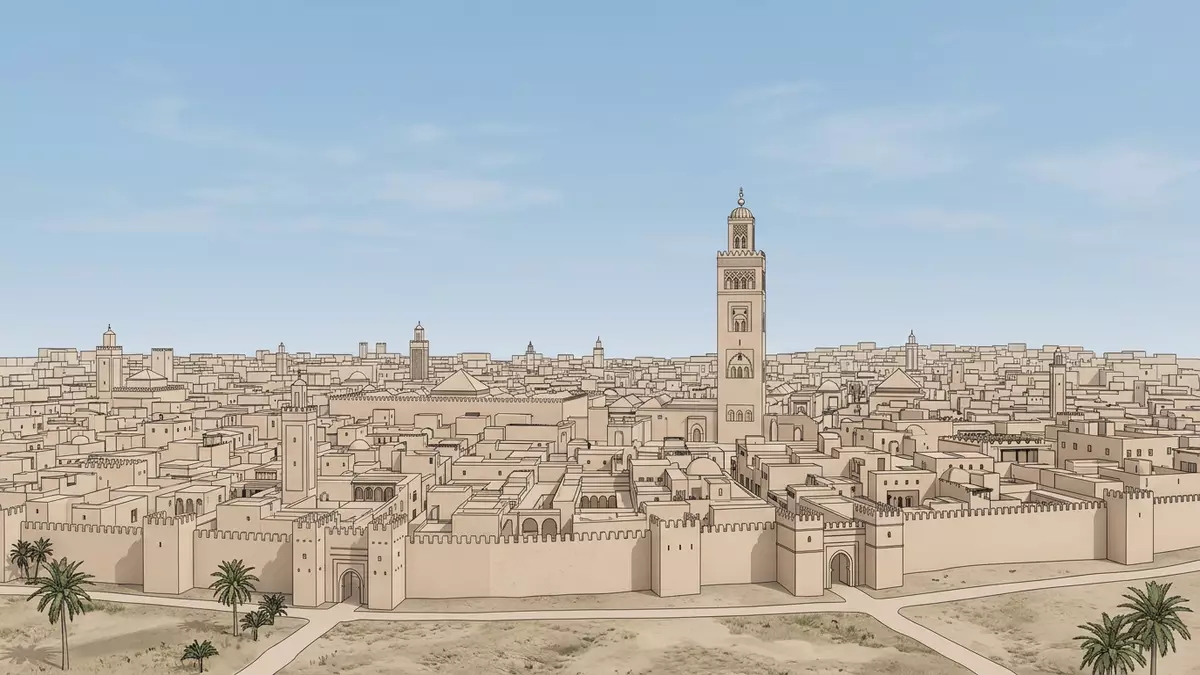
Medina of Marrakesh is the historic core of Marrakesh, enclosed by ramparts, gates and a fabric of lanes that still reads as a walled city. Its identity is tied to the Almoravid foundation and to its 1985 World Heritage listing.
Almoravid streets and Almohad monuments
The medina began in the 1070–72 Almoravid period, then gained many of the monuments that define its profile under later dynasties. The Koutoubia Mosque, the Kasbah, battlements, monumental doors and gardens belong to that layered urban history.
Within the same area, the Koutoubia minaret rises above the roofs as a fixed point in the cityscape. UNESCO describes it as a 77-metre minaret and an essential monument of Muslim architecture.
Red walls, gates and a dense urban fabric
The medina is not a single monument but a compact urban landscape of houses, markets and religious buildings within fortifications. Its walls and gates remain part of the place’s visual identity, and the red earthen tone links the whole area to Marrakesh’s nickname, the Red City.
The city’s enclosure also gives the medina a clear edge on the map. The gates create a sequence of entries into districts that preserve older street patterns, while the interior remains closely built and rhythmically varied.
A living quarter of courts, souks and mosques
Medina of Marrakesh is still recognisable as a lived-in historic quarter rather than an isolated museum zone. Courtyard houses, souks, mosques and gardens sit within the same urban field, and that mixture is part of its value.
The UNESCO record also links the medina with the Gardens of Aguedal, Ménara and the Palmeraie, all part of the wider historic setting. Together they show how the city combines masonry, planting and open ground within one long-established urban form.
Visiting Medina of Marrakesh: what travellers from Western Europe should know
- The medina sits in central Marrakesh, within the city’s older enclosed core. It is reached through the street network and the gates in the ramparts.
- The terrain is a dense mix of lanes, walls and courtyard-based buildings. The urban fabric is compact, and many routes run through narrow passages.
- The Koutoubia Mosque stands near the southwest side of the medina. Its minaret serves as a clear landmark across the historic centre.
- The official language is Arabic and the currency is the Moroccan dirham.
Searching for Medina of Marrakesh on social platforms
These links open searches for Medina of Marrakesh on each platform.
Frequently asked questions about Medina of Marrakesh
Where is Medina of Marrakesh?
It is the historic core of Marrakesh in Morocco, enclosed by ramparts and gates. The Koutoubia area lies on its southwest side.
What does a visit involve?
The place is a dense old city quarter of lanes, souks, mosques and houses. Walking through it means moving between gates, narrow passages and open market streets.
What makes it distinctive?
Its strength lies in the survival of a walled medieval city with later dynastic layers, especially the Almoravid foundation and the Almohad monuments. The Koutoubia minaret and the ramparts are among its most recognisable features.