

Medina of Essaouira and its fortified seafront
Published on 08/24/2026 at 07:09 | Editorial responsibility: Rafael Müller, Editor-in-Chief AD HOC NEWS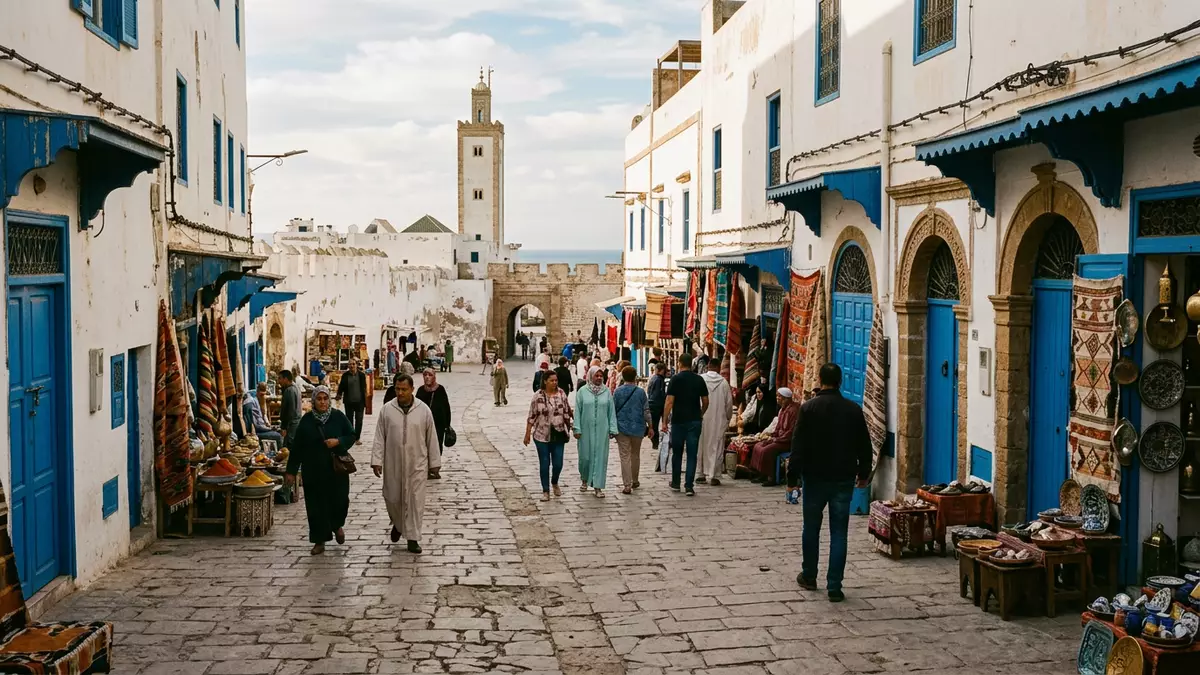
Medina of Essaouira is the fortified old town of Essaouira on Morocco’s Atlantic coast, and its walls remain the place’s defining outline. The medina was inscribed on the UNESCO World Heritage List in 2001, and its form reflects the work of Sultan Sidi Mohammed ben Abdallah and the town planner Théodore Cornut in the eighteenth century.UNESCO World Heritage
Ramparts, gates and a maritime grid
The medina’s streets follow a regular grid, unusual for many North African historic centres, and its enclosure is made by walls, bastions and gateways. Skala de la Ville and the harbour front give the town its most recognisable edges, with stone platforms and cannon-lined stretches facing the sea.late 18th-century fortified town
The UNESCO description places the town in the late eighteenth century and links its military character to European principles adapted in a North African setting. That combination is visible in the compact scale of the old town and in the disciplined geometry of the fortifications.European military architecture
Essaouira as a trading port
Essaouira has long been tied to trade across the Atlantic and into the Sahara hinterland, and that history gives the medina a commercial rather than purely defensive character. The port relationship is part of the town’s identity, and it explains the presence of gates, harbour access and a planned urban core.international trading seaport
The old city is also associated with Mogador, its former name, which appears in the UNESCO listing and in historical writing on the town. That older name underlines the layered history of a place that has been known through more than one cultural frame.formerly named Mogador
Stone walls and Atlantic edges
The most immediate experience of Medina of Essaouira is its stone enclosure against the Atlantic. Sea walls, bastions and gateways shape the perimeter, while the interior stays low-rise and tightly ordered.
That physical clarity is part of the appeal of the place as an urban ensemble. Rather than a single monument, it is a whole historic district in which walls, lanes, harbour edges and squares belong to the same designed setting.World Heritage Site in Morocco
Visiting Medina of Essaouira: what travellers from Western Europe should know
- Essaouira lies on Morocco’s Atlantic coast, and the medina forms the historic core of the city.
- The old town is enclosed by walls and crossed by narrow streets, so the clearest way through is on foot.
- The sea-facing ramparts and harbour edge are among the most distinctive parts of the site, with long stone platforms and cannon positions.
- English is widely understood in tourist settings, while Arabic is the official language and the currency is the Moroccan dirham.
- Entry requirements depend on your nationality; UK travellers can check the FCDO travel advice at gov.uk/foreign-travel-advice, Irish travellers the Department of Foreign Affairs at ireland.ie.
Searching for Medina of Essaouira on social platforms
These links open searches for Medina of Essaouira on each platform.
Frequently asked questions about Medina of Essaouira
Where is Medina of Essaouira?
It is the historic walled centre of Essaouira on Morocco’s Atlantic coast.
What does a visit involve?
The medina presents walls, gates, narrow streets and harbour-facing fortifications. Its layout is compact and readable on foot.
What makes it distinctive?
The combination of a planned eighteenth-century grid, seafront fortifications and UNESCO World Heritage status gives the place its identity.


