

Matterhorn, a solitary pyramid above Zermatt
Published on 08/29/2026 at 19:20 | Editorial responsibility: Rafael Müller, Editor-in-Chief AD HOC NEWS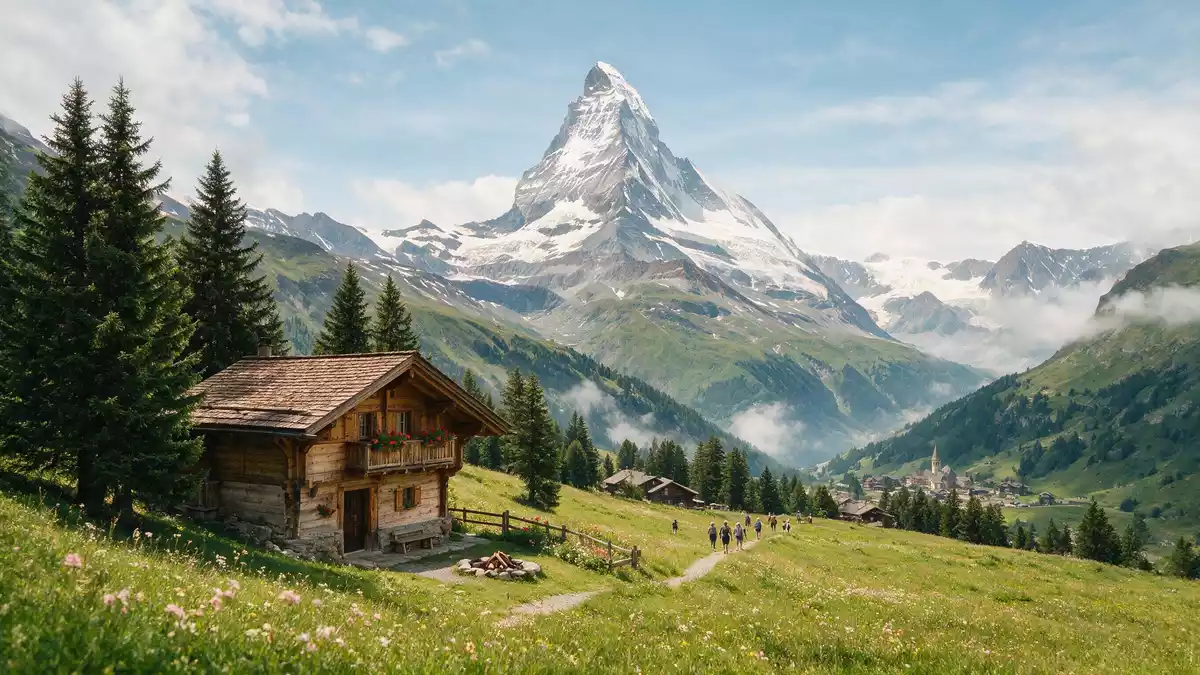
The Matterhorn rises above Zermatt as a solitary pyramidal peak whose sharply defined faces have become the emblematic outline of the Alps. Straddling the frontier between Switzerland and Italy and standing at 4,478 m (14,692 ft), it dominates the head of the valley and anchors the landscape for both Zermatt and Breuil-Cervinia.a mountain of the Alps
The pyramidal peak and its setting above Zermatt
The Matterhorn stands in the Pennine Alps, part of the broader Alpine chain that stretches across much of central Europe, with its summit on the main watershed between the Rhone and Po basins.Pennine Alps region Its four faces align broadly with the cardinal points, each dropping away in steep rock and snow and giving the mountain a near-symmetric pyramidal form that is immediately recognisable in silhouette.four faces of the Matterhorn
To the north-east, the Matterhorn looks over the Swiss town of Zermatt in the canton of Valais, its rocky ridges rising above pastures, forests and the clustered roofs of the village.overlooks the Swiss town of Zermatt On the southern side lies Breuil-Cervinia in Italy’s Aosta Valley, where the mountain forms part of a high, glaciated amphitheatre above the town. Between these two settlements, the peak serves as a natural frontier marker as well as a shared landmark, visible from different angles yet always defined by its steep ridges and corniced summit.
Height, geology and the border between Switzerland and Italy
At 4,478 m (14,692 ft), the Matterhorn ranks among the higher Alpine summits and belongs to the group of peaks known as “four-thousanders”, mountains above 4,000 m that have long attracted climbers and surveyors.height in metres and feet The summit lies directly on the border between Switzerland and Italy, with the ridge line forming part of the international boundary and linking the mountain to neighbouring peaks in the Monte Rosa and Pennine Alps ranges.countries Switzerland and Italy
The peak is composed of hard, resistant rock that geologists link to the African continental plate, carried northwards and uplifted during the formation of the Alps.rock linked to African plate Below the summit block, glaciers and steep scree slopes feed into high cirques and hanging valleys that are cut by streams and framed by other peaks of the Monte Rosa area. From Zermatt, the mountain appears as a freestanding pyramid, with its north and east faces rising above meadows and larch woods and its principal ridges forming a stark contrast against the sky.
Climbing history and the Hörnli ridge
Human engagement with the Matterhorn shifted decisively in the nineteenth century, when alpinists began systematic attempts on its summit. The first ascent was achieved on 14 July 1865 from the Zermatt side by a party led by the English climber Edward Whymper, accompanied by guides Michel-Auguste Croz, Peter Taugwalder senior and Peter Taugwalder junior, and climbers Douglas R. Hadow, Charles Hudson and Francis Douglas.first ascent on 14 July 1865 During the descent, a fall on the mountain claimed the lives of Hadow, Hudson, Douglas and Croz, an accident that immediately entered mountaineering history and has been recounted in many narratives of Alpine exploration.
Subsequent ascents established different lines of approach, but the Hörnli ridge, which rises between the north and east faces above Zermatt, became the classic route and remains closely associated with the mountain.Hörnli ridge as popular route Climbers typically reach the high alpine terrain by cableways and mountain paths from Zermatt, then follow the ridge over rock steps and snowfields towards the summit. The history of guiding in Zermatt is intertwined with these ascents, and the Matterhorn’s profile has appeared on maps, guidebook covers and local imagery since the later nineteenth century.
Visiting Matterhorn: what travellers from Western Europe should know
- The Matterhorn rises south-west of Zermatt in the upper Valais, and the mountain is reached via the transport network that serves Zermatt, including mountain railways and cableways from the village towards the high slopes.
- Terrain around the Matterhorn includes steep mountain paths, rocky ridges and high-altitude glaciers, and any approach beyond the valley floor involves significant gradients and sections of ground where sure-footed movement is essential.
- The mountain forms part of a broad high-alpine basin where weather can change quickly, and conditions at elevations above 3,000 m (9,843 ft) differ markedly from the milder climate of lower villages in the surrounding valleys.
- Zermatt lies in the German-speaking part of Valais, where the official language is German and the national currency is the Swiss franc (CHF).
Searching for Matterhorn on social platforms
These links open searches for Matterhorn on each platform.
Frequently asked questions about Matterhorn
Where is the Matterhorn located?
The Matterhorn stands in the Pennine Alps on the border between Switzerland and Italy, overlooking Zermatt in Valais and Breuil-Cervinia in the Aosta Valley.
What can visitors expect when seeing the Matterhorn from Zermatt?
From Zermatt, visitors see the Matterhorn as a sharply defined rocky pyramid rising above forests, meadows and glaciated slopes at the head of the valley.
What makes the Matterhorn distinctive among Alpine peaks?
Its near-symmetric pyramidal shape, four faces aligned with the compass points and position directly on the international border make the Matterhorn distinctive in the Alpine landscape.


